
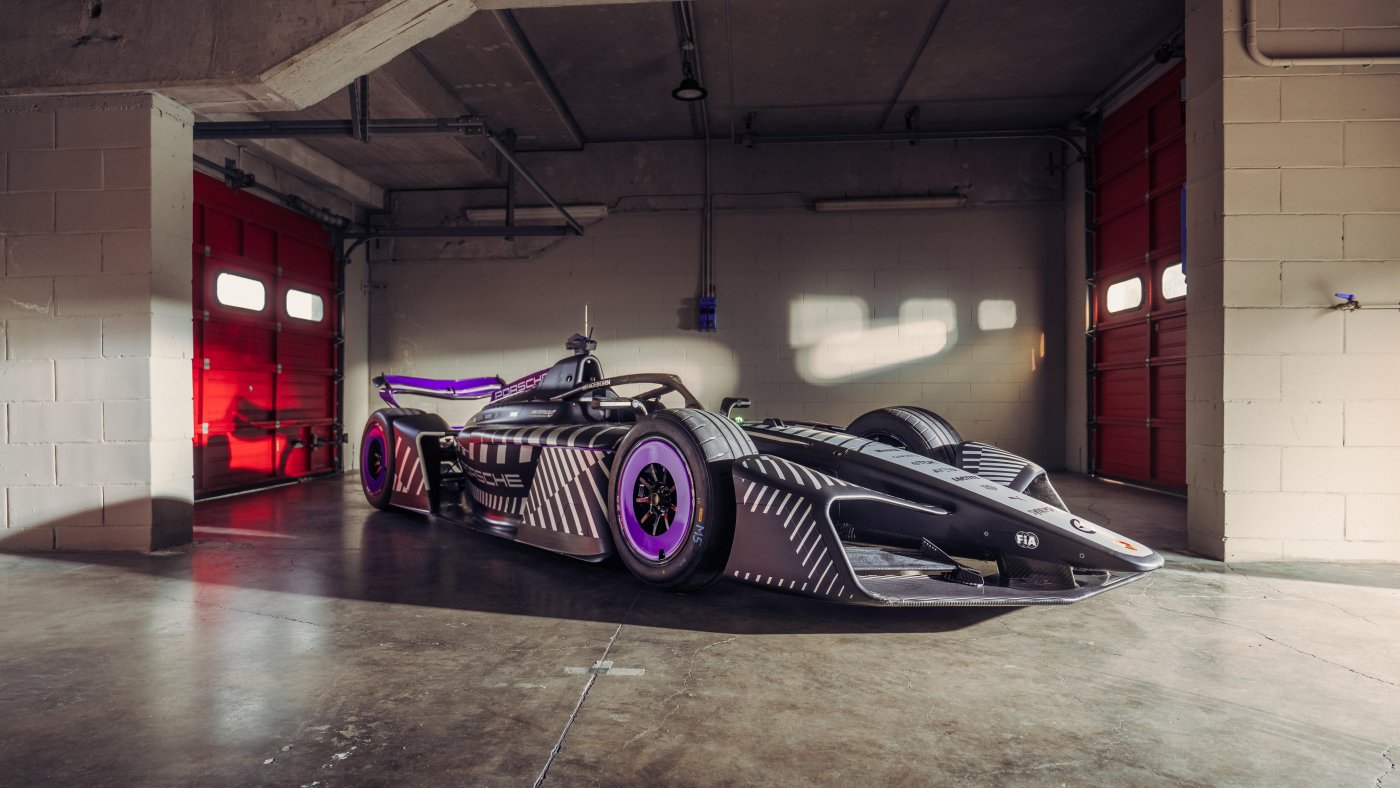
Formula E’s GEN4 cars will be much faster, but that is not the most consequential thing about Porsche’s 975 RSE. The new car makes the invisible contest easier to see: as a championship standardizes more of the physical machine, the decisive work moves into the hardware a manufacturer is still allowed to shape—and the software that joins it together.
Porsche says the 975 RSE will race from December, starting the 2026/27 Formula E season. Its headline numbers are serious: up to 600 kW (804 hp), permanent all-wheel drive, a claimed 0–62 mph time of roughly 1.8 seconds and a top speed expected to reach about 208 mph. But a fast electric single-seater is not automatically a useful road-car story. This one becomes interesting because energy recovery, power delivery and controls are the things Porsche is treating as its own craft.
That is relevant well beyond the paddock. Modern EVs increasingly live or die by how convincingly their software manages battery energy, braking and traction—not merely by the cell capacity printed in a brochure. We made a similar point in our look at why home charging speed can cut waste: the useful number is the one that describes the whole system, not the flashiest component.
The brute-force figures are real, with context
The 975 RSE is Porsche’s version of Formula E’s fourth-generation car. It is not a blank-sheet road-going Porsche and it is not a promise that a future Taycan will do a 1.8-second launch. Formula E supplies major common elements, including the battery, chassis and bodywork. That is what keeps costs and competition in check.
| Published figure | Porsche 975 RSE | Why it matters |
|---|---|---|
| Peak power | 600 kW / 804 hp | Available in Attack Mode and qualifying duels, not necessarily throughout a race. |
| Normal-mode power | 450 kW / 603 hp | A better guide to its sustained race operating point. |
| Drive | Permanent all-wheel drive | Gives GEN4 a new traction and control challenge. |
| 0–62 mph | Approx. 1.8 seconds | A headline acceleration claim; track conditions still matter. |
| Regeneration | Up to 700 kW | Porsche says roughly 40–50% of race drive energy can come from braking recovery. |
| Battery | 51.25 kWh usable, standard supplied | A reminder that manufacturers compete around a common energy store. |
| Race debut | Expected December 2026 | Subject to the remaining testing and FIA homologation process. |
The downforce increase deserves as much attention as the power. Porsche describes separate high- and low-downforce aero packages, saying GEN4 can generate up to 150% more downforce than GEN3 Evo. More grip means higher corner speed, but it also means more drag. That tension is exactly why a clever control strategy becomes valuable: speed that burns the energy budget too early is not race pace.
The competitive space is getting narrower—and more technical
Porsche lists its own pulse inverter, electric motor, gearbox, differential, rear-axle parts, brake-by-wire system, electronics and operating software among its in-house work. The shared chassis and battery do not make the cars identical; they make the places where teams can differentiate more consequential.
Independent Formula E outlet e-Formel reports that Porsche’s new car has more than 1.5 million lines of code in its control units. Treat that number as Porsche programme context, rather than a consumer-software quality metric. It does, however, make the direction clear. The work is increasingly about deciding how a car responds at the boundary: when to recover energy, how to blend friction and regenerative braking, and how to put torque down without wasting tires or charge.
ANSA’s report on the programme reaches the same useful conclusion from the outside: the performance leap is substantial, but energy management is central to the 975 RSE’s development. That is a better lens than treating Formula E as a quiet imitation of combustion racing. Its constraint is the point.
What not to read into the road-car claim
Porsche calls Formula E a development laboratory for its electric road cars. There is truth in that, but it needs a firm caveat. The 975 RSE’s 600 kW charging design, fixed race battery and extraordinary power-to-weight ratio do not translate directly into a production EV. Nor does a control algorithm proven on a temporary street circuit simply drop into a family SUV.
What can travel is the method: tighter software integration, higher-efficiency power electronics and better coordination of powertrain, thermal management and braking. Those are less glamorous than a giant battery pack, yet they are exactly the ingredients that can make an everyday EV feel more predictable and waste less energy. Porsche’s GaN audio-system experiment is a useful reminder that efficiency improvements often show up as a collection of system choices.
Bottom line
The 975 RSE is a welcome antidote to the idea that electric motorsport has hit a generic, spec-car plateau. GEN4 will be visibly quicker, but Porsche’s more durable bet is that the next advantage will come from the code and power electronics working between the wheels and the battery.
That makes the car worth watching even if you never plan to watch a Formula E race. The future-facing part is not the 804-hp figure. It is the discipline required to turn a fixed energy budget into usable, repeatable speed.