
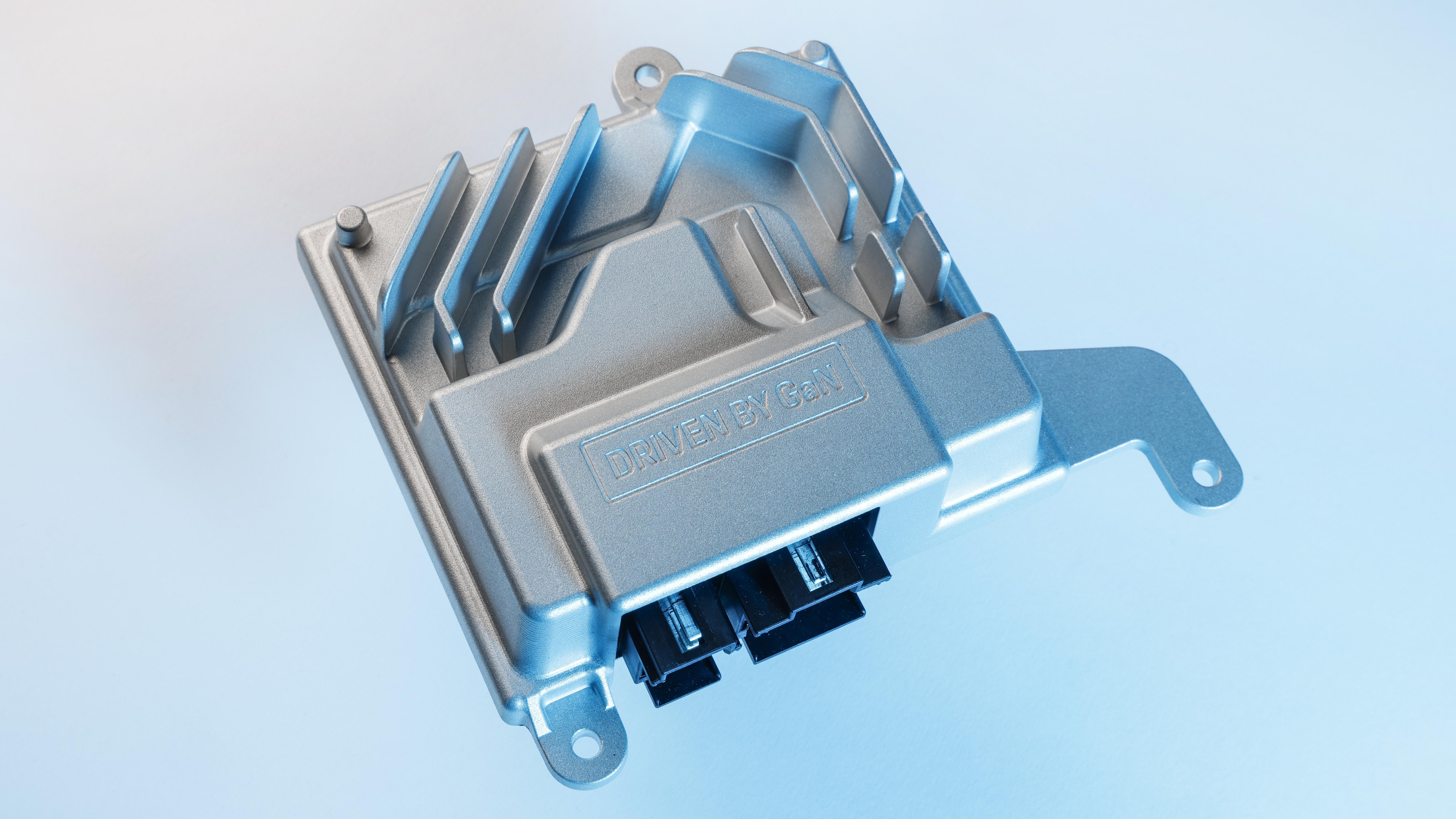
The next Porsche semiconductor story is not about range, charging or a faster inverter. It is about bass.
Porsche says a future 2027 vehicle will use gallium nitride—GaN—in the voltage-conversion stage that feeds a 400-watt Burmester subwoofer amplifier. That sounds like an extravagance until you look at what it changes: less wasted energy becomes heat, which lets the cooling hardware and supporting components get smaller. Porsche says the heat sink can be about 20 per cent lighter than an equivalent silicon-based design.
It is a modest component-level change, but a telling one. Cars are steadily becoming collections of power electronics, and the useful gains will not always arrive with a new motor or a larger battery. Sometimes they arrive where a design team can reclaim mass, volume and thermal headroom without asking the driver to compromise on the feature itself.
What Porsche has actually announced
The project is a production target, not a new option that can be ordered today. Porsche developed the prototype with the University of Stuttgart and says the production system will debut in an unspecified future Porsche from 2027. The company has not named the car, published an option price or promised a global launch date.
| Confirmed | Still unknown |
|---|---|
| GaN handles voltage conversion for a 400W subwoofer amplifier | The first Porsche model to receive it |
| It is part of the Burmester 3D High-End Surround Sound System | Price and market-by-market availability |
| Porsche says the heat sink can be about 20% lighter | Whether total audio output changes |
| Series production is planned from 2027 | Independent measurements of sound, heat or efficiency |
That distinction matters. A more efficient power stage does not automatically mean more power, a louder system or better tuning. The claim is principally about achieving the required power conversion with fewer losses and less cooling burden. What Hi-Fi? and Driven Car Guide both reach the same practical conclusion from Porsche’s details: packaging is the immediate win, while the car and the listening result remain unannounced.
Why GaN belongs here
GaN is already familiar from compact, high-wattage USB-C chargers. Compared with conventional silicon power devices, it can switch at higher frequencies with lower losses. In an amplifier’s power supply, that can reduce heat and allow inductors, capacitors and heat sinks to shrink.
Porsche’s choice of a subwoofer amplifier is smart engineering theatre in the best sense: it is a defined, power-hungry job that makes the benefit tangible. The company says its GaN chip performs the voltage conversion for the 400W subwoofer stage, rather than claiming the semiconductor has somehow improved the music by itself. The less glamorous parts—thermal management, aluminium mass and installation space—are exactly where an automotive application has to earn its place.
The lesson extends beyond audio. Porsche says it is evaluating GaN for other vehicle applications, including high-voltage systems. That should be read as exploration, not a product roadmap. Automotive qualification demands more than a clever chip: vibration, temperature cycles, electromagnetic compatibility and a service life measured in years all need to work. Still, audio is a sensible way to prove the manufacturing and reliability case in a tightly bounded system.
The buyer relevance is real, even before the first car arrives
For a buyer, this is not a reason to defer a Porsche purchase or assume a 2027 system will sound better. It is a useful signal of where premium-car engineering is going. Weight, heat and room inside a vehicle are zero-sum resources. Reducing any one of them can give a manufacturer more freedom to improve another part of the car—or simply deliver the same feature with less material.
That is especially relevant as premium cabins add larger screens, more computing hardware, more speakers and more complex climate systems. The best technical changes are often the ones that make that complexity less burdensome. Porsche’s shift is more persuasive than a vague “AI audio” badge because it names the component, the job and the trade-off.
It also fits the direction we saw in the Porsche Taycan’s new shift paddles: the most credible upgrades explain how the hardware changes the driving or ownership experience, rather than treating novelty as a benefit by itself.
Bottom line
Porsche’s GaN Burmester amplifier is a small story with a larger point. It does not promise a new acoustic benchmark, and Porsche has not supplied the listening evidence to claim one. What it does promise is a cleaner way to supply serious audio power in a car: lower losses, less heat and a lighter cooling assembly.
That is the kind of semiconductor progress worth watching. If it survives the route to series production in 2027, the headline will not be that a Porsche charger got clever. It will be that the chip technology behind modern compact power supplies found a credible new home in the dashboard.