
Ferrari has not brought a ceremonial car to Monza. It has brought a deadline.
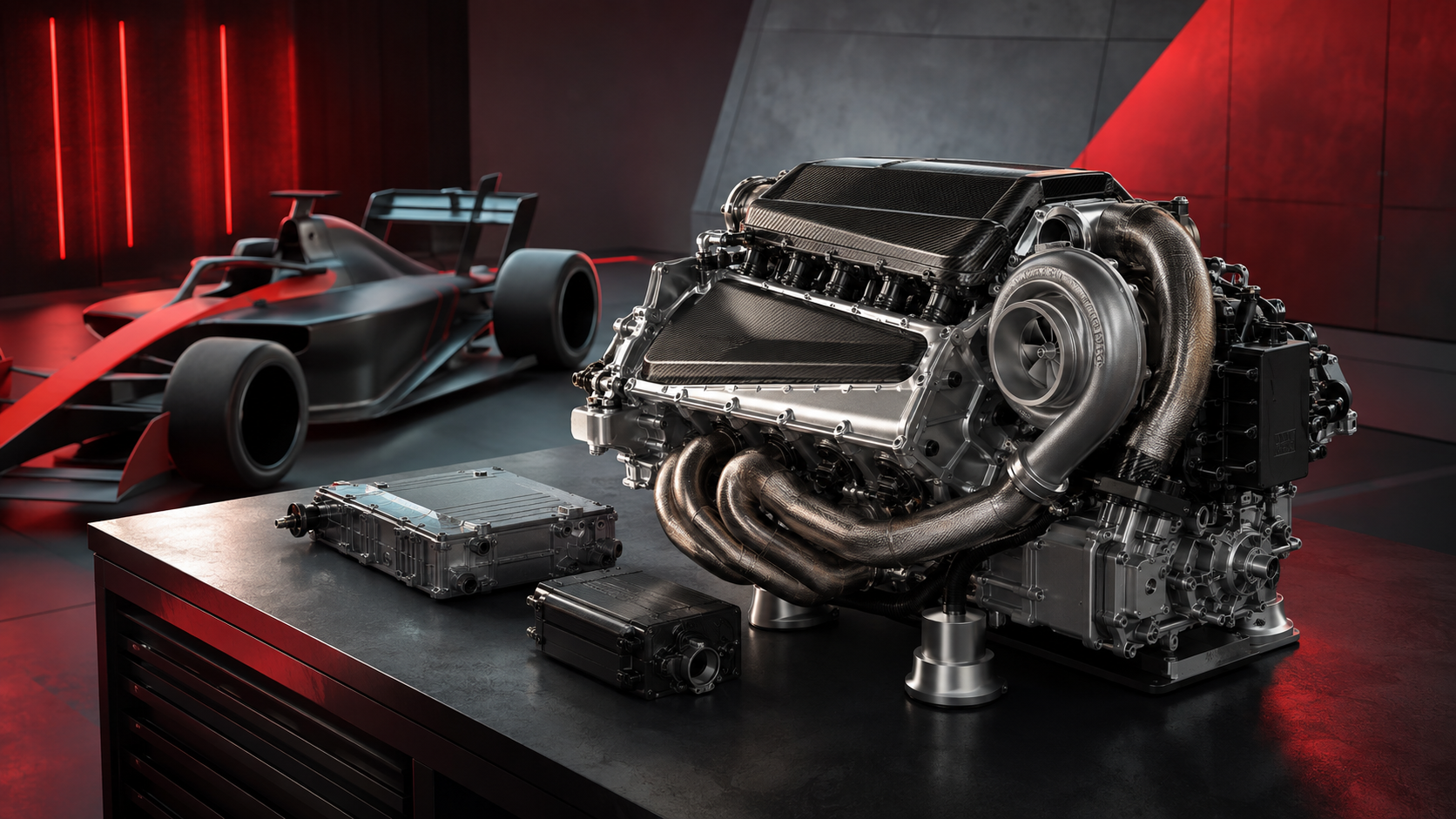
Charles Leclerc and Lewis Hamilton have confirmed that the SF-26 will run a new power unit at Ferrari’s home race, the team’s second 2026 step under Formula 1’s Additional Development and Upgrade Opportunities system. The name is clumsy; the decision is not. Ferrari has used one of the few regulatory mechanisms designed to let a trailing manufacturer improve, and it has spent that opportunity at the calendar’s most exposed circuit.
That makes the update more than a home-race flourish. Monza is where every weakness in a package becomes conspicuous: low drag matters, traction out of the chicanes matters, and a small deficit can turn into a frustratingly long view of another car’s rear wing. Leclerc’s phrasing was suitably restrained—he said Ferrari has “a new engine” and new car parts, and hopes they put rivals under pressure. Hamilton’s optimism is more understandable than predictive. Neither driver has claimed a number, and neither should.
The meaningful part is the choice, not a promised gain
ADUO was introduced to give power-unit makers additional development chances when the FIA’s measurements place them sufficiently behind the benchmark. Motorsport.com reports Ferrari was eligible for two opportunities after the relevant assessments; the first arrived in Austria, and this is the second. In other words, Monza is not an ordinary revision on a normal development curve. It is Ferrari cashing in a limited corrective allowance.
The practical temptation is to translate that immediately into a lap-time prediction. Resist it. A power-unit change can alter more than peak output: delivery, efficiency, cooling demand and the way a car behaves across a race distance all live in the same conversation. The precise hardware details and any performance figure remain Ferrari’s business, and GearPulse has not measured either. A new component also has to work with the low-drag configuration, the tyres and the energy-management demands of a very unusual 2026 Monza.
Still, this is a very clear strategic signal. Ferrari is not treating its Schumacher tribute livery as the whole story of its home weekend. The team has paired one of its most emotionally loaded stages with a technical intervention that will be judged ruthlessly on Sunday.
Ferrari is trying to make its chassis argument count
Independent reporting has framed Ferrari’s 2026 problem as an engine deficit that has obscured a more competitive chassis. That needs a caveat: the two cannot be cleanly separated from the outside, and championship results are shaped by strategy, reliability, traffic and driver execution as well as raw car performance. But the premise explains why this update matters.
Ferrari’s wins this season—Hamilton in Barcelona and Leclerc at Silverstone—already establish that the team can put together a winning weekend. The missing question is whether it can make that threat repeatable. An upgrade introduced at Monza will not answer everything at once, but it can reveal whether the development direction gives the SF-26 a more usable platform at a circuit that punishes compromises.
It also arrives with a deliciously uncomfortable comparison next door. Mercedes has an engine-related decision of its own at Monza, with Kimi Antonelli facing a back-of-grid penalty for a new power unit. GearPulse’s look at that penalty dilemma focused on the championship leader’s calculation: sacrifice track position now to protect the final run of races. Ferrari’s calculation runs the other way. It is trying to turn a regulatory opening into immediate pressure, on the weekend when Mercedes is least able to hide a poor recovery drive.
The customer wrinkle keeps this honest
There is a useful reminder not to make the story too tidy. Motorsport.com reports Haas will have only one updated Ferrari power unit available in Monza, allocated to Oliver Bearman rather than Esteban Ocon. The report says the FIA considers the customer-supply requirement met if at least one matching unit is made available. That may satisfy the rule, but it illustrates the practical constraint behind an update: a new specification is not just an item on a works-team release; it has to be manufactured, allocated and raced.
For Ferrari, that is another reason to avoid the fantasy of a magic button. Early use gives the works team an opportunity to learn in the highest-pressure setting, but it also raises the cost of any disappointment. If the car remains awkward in the areas that decide Monza, the update will be judged by the Tifosi as loudly as the livery is admired.
Monza will give an answer, but not a verdict
One weekend will not prove that Ferrari has solved its power-unit gap. Slipstream, tow games in qualifying, tyre phase and safety-car timing can make Monza particularly unkind to simple conclusions. Nor does “more power” automatically mean Ferrari has suddenly become the favourite; the drivers’ comments are an expression of intent, not evidence of a result.
But this is precisely the kind of decision a major team should be willing to make. Ferrari has a finite development tool, a car capable of winning on the right weekend and a home race built to magnify marginal gains. Waiting for a less visible circuit might have reduced the theatre. It would also have delayed the information the team needs.
Bottom line
Ferrari’s second ADUO power-unit update is its loudest technical bet of 2026 because it puts a scarce development opportunity into the fastest, most unforgiving spotlight on the calendar.
It is not a guarantee of a home victory, and it should not be sold as one. What it does create is a sharper test: if Ferrari can turn this new hardware into a more complete Monza package, the fight after the Italian Grand Prix will look more alive. If it cannot, the problem will be harder to disguise than ever.