
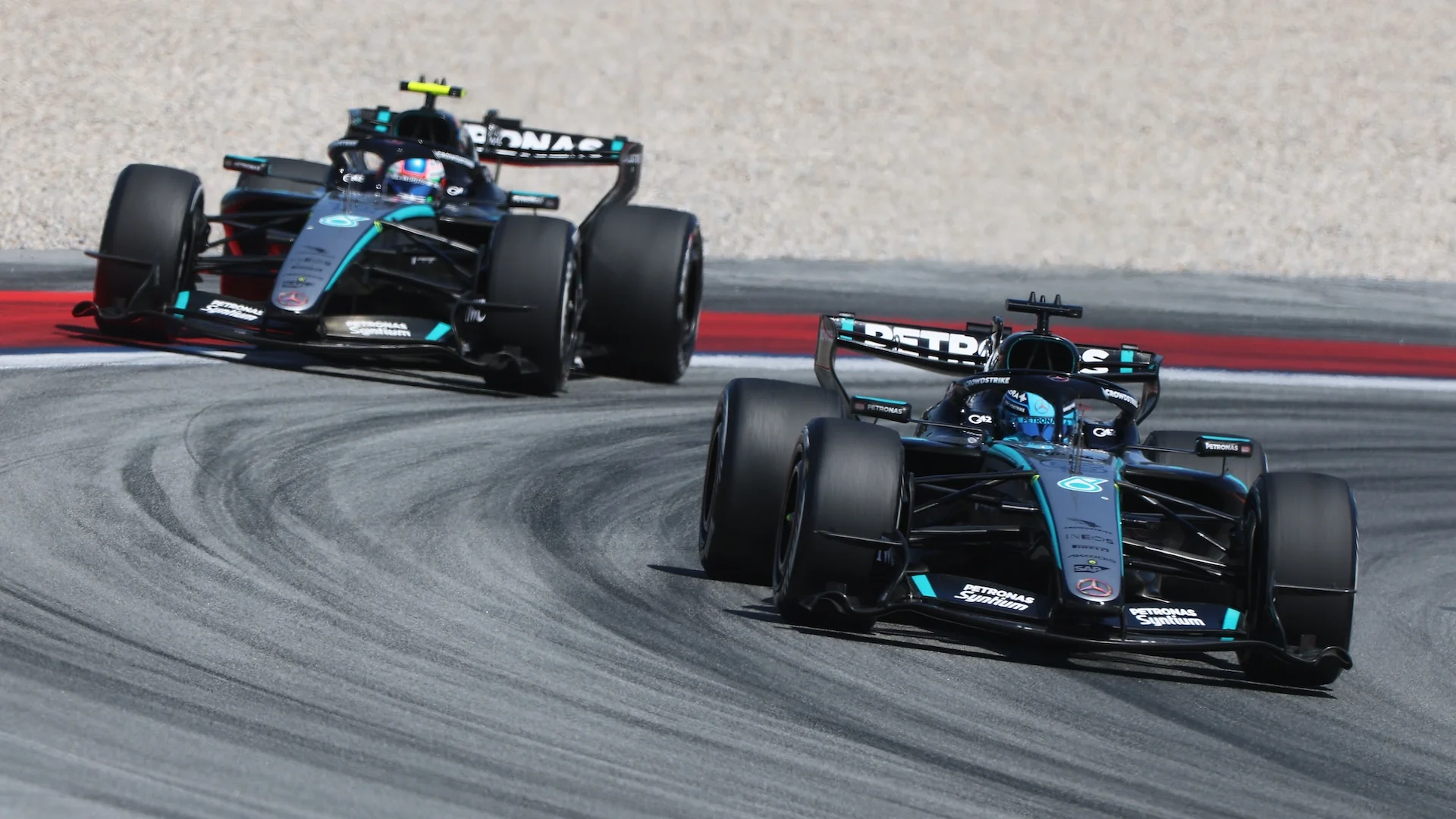
Mercedes has reached the Formula 1 summer break in the position every team wants and nobody fully trusts: leading both championships, yet still doing arithmetic that could decide when its drivers start from the wrong end of a grid.
The Race reported today that Mercedes is anticipating engine-related penalties for both Kimi Antonelli and George Russell in the second half of the season. Motorsport.com had already flagged Monza as a possible target for Antonelli’s first hit, with Toto Wolff weighing whether the Italian Grand Prix’s long straights and overtaking profile make it the least damaging place for a home-race sacrifice.
GearPulse’s view: this is the most interesting F1 story of August 10 because it turns Mercedes’ reliability problem into a calendar strategy problem. The question is no longer simply whether the W17 is quick enough. It is whether Mercedes can choose the least bad weekend to absorb a penalty before Ferrari and McLaren choose it for them.
Why this rose today
The trend signal is cleaner than another generic summer-break ranking. The Race put fresh numbers and Mercedes deputy team principal Bradley Lord’s probability framing around the issue: Antonelli and Russell are already deep enough into their component pools that finishing the season on existing hardware looks unlikely. Motorsport.com supplied the earlier Wolff angle that Monza or Baku could be considered if Mercedes has to take a penalty.
Formula 1’s own August 7 reliability review adds the official backdrop. Mercedes’ first half has not just been imperfect; F1.com itemised how mechanical and power-unit problems cost both drivers meaningful points in Canada, Barcelona-Catalunya, Silverstone and Hungary. Official standings make the timing sharper: Antonelli leads Lewis Hamilton by 50 points, while Mercedes is 72 points clear of Ferrari in the Teams’ Championship.
Grande Premio adds the other side of the pincer. Ferrari is expected to bring a significant floor evolution after the break and a power-unit-related Monza step aimed at stronger high-speed performance. Treat that as reported development planning, not a confirmed magic bullet, but the direction matters. Mercedes may be trying to choose a penalty weekend at exactly the moment Ferrari wants to make Monza a statement race.
The penalty table tells the story
The 2026 rules era has made power-unit management feel less like background paperwork and more like race strategy. Teams are juggling internal combustion engines, turbochargers, energy stores, control electronics, MGU-Ks, exhausts and ancillary components while the cars lean heavily on electrical deployment and software-managed energy recovery.
| Mercedes pressure point | Why it matters |
|---|---|
| Antonelli is already at the limit on key components | The next use of certain fresh parts can trigger a grid drop. |
| Russell has also burned through more hardware than ideal | Mercedes may not be able to protect just one side of the garage. |
| Monza is easier to overtake than Zandvoort | That makes it a logical penalty venue, but a costly emotional one for Antonelli. |
| Ferrari is targeting second-half upgrades | Mercedes’ “least bad” penalty weekend could line up with a rival’s best opportunity. |
| There are 12 rounds left after Hungary | Nursing old hardware for that long is a risk, not a plan. |
The awkward part is that the championship leader is the driver most exposed to the optics. Antonelli taking a grid drop at Monza would make strategic sense on paper. It would also put the Italian driver at his home Grand Prix in recovery mode while Hamilton and Leclerc race in front of a Ferrari crowd that has been waiting for the 2026 season to turn properly red.
That does not mean Mercedes should duck the decision. Zandvoort is narrow and hard to pass. Baku rewards straight-line speed but can punish mistakes and safety-car timing. Singapore is a Sprint weekend later in the year and carries its own risk profile. If Mercedes believes a fresh component now prevents a late-season DNF, taking the hit at a circuit with overtaking is more rational than praying old hardware survives until Abu Dhabi.
Antonelli versus Russell is the internal complication
Mercedes’ driver comparison makes this tougher. Antonelli has been the title leader and the clearer race-winning force. Russell has had enough speed to hurt him, but his season has repeatedly been bent by reliability, software behaviour and poor starts that Mercedes itself has not always framed as driver error.
If only Antonelli needed a penalty, Mercedes could treat it as a leader-protection exercise: pick the least damaging venue, give him the fastest car possible, and limit the loss. If both drivers are likely to need penalties, the team has to decide whether to split them across different races or stack them into one weekend.
Splitting the penalties protects constructors’ points because one Mercedes can still fight near the front. Stacking them could avoid dragging the pain through multiple weekends, but it risks giving Ferrari and McLaren a clean run at a large points swing. With Ferrari second in the constructors’ table and Hamilton sitting between Antonelli and Russell in the drivers’ standings, Mercedes does not have a huge amount of margin for an experiment.
There is also a psychological wrinkle. Antonelli has spent the summer break being discussed as the driver who turned last year’s pressure into this year’s control. Asking him to start deep at Monza would be a very different stress test. Russell, meanwhile, cannot afford another weekend where the car’s hardware story dominates his race before strategy or pace gets a say.
Why Monza is tempting, and why it bites
Monza is the obvious candidate because overtaking is possible, drag sensitivity is high, and a fast Mercedes should be able to recover if it stays out of trouble. It is also one of the few tracks where sacrificing qualifying position can look less severe than carrying compromised hardware.
But Monza is not a neutral spreadsheet cell. It is Ferrari’s emotional centre, a power-sensitive circuit, and a place where any Scuderia upgrade will be judged instantly. If Ferrari’s reported turbocharger and floor work delivers even a modest straight-line and balance gain, Mercedes could find that the “easy recovery” race is not easy at all.
Probability-wise, GearPulse would frame a Mercedes second-half penalty for at least one driver as high, and for both drivers as more likely than not based on the public component-use picture. The exact venue is less certain. Monza is logical, Baku is plausible, and a later penalty becomes more dangerous if the title gaps narrow.
Bottom line
Mercedes still has the strongest position in the 2026 championship. That is precisely why this penalty decision matters.
A chasing team can take risks because it has to. A leading team has to decide when to spend pain. If Mercedes gets the timing right, a Monza or Baku grid drop becomes a controlled inconvenience on the way to a more reliable title run. If it gets it wrong, Ferrari’s second-half upgrades and McLaren’s renewed development push could turn a component ledger into the first real crack in Mercedes’ control.
The summer break has stopped the factories. It has not stopped the math.