
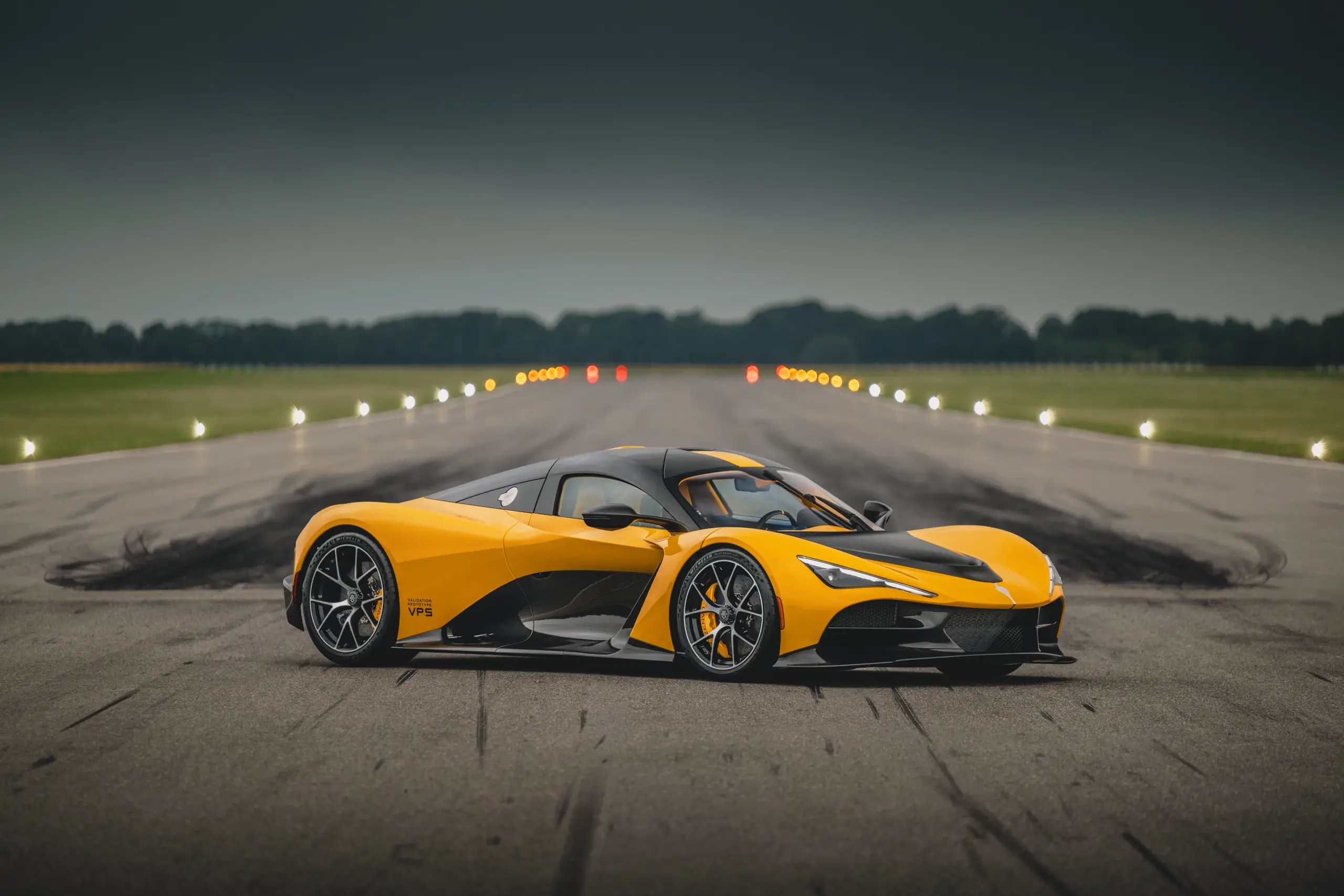
There is a particular kind of hypercar announcement that feels like a promise made through smoke, renderings and a heroic number. Zenvo’s Aurora Tur is past that stage now.
The Danish maker brought two production-intent validation prototypes to the 2026 Goodwood Festival of Speed, with an Aurora Agil show car alongside them. That matters because the Aurora has spent three years building an enormous reputation on paper: a bespoke quad-turbo V12, three electric motors, 1,850 bhp and a claimed 9,800-rpm redline. In July, Zenvo finally showed the version that is meant to become a customer’s car.
GearPulse’s view: the Aurora is relevant because it is one of the few new hybrid hypercars that puts the engine at the center of the experience. The electric system is not being sold as a virtuous excuse for a quiet GT. It is there to sharpen response, add front-axle traction and turn an already extreme V12 into something properly surreal. That is a more interesting use of hybrid hardware than another launch-control statistic.
Goodwood was the reality check
Zenvo says the two Tur cars shown at Goodwood are validation prototypes, the last major step before production. The company is targeting first customer deliveries in the second half of 2027. That is a better-defined timeline than an early concept reveal, but it is still a target, not a handover date buyers can circle in ink.
The Tur is the road-oriented Aurora. Its sister car, the Agil, is the lighter and more track-focused interpretation. Both use the same new carbon-composite architecture and the same 6.6-liter V12 built with MAHLE Powertrain, but their hybrid layouts and intent diverge.
| Aurora detail | Tur | Agil |
|---|---|---|
| Claimed combined output | 1,850 bhp | 1,450 bhp |
| Drive layout | All-wheel drive | Rear-wheel drive |
| Claimed weight | 1,548 kg | 1,360 kg |
| Claimed top speed | 420 km/h (260 mph) | 360 km/h (224 mph), electronically limited |
| Production | 50 cars | 50 cars |
| Character | Road-focused grand tourer | Road-legal, track-focused model |
Those are Zenvo figures, and that qualifier matters. The company labels several of them as estimates. Road & Track likewise notes that final production performance numbers had not been confirmed when the prototypes appeared. The output, acceleration and speed claims are impressive, but the meaningful news is that Zenvo is now showing hardware close enough to production for the caveats to become specific.
The V12 is still doing the emotional heavy lifting
At the heart of both cars sits Zenvo’s Mjolner V12: 6.6 liters, four turbochargers mounted in the engine’s vee, 1,250 bhp from combustion alone and a 9,800-rpm redline. The Tur adds a 200-bhp motor at the transmission and two 200-bhp motors at the front axle. The resulting system has all-wheel drive and front torque vectoring.
That layout explains why the Tur, despite its supposed grand-touring brief, is the more powerful Aurora. It also explains why it weighs almost 190 kg more than the Agil. The Tur is the version for a buyer who wants a big-distance hypercar that can be less punishing between the astonishing moments, rather than a car that treats every road like the out lap.
Zenvo claims 0 to 100 km/h in 2.3 seconds, 0 to 300 km/h in nine seconds and 0 to 400 km/h in 17 seconds for the Tur. The numbers are bonkers, but the configuration is more revealing. A triple-motor hybrid system could have made the V12 feel incidental. Here it appears to have been arranged around the V12’s theater: torque fill, traction and response serving an engine that still wants to sing at nearly five figures.
That is not nostalgia for its own sake. Hybrid assistance can solve genuine problems in a turbocharged V12, especially at low rpm and while putting power down. It becomes worthwhile when it makes the car more legible to the driver, not merely faster in a press-release table.
Big money, small production, real caveats
Top Gear reports an asking price of EUR 2.8 million before local taxes. Zenvo’s own current announcement does not quote a price, so that should be read as third-party reporting rather than a factory-confirmed order figure.
The more concrete number is 100. Zenvo plans 50 Turs and 50 Agils, all hand-assembled in Denmark. That scarcity is unsurprising at this price, but it puts extra weight on the question that every small-volume manufacturer has to answer: can it turn an extraordinary prototype into a car that starts, cools, brakes, shifts and feels coherent every time a customer uses it?
The proof will come later. We have not driven the Tur, and neither manufacturer claims nor Goodwood photographs can establish ride quality, heat management, visibility, service support or how the calibration behaves in imperfect weather. A 1,850-bhp road car is not made credible by a huge peak output. It is made credible by the unglamorous behavior around the peak.
There is a useful contrast with GearPulse’s look at Lanzante’s road-legal Bugatti Bolide. That project starts with a track-only car and asks it to tolerate roads. The Tur begins as Zenvo’s road-minded Aurora, then gives it the full technical payload. Both ideas are spectacular. The Tur has the cleaner engineering brief.
Why this sort of car still earns attention
It is easy to dismiss a EUR 2.8 million hypercar as irrelevant theater. Most people will never see one outside a screen, let alone drive it. But machines at this end of the market show what manufacturers think performance should feel like before those ideas filter down into less absurd cars.
The Aurora’s message is refreshingly direct: weight still matters, combustion character still matters, and electrification can make a fast car more expressive rather than more remote. Whether Zenvo succeeds will depend on execution, not rhetoric. The company has to hit its delivery target and prove its claimed numbers with finished customer cars.
The bottom line
The Zenvo Aurora Tur has moved from a thrilling specification sheet to a production program with a date, prototypes and a much clearer personality.
Its 1,850-bhp hybrid system is outrageous, but not empty. The V12 remains the point, while the electric motors provide the traction and response a road-focused car needs to make that power usable. With deliveries targeted for the second half of 2027, Zenvo now has time to prove that the Tur can be more than Goodwood’s loudest promise.