
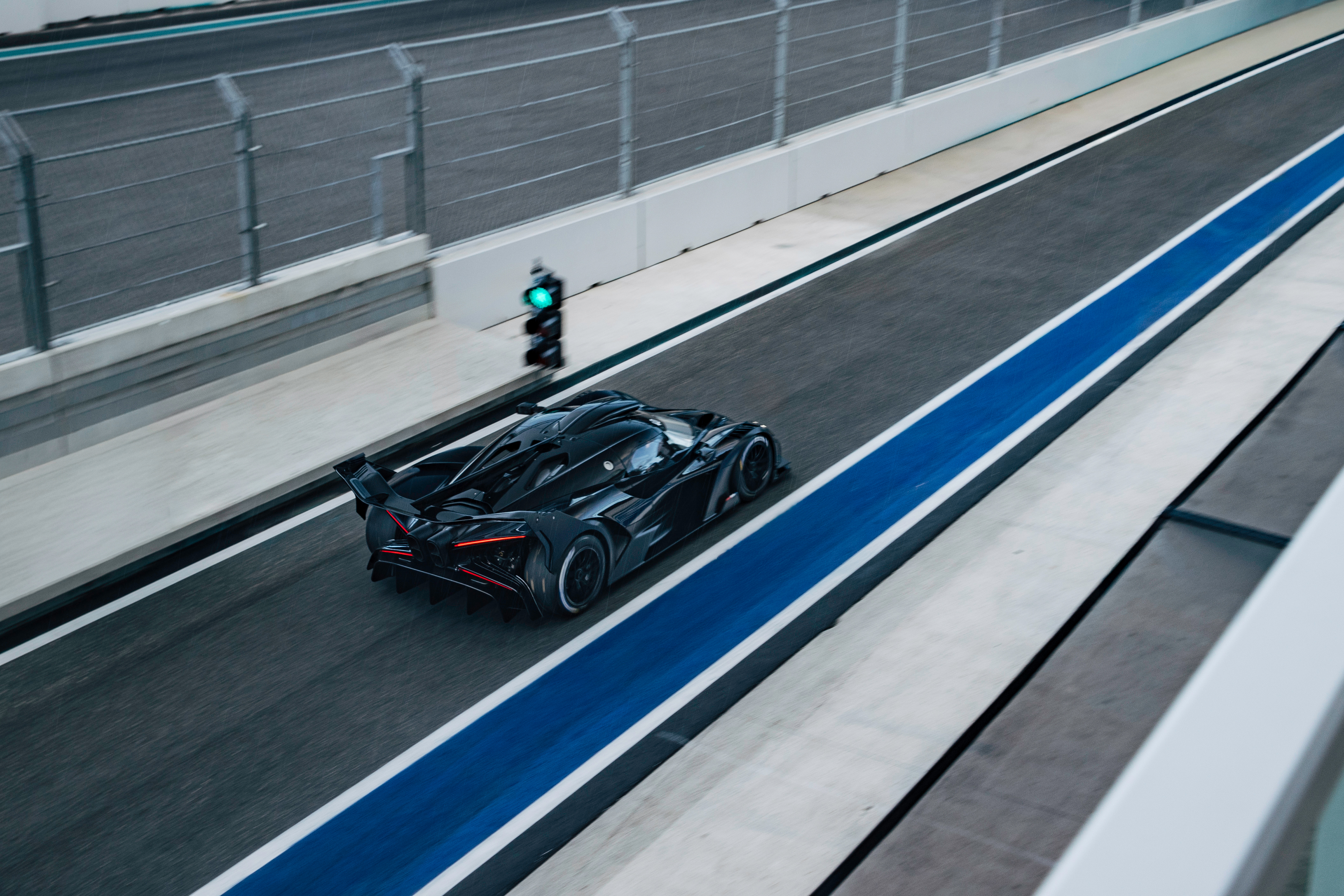
The phrase “road-legal Bugatti Bolide” sounds almost designed to break car culture into arguments.
Bugatti built the Bolide as a track-only machine: 1,600 hp, 1,450 kg dry weight, racing slicks, carbon-carbon brakes, extreme aero and no official permit for public-road operation in its factory technical specification. Lanzante’s reported Goodwood conversion changes the setting. It takes one of the most focused W16 Bugattis and asks whether a car engineered for circuits can be made credible on actual roads.
GearPulse’s view: this is relevant because road-legal conversions are not just collector theater. They expose the difference between making something technically registerable and making it trustworthy to use. With a Bolide, that gap is enormous.
What Bugatti built first
Bugatti’s official Bolide materials are clear about the starting point. The spec sheet lists a W16 engine, 7,993 cc displacement, four turbochargers, 1,600 hp at 7,050 rpm, 1,600 Nm of torque, permanent all-wheel drive and a seven-speed DSG transmission.
The same document lists a 1,450 kg dry weight, 0 to 100 km/h in 2.2 seconds, 0 to 200 km/h in 5.4 seconds, 0 to 300 km/h in 11.5 seconds and a 380 km/h top speed. It also says the model is intended for pure track use and has no official permit for public-road operation.
| Factory Bolide detail | Official figure | Why it matters for conversion |
|---|---|---|
| Power | 1,600 hp | Road tires, cooling and calibration have little margin for error. |
| Dry weight | 1,450 kg | Lightness is part of the car’s identity. Added road hardware matters. |
| Top speed | 380 km/h | Legal road use does not mean road environments suit the performance. |
| Tires | Michelin racing slicks | Slicks are not ordinary road tires. |
| Brakes | Carbon-carbon discs | Track brakes behave differently from normal road brakes. |
| Legal note | No official permit for public-road operation | Lanzante is solving a problem Bugatti did not design the car around. |
Bugatti’s 2023 aero-testing release also described the Bolide as a track-only car built around the quad-turbo 8.0-liter W16, with production limited to 40 units. In other words, Lanzante is not starting with a thinly disguised road car. It is starting with a circuit product.
What Lanzante reportedly changed
Motor1, Supercar Blondie and duPont Registry all report that Lanzante showed a road-legal Bolide conversion at the 2026 Goodwood Festival of Speed. Supercar Blondie says the conversion includes custom LED headlights integrated into the front fascia, suspension changes for potholes and speed bumps, and road tires instead of the factory racing slicks.
Those are the visible necessities. The deeper question is what else had to change.
A road car needs lighting, mirrors, tire compliance, ride height, noise and emissions answers, legal paperwork and enough cooling for low-speed driving. It also needs a service plan. A Bolide can run as part of a curated track program with engineers, tires, fuel and data support. A road-converted Bolide has to survive mundane use cases: heat soak, uneven roads, stop-start traffic, curbs, debris and a driver who may not have a pit crew five meters away.
That does not make the conversion unserious. Lanzante has a long reputation for road-converting extreme machinery. It does mean the conversion should be judged by engineering discipline rather than spectacle.
The road-legal label is not the finish line
“Road legal” is a legal status, not a full review. It can mean different things depending on jurisdiction, inspection path and how often the car will actually be driven.
For a collector, the conversion may be enough if the goal is to drive to events, do short demonstration miles or own a more usable one-off. For a driver, the relevant questions are more demanding.
| Question | Why it matters |
|---|---|
| Which jurisdiction is it legal in? | Registration rules vary, and one approval does not equal global legality. |
| What tires are fitted? | Tires decide whether 1,600 hp is usable or decorative. |
| How much ground clearance changed? | A track aero platform may hate real road geometry. |
| What cooling changes were needed? | Track cars often dislike slow traffic. |
| What happens to Bugatti support? | Factory and conversion responsibilities need clear boundaries. |
| How reversible is the conversion? | Collectors may care about original track configuration. |
The most honest caveat is that GearPulse has not inspected the Lanzante car. Current public information supports the broad claim that the conversion exists and appeared at Goodwood, but many engineering and legal details remain outside public spec sheets.
Why it still matters
The Bolide conversion is interesting because it pushes the “race car for the road” idea to an extreme.
Most cars sold with track language are still road cars underneath. They have concessions baked in from day one. The Bolide is the opposite: a track machine being pulled toward the road after the fact. That reverses the usual compromise.
There is a cultural angle too. As performance cars become heavier, quieter and more electrified, the W16 Bolide feels like a closing chapter. A road conversion gives that chapter a strange epilogue: the last and most extreme Bugatti W16 architecture escaping the circuit, even if only for a tiny number of miles.
That makes it easy to romanticize. It also makes skepticism useful. The better question is not whether the car is outrageous. It obviously is. The better question is whether the conversion respects the engineering purpose of the original car while making road use more than a registration stunt.
The bottom line
Lanzante’s road-legal Bugatti Bolide is compelling because it turns excess into an engineering accountability test.
The official Bugatti numbers are already absurd: 1,600 hp, 1,450 kg dry, 380 km/h, racing slicks and track-only intent. Making that road legal is not just a lighting job. It is a negotiation between legality, drivability, safety, serviceability and collector value.
For GearPulse readers, the lesson is simple: road-legal does not automatically mean road-sensible. But if Lanzante has made the Bolide usable without dulling what makes it special, this becomes one of the most fascinating W16 send-offs yet.