
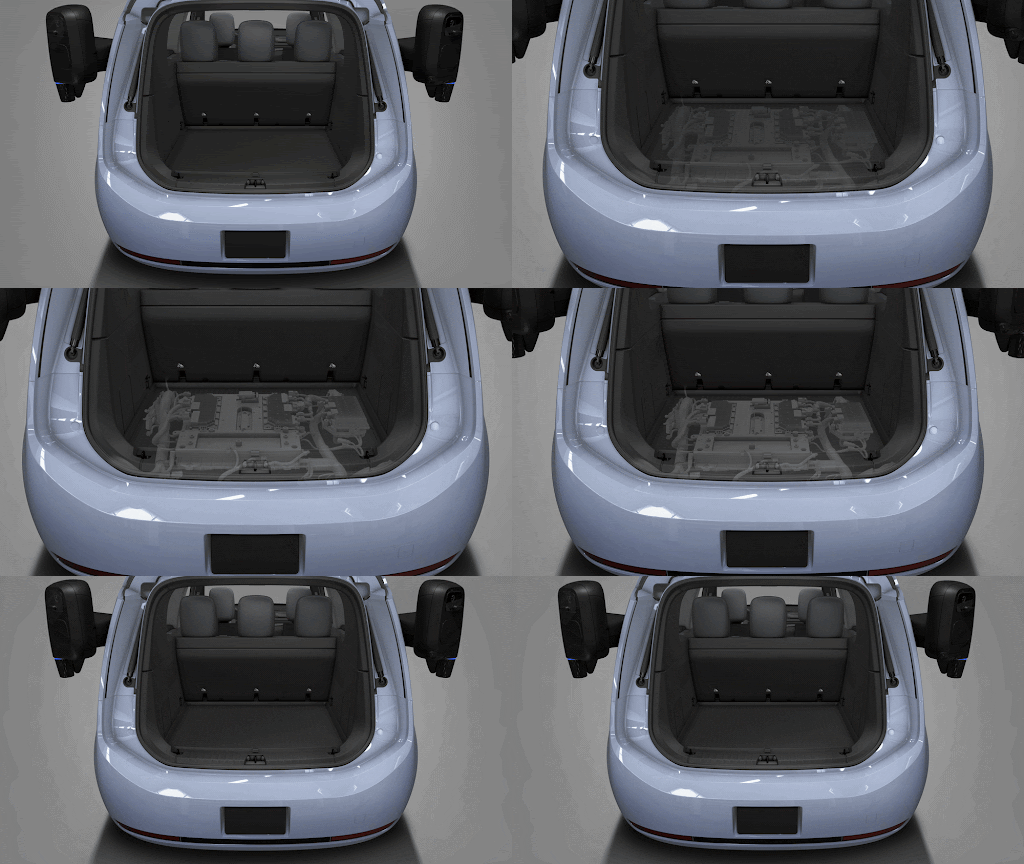
Waymo has finally put a useful number on a part of a robotaxi that riders never see: the silicon that turns a storm of camera, lidar and radar data into something its driving system can use.
The company says its purpose-built 5nm ASIC is already in its latest robotaxi generation and provides more than 1,000 TOPS of machine-learning performance for front-end sensor processing. That is an impressive figure, but it is not the reason this announcement matters. The significant move is vertical: Waymo is designing a specialized chip, a low-latency software stack, vehicle cooling and redundant compute around the same autonomous-driving problem.
For passengers, that does not make a robotaxi automatically safer or more capable. Waymo has not published independent safety results tied to this chip, a wattage figure, or a like-for-like comparison with its previous hardware. It does make the company’s strategy clearer. Scaling robotaxis is becoming as much a computer-engineering exercise as a mapping or fleet-operations exercise.
What Waymo actually disclosed
Waymo describes the ASIC as a specialist processor that receives raw data from 13 high-resolution cameras, lidar and radar. Its job is to pull out useful information, including temporal denoising for low-light perception, before that data reaches the system’s inference engine for sensor-fusion models.
The company is not claiming that one chip drives the car. Its computer remains a heterogeneous system: CPUs, GPUs, accelerators and custom ML components work together, while two independent compute engines run parallel workloads so one can take over if the other develops a fault.
| Detail | What Waymo says | What it means in practice |
|---|---|---|
| Process | 5nm | A modern manufacturing node, not a standalone measure of driving ability. |
| Role | Front-end processing of camera, lidar and radar streams | The chip prepares and fuses a huge volume of sensor data before higher-level driving models use it. |
| Claimed performance | More than 1,000 TOPS for ML processing | A capacity figure; it does not reveal real-world latency, power draw or safety performance. |
| Architecture | Two independent compute engines with redundancy | A fault-tolerance design that matters more in a driverless vehicle than in a consumer gadget. |
| Cooling | Integrated with the vehicle’s liquid-cooling system | Sustained operation in heat and cold is part of the product, not an afterthought. |
Gadgets Now and IT Home independently reported the same core point: this is a production custom ASIC for the current generation, not merely a lab demonstration. Both also underline an easy-to-miss caveat: Waymo still lists AMD, Micron, Nvidia, Samsung, Sandisk, Socionext and TSMC among the companies it works with. Custom silicon does not mean the robotaxi has become a one-chip machine, nor does it mean Waymo has abandoned outside suppliers.
The number to resist over-reading
TOPS—trillions of operations per second—can be a helpful capacity signal, but it is a terrible shortcut for answering the question riders actually care about: can the vehicle handle a difficult street safely and predictably?
An autonomy computer needs more than maximum throughput. It needs consistent response times when conditions are ugly, efficient data movement, reliable sensor synchronization, thermal headroom, usable redundancy and software that gets the right model onto the right hardware. The slowest or least predictable moment can matter more than an average-case benchmark.
Waymo says it has increased raw compute 20-fold over eight years and optimized its “pixels-to-actuation” latency. It did not publish a latency value or a standardized before-and-after test. That is a sensible place for readers to stay skeptical. The disclosure tells us where Waymo has invested; it does not independently prove an improvement in safety or ride quality.
| A claim worth hearing | The question still unanswered |
|---|---|
| More than 1,000 TOPS | At what power draw and with what sustained thermal behavior? |
| Lower latency | What are the measured median and worst-case delays in comparable conditions? |
| Redundant engines | Which failures can the system tolerate, and how is that validated? |
| Better low-light sensor processing | How does it change performance in independently measured, difficult scenes? |
| Custom hardware in production | How quickly can it be manufactured, serviced and upgraded across a fleet? |
Why a robotaxi builder wants its own chip
Off-the-shelf compute is flexible, but a fleet that operates without a human fallback has unusually fixed constraints. Its sensors, models, heat load, packaging, battery consumption and failure strategy must work together in thousands of vehicles. An ASIC lets a company trade general-purpose flexibility for efficiency on its own most repeated workload.
That may be especially valuable at the sensor front end. Raw sensor streams arrive continuously and must be handled quickly; saving bandwidth or energy before they enter the wider inference pipeline can free up room for the models that understand the scene and plan a response. Waymo’s statement that the chip was co-designed with its sensors and algorithms points at that whole-system calculation.
It is also a business decision. A purpose-built computer could eventually reduce packaging and operating compromises as Waymo moves beyond retrofitting existing cars. The company has not given a per-vehicle cost or efficiency comparison, so it would be premature to call the chip a cost breakthrough. But the direction is clear: a mature robotaxi service cannot treat its main computer as a commodity forever.
This is the counterpart to the nicer cabin
We recently covered Waymo’s Gemini-equipped Ojai cabin, where the company carefully separated a passenger assistant from the driving system. This announcement is the other side of that separation. The cabin can be conversational and pleasant; the vehicle’s actual driving computer needs to be narrow, fast, redundant and rather boring.
That is good product discipline. A rider should not infer anything about the vehicle’s road judgment from a polished screen or a chatty assistant. Likewise, a 1,000-TOPS claim should not be read as a promise that a robotaxi now has human-like perception. One is passenger software, the other is infrastructure. Both need clear boundaries.
The next evidence to watch is less glamorous than a die-process number: disclosed power consumption, fleet reliability, maintenance outcomes and independent safety analysis as the hardware spreads. Those measurements will tell us whether Waymo’s computer is simply more powerful or materially better suited to real streets.
Bottom line
Waymo’s custom 5nm ASIC is a meaningful disclosure because it shows robotaxis becoming integrated machines, not just cars carrying an expensive sensor rack.
The company has made a credible case that sensor processing, cooling, redundancy and driving models should be designed together. It has not supplied enough public data to turn that argument into a proven safety advantage. For now, the right reading is more restrained: Waymo is building the computational plumbing a large driverless fleet needs, and the real test will be whether that plumbing holds up quietly, efficiently and safely at scale.