
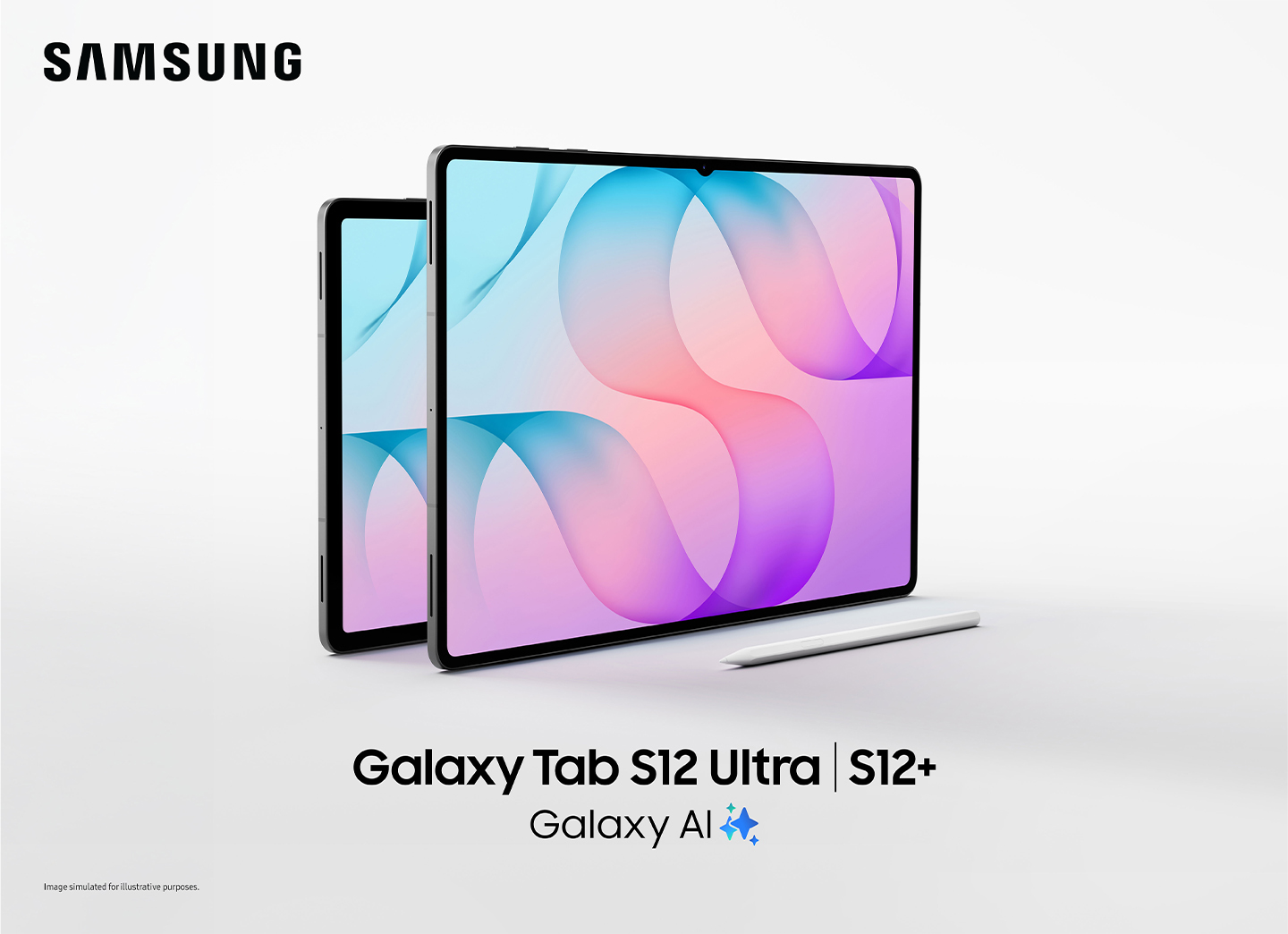
Samsung’s latest flagship Android tablets make a sharper argument than their familiar silhouette suggests. The Galaxy Tab S12 Ultra and Galaxy Tab S12+ are not merely thinner revisions with a new chip. They reset the price of admission: there is no ordinary Galaxy Tab S12 this year.
That leaves the 12.6-inch Tab S12+ at $1,199.99 and the 14.6-inch Tab S12 Ultra at $1,399.99 in the US, with sales beginning October 7. For shoppers who regarded Samsung’s flagship tablets as premium alternatives to a laptop, that may be defensible. For everyone else, it is a meaningful change in what “flagship Android tablet” now means: the smaller option is still a very large, very expensive machine.
The upside is that Samsung has put its effort into the things that make a tablet credible for sustained work, rather than just streaming. Both models use MediaTek’s Dimensity 9500, include an S Pen, add a 3D vapor chamber for long workloads, and run Android 17 with One UI 9. Samsung says the Ultra is 5.1mm thick; both screens are 120Hz Dynamic AMOLED 2X panels rated for up to 1,600 nits, and both have IP68 dust and water resistance.
The lineup is simpler, but not more accessible
Samsung brought back the Plus label after skipping it in the S11 generation, but it did so at the expense of the base model. That is an interesting choice because the Plus is not a modest middle ground. Its 12.6-inch display is larger than a conventional laptop screen in one direction, and it starts at twelve hundred dollars before a keyboard.
| Model | Display | Starting US price | What it is really for |
|---|---|---|---|
| Galaxy Tab S12+ | 12.6-inch, 120Hz AMOLED | $1,199.99 | The more plausible portable canvas for notes, editing and split-screen work |
| Galaxy Tab S12 Ultra | 14.6-inch, 120Hz AMOLED | $1,399.99 | A desk-friendly screen for people who genuinely want tablet-and-keyboard computing |
Android Central reports 10,600mAh and 11,600mAh batteries respectively, with 45W charging on both. Samsung quotes up to 21 hours of video playback for the Plus and 23 hours for the Ultra, along with a roughly 95-minute 0-to-100-percent charge using a 45W adapter. Those numbers are useful as a signal of intent, but they are not a promise about a day of Photoshop, video exports, calls and three-app multitasking. They need independent testing.
The same care applies to Samsung’s performance figures: it claims, against the Tab S11 Ultra, up to 19% faster CPU performance, 17% faster GPU performance and 61% faster NPU processing. The new vapor chamber is the more consequential detail. A thin tablet can look powerful in a benchmark and still fade under a long render; cooling is Samsung acknowledging that the serious use case is sustained, not momentary.
Samsung is finally treating software as part of the hardware pitch
The genuinely distinctive move is not an AI button. Adobe Photoshop comes preloaded, which Samsung says is a first for Android tablets, with four months of the Photoshop mobile plan included. Notability is also preloaded with a six-month trial, while LumaFusion and Clip Studio Paint are among the other creative apps in the bundle. That does not make a tablet a workstation by declaration, but it gives the S12 line a much clearer destination than “a bigger phone.”
Samsung also leans into the large screens with a three-way Multi Window layout. An owner can keep a source video, Samsung Notes and an AI assistant on screen together. It is exactly the kind of workflow where an S Pen and a 12.6- or 14.6-inch panel earn their space—provided the apps involved cooperate.
There is an irony here. The company’s best new productivity story still depends on an optional Pro Keyboard cover, not included with either tablet. Samsung positions it as the route to a more structured desktop setup, but its absence from the box is important when judging total cost. A buyer should price the storage tier, keyboard and any needed charger before comparing this with an iPad, a Windows ultraportable or a MacBook Air.
A better upgrade for the right owner, not a universal tablet answer
Early reporting is consistent on the essentials: Android Authority confirms the missing base model, the $1,199.99/$1,399.99 starting prices and October 7 availability; Android Central lists the 14.6-inch Ultra and 12.6-inch Plus displays and the Dimensity 9500 platform. The editorial question is less settled. Samsung has made the Tab S12 pair more purposeful, but also less forgiving of an uncertain buyer.
Someone who works in PDFs, marks up briefs, draws, edits on the road or wants one large screen for study and notes will find a sensible evolution here. The bundled stylus, brighter panel, cooling changes and unusually credible app bundle all serve that audience. An owner of a recent Ultra whose workload is mostly browsing and video, though, should not read Samsung’s headline percentage gains as an automatic reason to trade in.
Samsung has already shown, with its flexible new Odyssey monitor lineup, that choosing the right form factor is often more useful than winning a spec-sheet contest. The Tab S12 series needs the same discipline. The Plus is the version most people should inspect first; the Ultra makes sense only when its vast display is a daily tool rather than a very expensive novelty.
Bottom line
The Galaxy Tab S12 line is Samsung’s strongest tablet pitch in years because it concentrates on real creative and multitasking work. But it also turns that pitch into a premium purchase from the first dollar. The hardware looks well judged, and the software bundle is more substantial than the usual launch-day filler. Wait for independent battery, thermal and keyboard testing—and buy the size that fits your work—before deciding that the biggest Galaxy Tab is the better Galaxy Tab.