
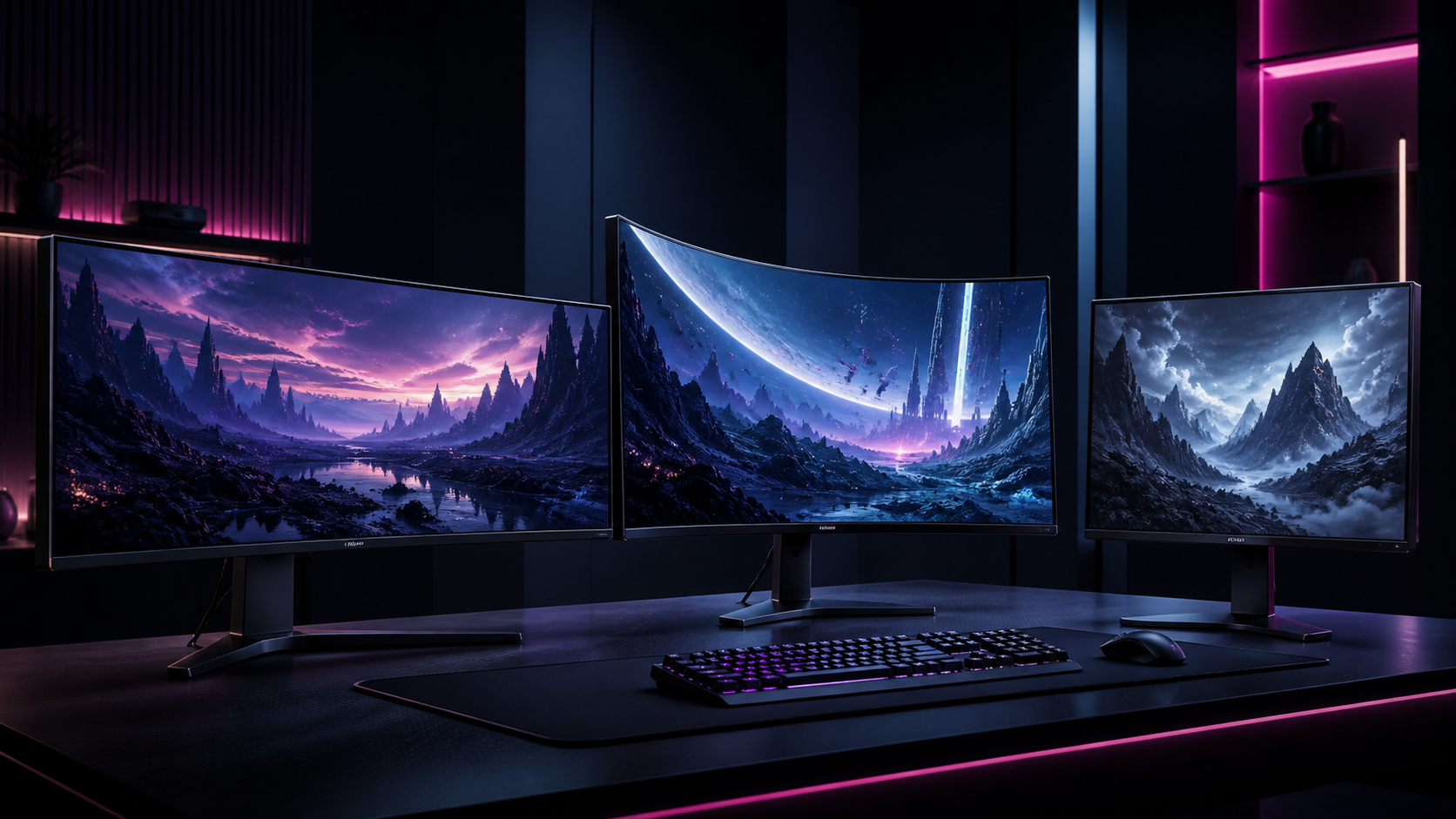
Gaming-monitor launches usually ask buyers to worship one number: more hertz, more pixels, more inches. Samsung’s 2027 Odyssey announcement at Gamescom is more useful because it acknowledges that those numbers pull against each other.
The new family includes a 49-inch OLED G9, a 42-inch curved OLED G7, a 32-inch OLED G8 and the exceptionally fast 27-inch G6. They are not four versions of the same idea. They are four arguments about what a gaming monitor should optimize for: field of view, immersion, image quality or competitive speed.
Samsung has not announced prices or market-by-market launch dates, so none is a buying recommendation yet. But the range points in a better direction than a simple annual spec race.
Four formats, four trade-offs
Samsung’s official announcement is clearest about the basic split.
| Model | Headline configuration | Who it is trying to serve |
|---|---|---|
| Odyssey OLED G9 | 49-inch Dual QHD OLED, 360Hz; Dual HD up to 720Hz | Sim-racing, strategy and wide-screen PC setups |
| Odyssey OLED G7 | 42-inch 4K curved OLED, 165Hz | Players who want a large, cinematic desk display |
| Odyssey OLED G8 | 32-inch 4K OLED, 360Hz; QHD 520Hz or FHD 680Hz | Players who switch between fidelity and fast action |
| Odyssey G6 | 27-inch QHD Fast IPS, 600Hz; HD up to 1,100Hz | Specialist competitive play |
The G8 may be the most revealing product in the group. Its three selectable modes make the compromise explicit: 4K at 360Hz, QHD at 520Hz or Full HD at 680Hz. Instead of asking a player to choose a single identity for the monitor at checkout, it lets the game dictate the balance.
Bigger is not automatically better
The 42-inch curved G7 is a fascinating outlier. Samsung calls it the first curved OLED gaming monitor in that size and conventional 16:9 format. That can make sense for someone who wants a desk display with the scale of a small television, particularly for slower single-player games. It can also be too much screen for a shallow desk or a player who spends long days working at the same panel.
The G9 makes the opposite bet: not height, but width. A 49-inch Dual QHD screen gives a game room to breathe and can replace a multi-monitor work setup. It also asks for compatible games, enough desk depth and a GPU that can drive 5120 × 1440 at worthwhile frame rates. Ultrawide remains wonderful when a game supports it and occasionally awkward when it does not.
Those are not flaws. They are the decisions buyers should make before the launch marketing does it for them.
The questions Samsung has not answered
The company says availability will vary by market and that pricing and timing will be shared later. Independent hands-on coverage can tell us how dramatic a display looks on a show floor, but it cannot replace retail testing for the questions that actually determine a purchase:
- How clean are the high-refresh modes in motion?
- How does each OLED handle brightness, text and reflection control in an ordinary room?
- What ports and bandwidth are required for each headline mode?
- Do regional prices leave meaningful room below established OLED alternatives?
The G6’s 1,100Hz mode is the clearest example. It is striking, but it runs at HD resolution; its QHD 600Hz mode is likely to be more useful to far more people. The same discipline applies to the rest of the range: the most impressive mode is not always the right daily setting.
Bottom line
Samsung’s new Odyssey family is at its best when it abandons the fantasy of a universally perfect gaming display. A wide OLED, a huge curved OLED and a fast desktop panel solve different problems, and flexible display modes make that distinction more practical.
Wait for price, regional availability and independent measurements. But if these monitors deliver their promised modes cleanly, the real advance will not be any one world-first claim. It will be giving players more honest choices about how they want their games to look and feel.