
The next useful advance in industrial AI may not arrive in the robot at all. It may arrive in the network rack beside it.
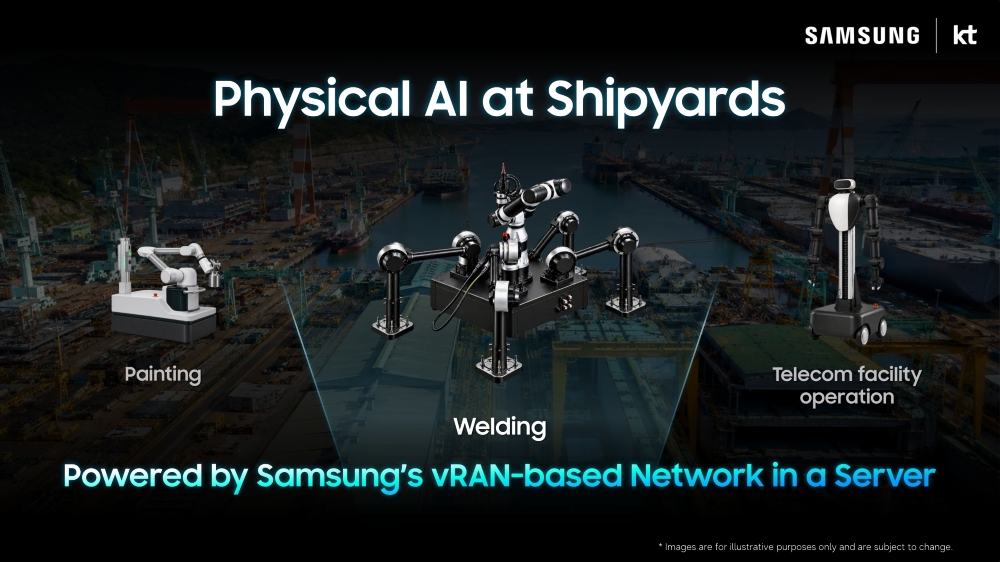
Samsung says it has signed contracts with KT and SK Telecom for Korean AI-RAN projects under the government’s Hyper AI Network programme. The work begins in October and pairs 5G Standalone private networks with edge AI at shipyards and a petrochemical site. The headline promise is physical AI: a welding robot, a patrol robot or an inspection system that can lean on nearby network compute instead of carrying every demanding inference task on board.
That is a more grounded story than another proclamation that 6G is around the corner. This is a test of whether the connection can be treated as part of the machine.
What is actually being tested
AI-RAN means adding AI computing and control to the radio-access-network layer that links devices to a mobile network. It does not turn a normal 5G tower into a magic robot brain. In this project, the important detail is where the work happens: close enough to the robot for its video, sensors and control loop to avoid a distant-cloud round trip.
| Site and partner | Planned use | What must be proved |
|---|---|---|
| HD Hyundai Samho’s Yeongam shipyard, with KT | Welding and painting robots plus network-operations automation | Whether a private 5G/edge stack can keep robotic work responsive in a demanding industrial environment |
| SK Incheon Petrochem, with SK Telecom | A quadruped patrol robot and CCTV-based hazard monitoring | Whether high-definition video can move reliably enough for real-time AI safety analysis |
| Later SK Telecom pilots | Autonomous material movement and a lower-power humanoid mode | Whether compute can be shifted between device and network without making the robot less dependable |
Samsung describes its Network in a Server platform as a bundle of virtualized RAN, 5G core, AI Core and applications. For readers, the hardware brand names matter less than the constraint: a robot in a chemical plant cannot tolerate a flaky connection, unpredictable latency or a server that decides a safety task can wait.
SK Telecom’s earlier project briefing adds useful context that Samsung’s announcement does not emphasize. The operator says its pilot is multi-vendor, involving Samsung, HFR, Ericsson and Nokia, and intends to compare compute configurations and deployment layouts. That is the right kind of messiness. A promising industrial network should work across equipment choices, not only in a carefully matched demo stack.
The buyer relevance is reliability, not robot theatre
For people who buy, build or work around connected machines, the appeal is straightforward. Moving some computation off a robot could reduce the size, heat, power draw and cost of the hardware that has to travel with it. It could also let a fleet share more capable models and monitoring tools.
But that trade only works if the network becomes boringly reliable. A cloud-connected consumer gadget can retry an upload. A welding system, a vehicle moving materials or a hazard-monitoring camera has a much narrower margin for failure. The more work the network assumes, the more the network becomes safety-critical equipment.
This is why the field locations are meaningful. Shipyards and petrochemical facilities are not forgiving showroom floors. The Korea Times reports that the government-backed initiative has a 17.2 billion won budget and is intended to quantify performance from AI-RAN, network slicing and AI-powered automation in real industrial settings. The programme is also explicitly a route toward standards work, not a finished commercial service.
That puts this alongside a broader GearPulse theme: AI infrastructure is becoming physical infrastructure. Our look at AI compute in Indonesia was about where national-scale capacity lives. Samsung’s project asks a smaller, tougher question: can enough of that capacity live close to the factory floor to change how a machine behaves?
Do not confuse the pilot with 6G
There are three caveats worth keeping in view.
- These deployments use 5G Standalone private networks. They are preparation for a possible 6G direction, not a 6G service launch.
- The projects begin in October; the claimed gains are targets to validate, not published results.
- AI-RAN can lower device-side burden, but it also adds dependencies: local servers, radio coverage, orchestration software, cybersecurity and a clear failure mode when the connection degrades.
Those caveats do not make the work less interesting. They make it more credible. Robotics is full of demonstrations that work precisely until conditions become inconvenient. Testing compute, connectivity and safety together is how a concept begins to earn a place in operations.
Bottom line
Samsung’s Korean contracts matter because they give AI-RAN an appropriately hard job. Rather than selling a vague vision of 6G, the partners will test whether edge-connected robots can weld, inspect and move safely where a dropped frame or delayed decision has a cost.
If the projects produce measurable reliability and efficiency gains across the mixed-vendor network, they will make a stronger case for AI-native wireless than any keynote can. If they do not, the result will still be useful: a clearer map of what physical AI cannot yet hand off to the network.
Support independent GearPulse articles at buymeacoffee.com/gearpulse.site.