
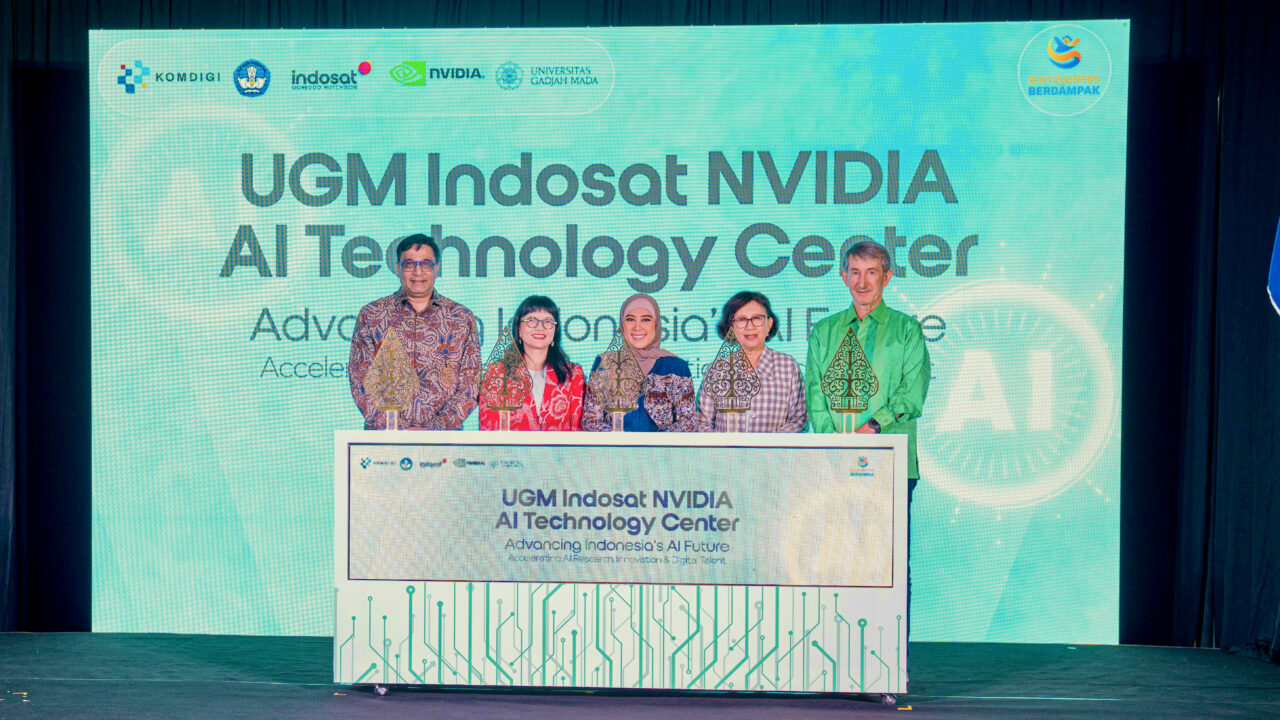
The AI infrastructure race usually sounds like a contest between enormous data centers, power deals and chip backlogs. Indonesia’s newest AI center is smaller in the frame but more interesting in the details: it puts the machinery inside a university, near researchers who already know the local problems.
NVIDIA, Indosat Ooredoo Hutchison, Universitas Gadjah Mada and Indonesia’s Ministry of Communication and Digital Affairs have opened the UGM Indosat NVIDIA AI Technology Center in Yogyakarta. NVIDIA says it is Indonesia’s first university-based AI technology center, built as part of the country’s AI Center of Excellence initiative. Indosat says the inauguration happened on August 13, 2026.
My read: this is the kind of AI infrastructure story that deserves more attention than another “country wants sovereign AI” slogan. The center is not being pitched only as national branding. Its first projects are tuberculosis screening, precision agriculture and disaster response. That is exactly where local data, local language, local deployment constraints and local urgency matter.
GearPulse recently covered Firebird’s Armenia AI factory and Google’s WeatherNext cyclone work. This Indonesia launch sits between those two ideas. It is infrastructure, but the pitch is not just raw compute. It is compute attached to public-health, food and resilience problems.
What actually opened
The center is called UGM Indosat NVIDIA AI Technology Center, often shortened to UGM Indosat NVAITC. NVIDIA’s announcement says the partnership brings together Komdigi, UGM, Indosat and NVIDIA to give Indonesian researchers, students, startups and developers access to accelerated computing, AI software, open-source and pretrained models, development frameworks, technical mentorship and a wider expert network.
Indosat’s official release adds two useful details. The center is powered by NVIDIA’s full-stack AI platform and GPU Merdeka, Indosat’s sovereign GPU-as-a-service platform. It also says the collaboration moved through governance planning in July 2025, a letter of intent in early 2026 and the August 13, 2026 inauguration.
That timeline matters because AI centers can become brochureware if they are announced before the operating model exists. This one has at least a clearer institutional path: government program, telecom infrastructure partner, university host and chip/platform partner.
| Piece | What the sources say | Why readers should care |
|---|---|---|
| Location | Universitas Gadjah Mada in Yogyakarta | Puts AI tooling close to students and applied researchers. |
| Infrastructure | NVIDIA platform plus Indosat GPU Merdeka | Makes sovereign compute less abstract. |
| First projects | eNose-TB, SmartAgri, Tech4Disaster | Focuses the center on Indonesian-scale problems. |
| Launch date | August 13, 2026 | This is a current opening, not just a planning memo. |
| Caveat | No independent capacity audit yet | Treat performance claims as program claims until more data is public. |
The best part is the problem list
NVIDIA and Indosat both point to three initial projects.
The first is eNose-TB, an AI-powered screening effort for tuberculosis using breath samples. NVIDIA’s write-up says Indonesia records more than 1 million new TB cases every year, and the project is meant to make screening more affordable and reachable for rural and underserved clinics.
The second is SmartAgri, which combines satellite imagery, sensor data, local agricultural knowledge, multimodal AI and edge computing for tropical farming. That sounds technical, but the goal is simple: help farmers make better irrigation and crop-management decisions in Indonesian conditions, not in a generic demo field.
The third is Tech4Disaster, a geospatial AI platform meant to process satellite and sensor data for disaster prediction, preparedness and response. For a country on the Pacific Ring of Fire, that is not a theoretical use case.
This is where the story becomes compelling. AI infrastructure is easiest to justify when the first users are not trying to make a shinier chatbot. Healthcare screening, smallholder agriculture and disaster response are hard, messy, high-consequence problems. They also need local iteration. A model that works in a Western hospital, a California field or a generic weather benchmark does not automatically fit an Indonesian clinic, farm or emergency command center.
Sovereign AI needs boring operational proof
The phrase “sovereign AI” is everywhere now, and it can mean almost anything: local data control, local model training, domestic cloud capacity, public-sector resilience or a policy speech with GPUs in the background.
The useful definition is more demanding. Sovereign AI should mean that local institutions can build, adapt and govern AI systems for their own priorities without waiting for a foreign platform owner to notice the use case.
By that standard, a university center is a strong place to start. Universities already sit at the junction of research, talent, public service and long timelines. Telecom operators understand infrastructure and distribution. Government can set priorities and procurement demand. NVIDIA brings the hardware and software stack. None of that guarantees impact, but the ingredients are better aligned than a pure corporate showcase.
The caveat is scale. The official announcements do not publish a detailed hardware inventory, utilization targets, pricing model for external users or benchmarks for the first projects. Until those details appear, the center should be judged by outputs: screened patients, farmer pilots, disaster-response integrations, trained students, published research and startups that keep building after the launch event is over.
Why this matters beyond Indonesia
The global AI race is often described as if every country needs its own OpenAI or DeepMind. Most do not. What they need first is the ability to solve problems that global labs are unlikely to prioritize because the data is local, the market is smaller, the language mix is specific or the deployment setting is difficult.
That is why the Indonesia launch is relevant to GearPulse readers. The next phase of AI infrastructure will not only be measured by who owns the biggest cluster. It will be measured by who can turn compute into useful institutions.
If UGM Indosat NVAITC becomes a place where Indonesian students can train on modern tools, researchers can build on local datasets and public agencies can evaluate practical systems before crisis moments, then the center has a reason to exist. If it becomes another logo wall, it will fade like every other AI announcement that confused access with adoption.
Bottom line
Indonesia’s new AI Technology Center is worth watching because it gives sovereign AI a concrete setting: a campus, a telecom compute platform, official government backing and three practical first missions.
The promise is not that NVIDIA hardware will magically solve TB, farming or disaster response. The promise is more grounded and more valuable: Indonesian researchers may now have a better shot at building AI systems around Indonesian problems.