
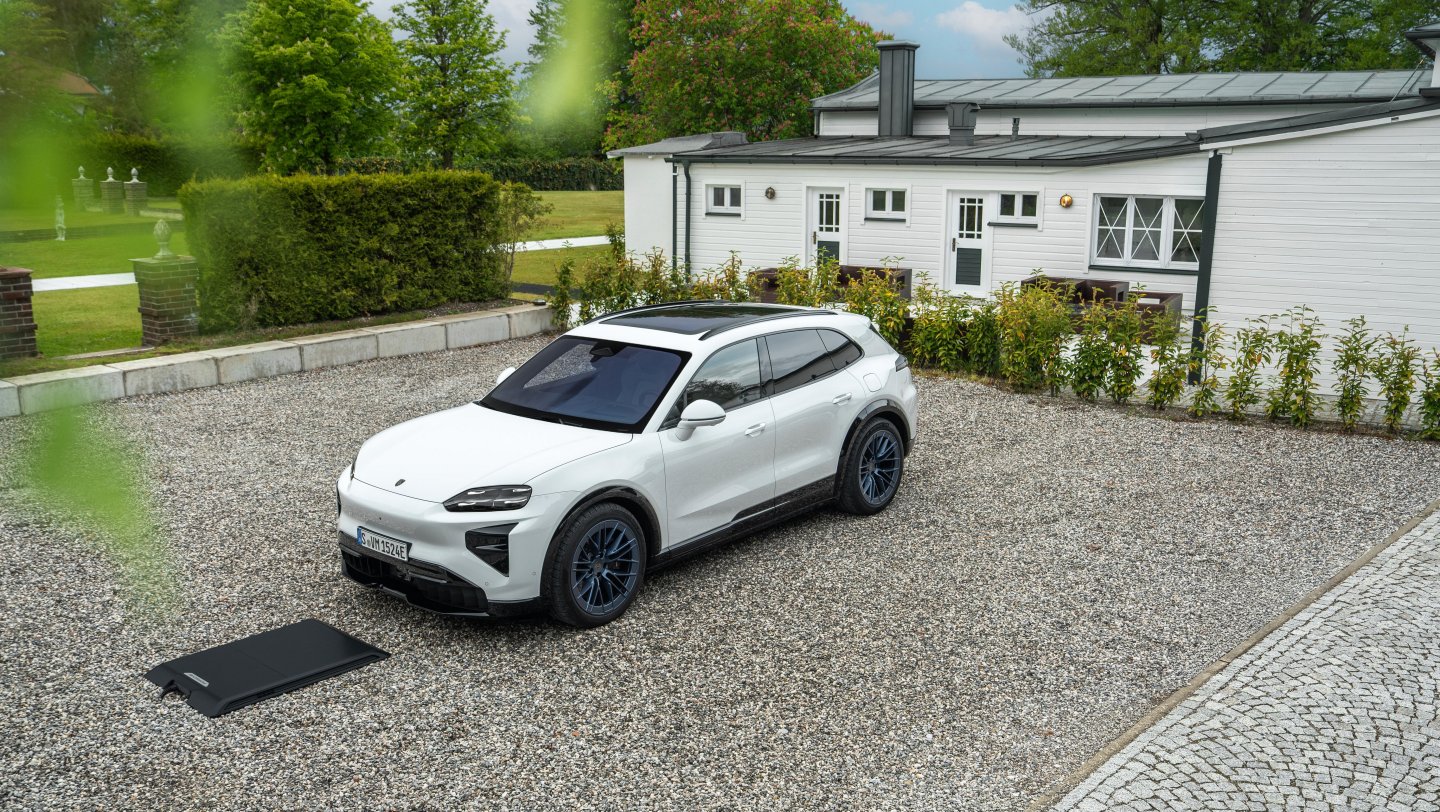
Wireless charging is most compelling when it removes a ritual you repeat every day. With a phone, that ritual is reaching for a cable. With an EV, it is uncoiling a thick lead, opening a flap and putting everything away again when you are late.
Porsche has now put that idea into production for the Cayenne Electric. Its new Porsche Wireless Charging system lets the SUV charge when it is parked over a permanently installed ground pad. The hardware can transfer up to 11 kW, Porsche says, at roughly 90% efficiency. It is available to order in Germany and other European markets, with a staged wider rollout planned.
That makes this more than a concept-car trick. It also makes it a very expensive way to save a few minutes of friction. T3 reports a UK total of around £7,300 for the relevant equipment and installation. For most EV households, a good wallbox and a cable hook remain the more rational answer.
What Porsche is actually selling
The system has three pieces: vehicle-side preparation, a pad on the car and a weatherproof ground pad installed in the parking space. Pulling into position starts charging automatically; there is no connector to pick up.
| Detail | Porsche’s stated position | What it means in practice |
|---|---|---|
| Charging power | Up to 11 kW | Comparable with a typical three-phase home AC wallbox, where supply allows. |
| Claimed efficiency | About 90% | Convenience comes with more energy loss than a direct cable connection. |
| Installation | Fixed, weatherproof ground pad | This is a home-parking solution, not a portable accessory. |
| Safety | Motion and foreign-object detection | The system is designed to stop if a person, animal or heating metallic object is detected near the pad. |
| Availability | Germany and other European markets initially | Do not assume it is orderable in every Cayenne market yet. |
Porsche says the car can use its camera system to help the driver centre the vehicle over the pad. That last detail matters: inductive charging only feels effortless if the parking routine is forgiving. A feature that requires five adjustments to line up would be cable charging with extra theatre.
The number to keep in view is 90%
An 11 kW headline is reassuring, but it is not the whole story. Porsche’s approximately 90% efficiency figure means some electricity becomes heat during transfer. That is a reasonable trade for an owner who values the automatic routine and charges frequently; it is not an environmental or cost advantage over plugging in.
The distinction is especially important because home charging is already the convenient part of owning an EV. Once a cable is installed beside a regular parking space, the extra work is usually measured in seconds. Induction eliminates those seconds and the occasional wet-cable annoyance, but it does not make the car charge faster than a comparable 11 kW AC setup. Our guide to matching home EV charging speed to the job explains why a bigger number is not automatically the more useful one.
Electrek correctly reads the announcement as Porsche finally moving vehicle-scale wireless charging into a customer order book. T3 adds the necessary financial context: even for a Cayenne buyer, the premium is substantial. This is the kind of option that is easiest to love after you have stopped looking at its invoice.
It makes most sense for a very particular driveway
The strongest case is a Cayenne Electric that returns to the same, private, level parking place almost every night. Owners with limited dexterity, a tight garage routine or a strong appetite for a cleaner-looking carport may find that the system earns its keep through repetition.
| It is a good fit if… | Think twice if… |
|---|---|
| You have a dedicated off-street parking bay and predictable overnight charging | You park in different places or rely mainly on public charging |
| Removing cable handling has real value for you | Your main goal is the lowest-cost home charging |
| You are ordering a new Cayenne Electric in a market where the option is available | You expect a retrofit for an existing EV or cross-brand compatibility |
| You prize a seamless arrival-and-charge routine | You need faster DC charging on road trips—this does not address that problem |
Porsche’s announcement also introduces powered doors, new interior options and more paint choice, but wireless charging is the update with the clearest daily consequence. It turns a premium SUV into something that behaves more like a device on a charging dock. The difference is that this dock needs an electrician, a permanent parking spot and a much larger budget.
Bottom line
Porsche Wireless Charging is real, thoughtfully specified and far more interesting than another decorative Cayenne option. At up to 11 kW, it can handle the overnight job just fine; automatic alignment support and safety detection make the experience sound credible rather than gimmicky.
But it is luxury convenience, not a breakthrough in EV ownership. The 90% efficiency claim and reported UK price put the decision in plain view: buy it if eliminating the cable ritual is genuinely valuable in your daily routine. Buy a quality wallbox if what you really want is dependable, economical home charging.