
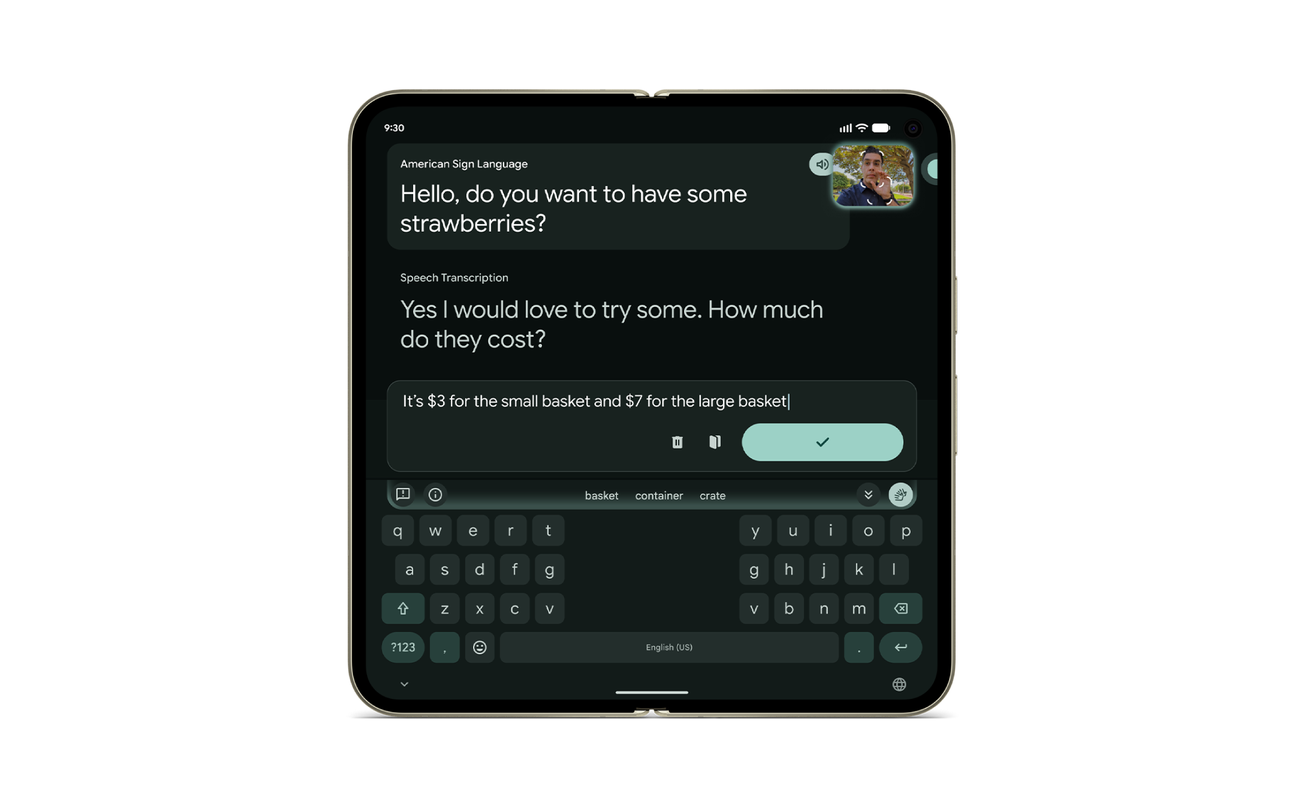
Most phone AI arrives asking us to admire the trick. Pixel 11’s new sign-to-text feature has a more useful ambition: let a signer use a phone’s ordinary text box without first translating their language into typing.
Google’s new feature uses the front camera to turn American Sign Language (ASL) into written English in Gboard and Live Transcribe. That means a signer can draft a message, search the web or respond in a text-led conversation by signing instead of reaching for a keyboard. Google says it is available first on Pixel 11 phones, which reached stores on August 20.
That is a meaningful change in where accessibility technology lives. It is not tucked into a specialist app or presented as a novelty demo. It sits in two of the places where phones ask people to produce language all day.
But this needs careful framing. ASL is a language, not English performed with hands. A camera-to-text system can be useful without being a substitute for an interpreter, a Deaf person’s own language or a guaranteed accurate record. Google’s first release is ASL-to-English, on one phone family, and should be judged by the people who would rely on it—not by a launch-stage clip.
What Pixel 11 actually adds
Google DeepMind calls the model Sign Language-to-Text, or SL2T. Its stated launch use is ASL-to-English dictation in Gboard and Live Transcribe on Pixel 11. The company says the system supports both one- and two-handed signing; its Pixel instructions say users add the sign-to-text option to the Gboard toolbar and sign toward the front camera.
| What is confirmed | What it means in practice |
|---|---|
| ASL to written English | This is a translation path for an initial language pair, not support for every sign language. |
| Gboard and Live Transcribe | It can enter the same everyday text surfaces used for messages, search and written replies. |
| Pixel 11 first | It is not a general Android feature today; Google says more devices and languages are to follow. |
| Front-camera input | Positioning, lighting, framing and the user’s ability to hold the phone are part of the experience. |
| Landmark-based processing | Google says an on-device model extracts body-pose landmarks and the raw camera video is discarded immediately; the coordinates go to a server for translation. |
The last point is especially worth understanding. This is neither a simple camera recording uploaded intact nor a fully offline translation tool. Google says MediaPipe Holistic identifies geometric landmarks on the signer, sends those coordinates for server-side translation and discards the original video immediately. That is a thoughtful privacy architecture, but it still means users should understand the service and connectivity boundary before using it for sensitive conversations.
Why this is more consequential than another keyboard feature
Voice dictation changed how many hearing users use phones: the input box became a place to speak naturally instead of type carefully. Sign-to-text tries to create a comparable path for people who communicate in ASL.
The audience relevance is straightforward. A person who signs may face a constant small tax when apps assume spoken or typed English is the default: form fields, quick messages, searches, prompts and back-and-forth text conversations. Reducing that tax inside the keyboard itself could be genuinely liberating when it works well.
There is also a product lesson here. Our Pixel 11 Pro launch coverage focused on cameras, display hardware and the HiLight LED. Those are ordinary flagship differentiators. Sign-to-text gives the Pixel line a rarer kind of distinction: a feature aimed at expanding who can use a familiar interaction, rather than simply making the interaction flashier.
Independent coverage gives the wider launch useful context. Ars Technica found the Pixel 11 generation light on hardware reinvention and heavily focused on AI features, while TechCrunch similarly described a lineup built around more Gemini-driven software. Against that backdrop, sign-to-text has a clearer human purpose than most AI conveniences. It is not asking people to hand a task to an agent; it is trying to make a basic input method more accessible.
The caveats are part of the story
Google’s technical post is unusually clear about why this is difficult. Sign languages use hands, arms, torso, head and face together; they are not a word-by-word code for English. The company says SL2T was trained on more than 100,000 hours across over 50 sign languages, with roughly a quarter of its data in ASL, and reports benchmark results for the model. Those claims are promising, but benchmark performance does not settle whether an output is appropriate in a real conversation.
That distinction matters most where mistakes carry a cost.
| Situation | Sensible expectation |
|---|---|
| Casual texts and searches | A potentially faster way to get an idea into a text field, with the output reviewed before sending. |
| Live everyday conversation | A useful bridge when typing is cumbersome, not a promise of perfect understanding. |
| Medical, legal, financial or emergency communication | Do not treat a consumer translation feature as a substitute for qualified human communication support. |
| Languages beyond ASL | Wait for explicit support; similarity between sign languages is not a safe assumption. |
There are practical questions, too. Signing to a front camera asks for a workable view of the body and face, enough light, and a position that does not turn one-handed phone holding into another accessibility barrier. Google says it worked with Deaf community partners and tested fairness for left-handed signers and one-handed signing. Those are good design targets. They are not the same as a universal claim that every signer, dialect, environment and conversation will work equally well.
The bottom line
Pixel 11’s sign-to-text is compelling because it puts a specific accessibility idea where people actually need it: at the point of input.
The right response is not to overstate it as a replacement for interpreters or as proof that AI has “solved” sign language. The right response is to take the launch seriously, demand clear support boundaries and let Deaf users define whether its speed, privacy tradeoffs and accuracy earn a place in daily life.
If Google follows through with more devices and languages while keeping those limits visible, this could become one of the Pixel 11 features that matters long after the spec-sheet conversation has faded.