
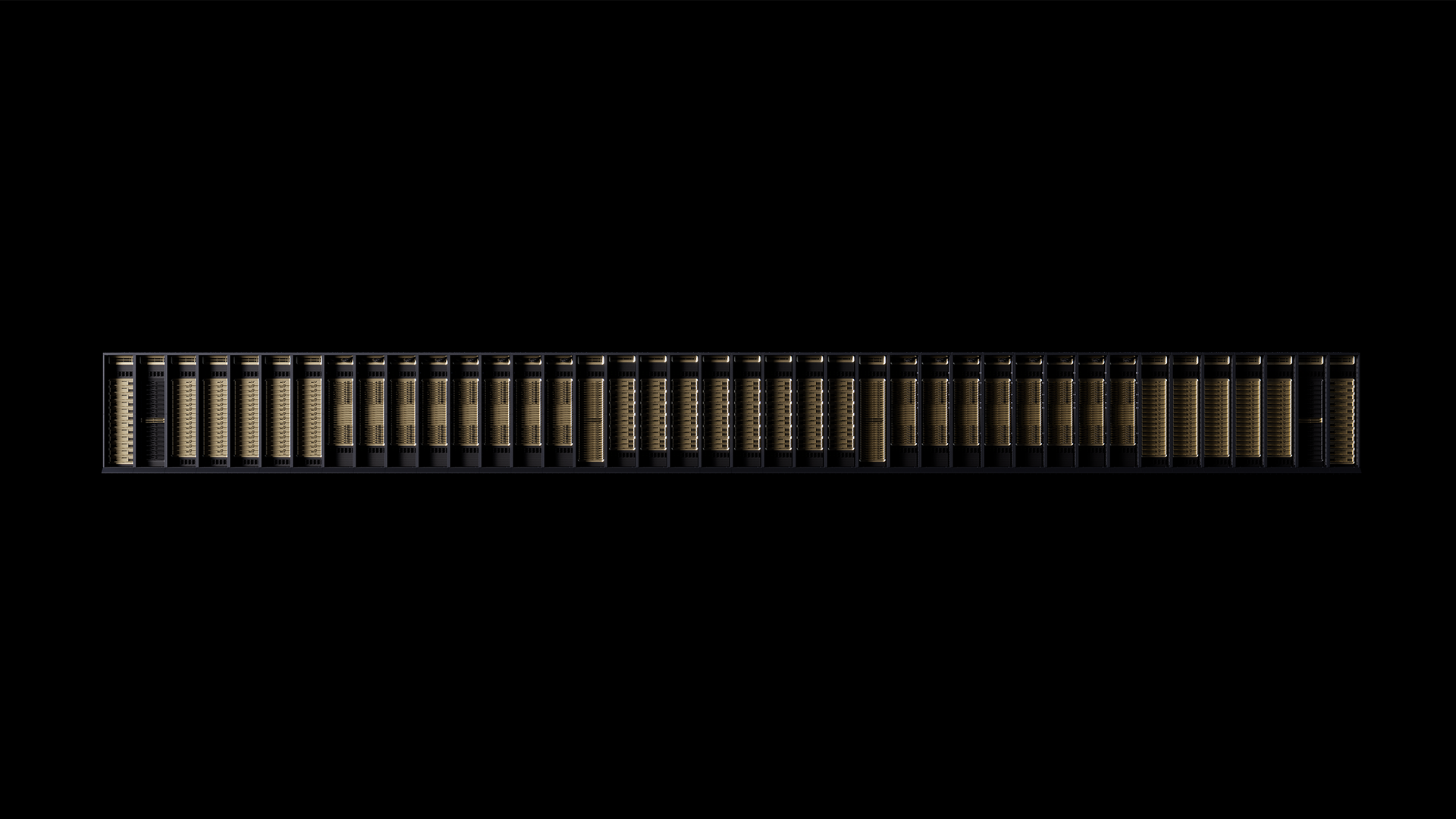
The most revealing part of NVIDIA’s first Vera Rubin NVL72 MLPerf result is not the biggest multiplier. It is that the system is being measured, discussed and sold as a rack.
In MLPerf Inference v6.1, NVIDIA submitted preview-category Vera Rubin NVL72 results for DeepSeek-R1 and Qwen3-VL. NVIDIA says its 72-GPU rack reached up to 3.7 times the throughput of a GB300 NVL72 on Qwen3-VL and up to 2.5 times on DeepSeek-R1. Those are substantial claims, but they are not a universal score for “AI.” They apply to named workloads, scenarios and NVIDIA’s selected software stack.
That distinction is the story. For anyone following the hardware behind AI services—not merely the chip-name carousel—the benchmark shows why the next infrastructure race is about a coordinated machine: accelerators, CPUs, interconnect, inference runtime and the way a provider schedules a live workload.
What MLPerf actually establishes
MLCommons describes MLPerf Inference as a standardized, reproducible suite. Its v6.1 round adds an end-to-end retrieval-augmented-generation test for datacenters and an agentic-inference test for edge systems. It also says NVIDIA Rubin and Vera Rubin NVL72 are in its preview category.
That last word deserves to stay attached to every headline. Preview results are valuable early evidence, but they are not the same thing as a broad, shipping-platform comparison across every model, latency target and cloud configuration. They should not be used to infer a price, availability date, power draw or a particular customer’s cost per token.
| What the result says | What it does not say |
|---|---|
| Vera Rubin NVL72 submitted results on DeepSeek-R1 and Qwen3-VL in MLPerf v6.1. | How it will perform on every model, prompt mix or context length. |
| NVIDIA reports higher throughput than its GB300 NVL72 comparison on those tests. | A like-for-like price or energy comparison for a buyer. |
| The suite has new RAG and edge-agentic workloads. | That either new workload is a measure of Vera Rubin’s performance. |
| The rack can be evaluated as an integrated system. | That a rack result can be reduced to one GPU’s headline figure. |
MLCommons’ release adds a useful external check on the scale of the round: it reports a record 30 participating organizations and says the best per-accelerator server result in the visual-language-model test improved 2.99 times from v6.0. StorageReview’s coverage similarly frames the release as the first peer-reviewed numbers for Vera Rubin NVL72, alongside a broad set of systems from other vendors and builders. This is a competitive benchmark round, not an NVIDIA-only demo.
Why two workload results matter more than one grand claim
NVIDIA used different software paths for the two showcase workloads. Its account says Qwen3-VL used vLLM with NVIDIA Dynamo, while DeepSeek-R1 used TensorRT-LLM. That is not a footnote. It is an admission of where modern inference performance comes from: the runtime and orchestration have become part of the hardware product.
A capable rack can still lose useful throughput to model routing, memory traffic, batching, queueing and latency constraints. Conversely, a strong runtime can extract more from the same physical kit. That is why a system that looks brilliant in an offline-throughput test may not map neatly onto an interactive assistant, a long-context coding agent or a service with spiky traffic.
We made a related point in our look at Vera Rubin’s post-training pitch: the infrastructure question is increasingly about the whole loop that keeps models running and improving. MLPerf’s result gives that argument a more concrete shape. NVIDIA is not presenting Rubin as a fast GPU beside a generic host; it is presenting a 72-GPU, software-defined inference appliance.
The buyer question is now utilization
NVIDIA naturally translates more throughput into more served users and lower cost per token. That is plausible, but it remains a vendor conclusion until customers can compare real pricing, power, utilization and service-level behavior. A cloud operator does not buy benchmark tokens. It buys a system it must keep fed with useful work, cool, network and support.
That makes three questions more useful than asking which rack won a single chart:
- Which models and request patterns match the benchmark’s workload?
- What latency and accuracy constraints were applied—and do they match the intended service?
- How much of the advertised gain survives once the rack is shared, partially utilized and operated at a real site?
NVIDIA’s Developer performance page makes the rack-level nature explicit, listing a Vera Rubin NVL72 configuration with 72 VR200 accelerators for its published entry. The figure is impressive precisely because it is a coordinated system result. It should not be casually recast as the performance of one GPU.
Bottom line
Vera Rubin’s MLPerf debut is a credible early marker, not a reason to declare the next AI generation settled. The benchmark verifies that NVIDIA has brought the NVL72 rack into a public, standardized evaluation, while NVIDIA’s own comparisons show why its software stack is inseparable from the performance pitch.
The practical takeaway is sharper than “new chips are faster.” The AI infrastructure product is now the rack and the operating model around it. When real deployments arrive, the meaningful test will be whether those preview gains remain useful under the messy conditions that benchmarks intentionally cannot capture.