
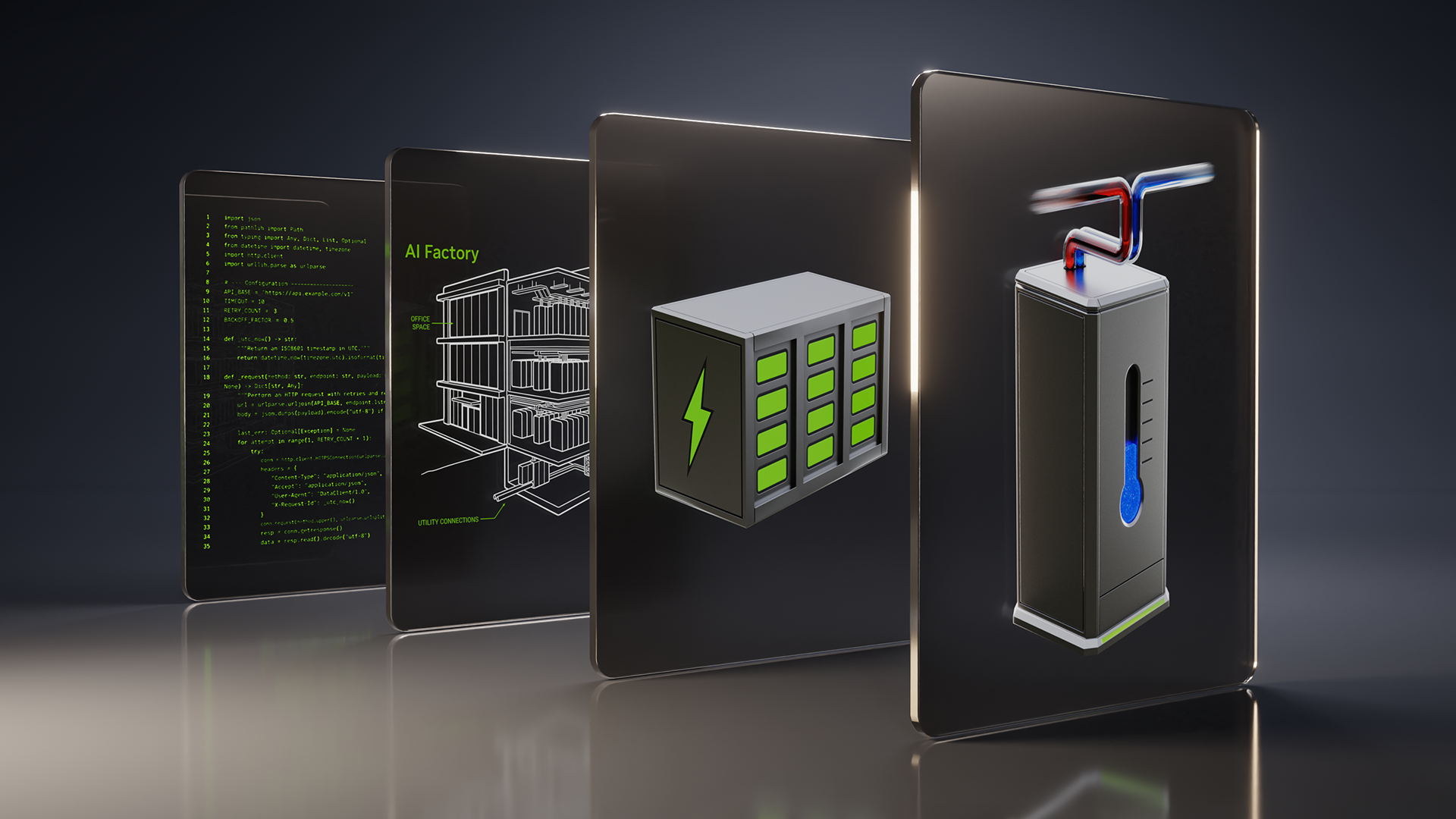
For years, the AI-infrastructure conversation has been dominated by accelerators. NVIDIA’s new DSX Ready program is a useful admission that the useful unit is no longer a GPU, or even a rack. It is the working system around it.
Launched on September 21, DSX Ready is a qualification program for partner products that meet applicable requirements in NVIDIA’s DSX AI-factory reference designs. It begins with two decidedly unglamorous categories: battery energy storage systems (BESS) and cooling distribution units (CDUs). Yet those are often where an ambitious deployment meets its practical limits—available power, heat removal, site design and the time it takes to make all of them operate together.
This is not a consumer-style certification badge. It does not mean a data-center operator can skip engineering, nor does it promise that a qualified component will suit every building. NVIDIA says exactly that for BESS: qualification does not replace site-level engineering or establish site-level stability. That caveat is the most important part of the announcement.
Still, the badge changes the buying conversation. Rather than asking only whether a supplier has a plausible cooling or storage product, an AI-factory builder can start with products tested against a defined slice of the same reference design as its compute stack.
What the program actually covers
NVIDIA lists three initial BESS suppliers—Hitachi Energy, LG Energy Solution and Tesla—and three CDU suppliers—LG Electronics, LiquidStack and Vertiv. The program is product-specific and category-specific, with further infrastructure and software categories planned.
| Building block | What it does in an AI facility | What DSX Ready means—and does not mean |
|---|---|---|
| BESS | Stores electricity and can help a site manage demanding, variable loads. | A qualified offering meets applicable program requirements; it does not settle interconnection, local codes, backup strategy or facility design. |
| CDU | Moves heat from direct-to-chip cold plates to the wider cooling system. | A qualified unit meets applicable functional criteria; the operator still must validate flow, redundancy, plumbing and fit at its site. |
LG Electronics’ new 2.6MW CDU makes the physical stakes concrete. LG says the unit is intended for centralized management of heat from multiple high-density racks and that it is its third qualified CDU capacity, after 600kW and 1MW models. The company describes the device as part of a direct-to-chip loop: it circulates coolant through cold plates, then transfers the heat toward the facility cooling infrastructure.
That is a meaningful distinction from saying that liquid cooling is simply “better.” A CDU is one link in a chain. A high-capacity unit may be appropriate for a dense build, but the rest of the chain—rack layout, coolant path, redundancy, chillers or dry coolers, water strategy and power quality—still decides whether the facility is dependable.
The clever part is reducing a handoff, not eliminating work
Reference designs can be powerful because they make interfaces explicit. NVIDIA’s DSX platform spans compute, networking, power, cooling, facilities and software. DSX Ready tries to carry that system view into the partner-selection stage.
For infrastructure teams, that can reduce a familiar kind of risk: a component that looks excellent in isolation may create a new bottleneck at the boundary with another system. A qualification signal will not make the integration painless, but it can narrow the number of unknowns before detailed design begins.
LG Energy Solution’s qualified BESS disclosure illustrates why that matters. Its AC-coupled offering uses modular 2.5MW / 5.1MWh battery blocks and is positioned for load smoothing, voltage ride-through and power reliability. Those are capabilities worth evaluating, not outcomes a buyer should assume. Local grid rules, utility agreements, controls and operating policies determine whether an energy-storage system can deliver the benefit a particular site needs.
This is the same broader lesson behind our look at Google’s Finland AI-infrastructure investment: compute ambitions become real only when the supporting energy system is equally deliberate. The new program gives that invisible layer a nameplate that procurement teams can recognize.
Why it matters beyond the data-center fence
Readers are not shopping for a 2.6MW CDU, but they will feel the consequences of whether AI capacity can be built predictably. Better-integrated infrastructure can affect how quickly cloud capacity comes online, where it is located, how much electricity it needs at peak times and how credibly operators can explain their resource plans.
That is precisely why qualified hardware should not be confused with a clean bill of health. It says something useful about product compatibility, not water use, grid impact, construction quality, electricity prices or the social case for a particular site. Those questions remain local and public.
Bottom line
DSX Ready is a sensible piece of industrial plumbing. NVIDIA is applying more structure to the hardware around its AI systems at the point where builders need to make expensive, interdependent choices.
The result is not a turnkey AI factory and it should not be sold as one. But qualifying power storage and cooling against a common design is more valuable than another abstract infrastructure pledge. The next test is whether the program expands with transparent requirements and helps operators build facilities that are not merely faster to commission, but easier to understand and run responsibly.