
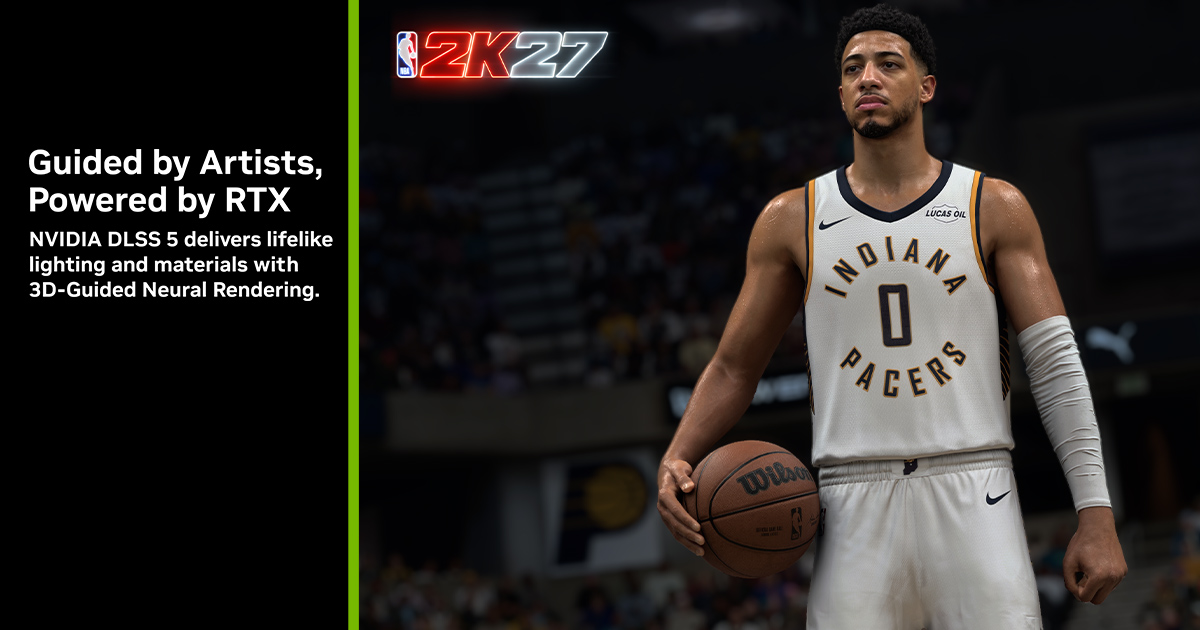
NVIDIA has put DLSS 5 into its first shipping game, NBA 2K27. That is a more interesting milestone than another “AI makes graphics better” announcement because the launch is unusually constrained. The new 3D-Guided Neural Rendering option is available in one game, for GeForce RTX 50-series PCs and laptops, plus GeForce NOW Ultimate in NVIDIA-operated regions. It also needs the new Game Ready driver.
Those limits are not an embarrassment. They are the clearest clue to what DLSS 5 really is. This is not a general-purpose filter to spray over an old game, and it is not a replacement for rendering. NVIDIA says it works from the game’s colour and motion-vector data to alter lighting and material response while retaining the geometry supplied by the game. Visual Concepts has controls over where and how aggressively it is applied.
That puts authorship back into a conversation that normally gets flattened into a settings-menu toggle. The early previews suggest that care changes the result.
A new graphics feature with a narrow launch lane
NVIDIA’s September 1 announcement says DLSS 5 went live at 9 p.m. Pacific on September 3 in NBA 2K27. The company calls it 3D-Guided Neural Rendering and says it can work alongside Super Resolution, Multi Frame Generation and Reflex. Driver 616.64 or newer and NVIDIA Streamline 2.14 or newer are part of the current PC setup.
| What is available now | The boundary that matters |
|---|---|
| NBA 2K27 | It is the only confirmed launch game, not a blanket DLSS upgrade |
| GeForce RTX 50-series desktops and laptops | Older RTX cards are not officially supported for DLSS 5 at launch |
| GeForce NOW Ultimate on RTX 5080-powered cloud rigs | Availability depends on NVIDIA-operated regions and an Ultimate membership |
| Developer controls for structure, tone and semantic masking | A game team still decides the look; players do not get a universal visual preset |
| A dedicated in-game DLSS Neural Rendering switch | The feature extends the render pipeline; it does not replace rasterisation, ray tracing or path tracing |
That is a healthier starting point than treating neural rendering as an automatic upgrade. A basketball broadcast-style game gives Visual Concepts a tightly defined target—faces, skin, hair, fabric, arena lighting and a crowd that needs to read at a glance. It is a sensible place to see whether a developer can preserve a game’s visual language while extracting extra material and lighting detail.
The early evidence is encouraging—but it is not a benchmark verdict
TechRadar’s Gamescom preview found the tuned NBA 2K27 presentation more convincing than the first, much more aggressive DLSS 5 demos. PC Gamer likewise reported that the lower-intensity implementation looked far less distracting in play, while still warning that a heavy hand can push an image into something garish. Those are useful observations from people who saw the integration, not proof that every future game will make the same choices well.
The performance story needs even more restraint. NVIDIA’s 4K “up to 370 fps” RTX 5090 figure uses a stack of settings: DLSS 5, Super Resolution, Multi Frame Generation, ray tracing and the Ultra preset. It cannot tell us the cost of neural rendering by itself. TechSpot made that limitation explicit: NVIDIA did not provide a like-for-like DLSS 5 on/off comparison with otherwise identical settings, and the published example implies a much lower underlying render rate before frame generation.
That does not make the headline figure false. It makes it incomplete. The number on a frame-rate counter can be useful, but it is not interchangeable with rendered responsiveness, image stability or controller feel. Until independent testing covers latency, motion and a range of GPU tiers, this is a feature to evaluate in a real game, not a reason to extrapolate from a marketing chart.
Why the artist controls are the story
Neural rendering changes what is visible in a completed frame. That creates a different responsibility from an upscaler that is primarily trying to reconstruct more pixels from less render resolution. If the tool overstates skin texture, changes the balance of a material, or gives background people too much synthetic detail, it can turn a deliberate art direction into a different picture.
NVIDIA says its controls allow structure, tone and semantic masks to calibrate the model. In practical terms, that means a studio can limit the effect to selected scene elements rather than asking an AI model to reinterpret everything with the same intensity. The Gamescom reports reinforce why that matters: the reviewers did not simply find “DLSS 5” good or bad; they found that the integration and its restraint determined whether it read as refinement or distraction.
That is a useful standard for the next wave of games. Ask what the developer tuned, where the option can be compared, and whether the game looks coherent in motion—not whether an isolated still looks more expensive. The same discipline helped separate meaningful progress from easy headlines in our look at DLSS 4.5 Ray Reconstruction. Reconstruction technologies earn their place when they reduce an artifact without creating a new one.
What PC players should watch next
The first practical test is simple: use NBA 2K27’s own toggle in gameplay and replays, then look at fast camera movement, faces, crowd detail and reflections rather than paused glamour shots. Players with an eligible card should also compare the setting with frame generation choices kept clear in their heads; a higher displayed number does not automatically explain the visual or input trade-off.
For everyone outside the initial hardware and cloud lanes, there is no buying advice hidden in this release. NVIDIA says more integrations are coming, but it has not turned DLSS 5 into a broad compatibility promise. Its value will be settled game by game, and that is exactly how it should be judged.
Bottom line
NBA 2K27 makes DLSS 5 feel less like a magic effect and more like a demanding new production tool. The early hands-on reporting suggests it can improve an image when a studio gives it disciplined boundaries. The unanswered questions—performance in comparable tests, motion consistency and support beyond RTX 50 hardware—are the ones that will decide whether it becomes a PC-gaming staple.
For now, the sensible reaction is curiosity with a measuring tape. The impressive part is not that a neural model can change a frame. It is whether the people making a game can keep that change serving the game.