
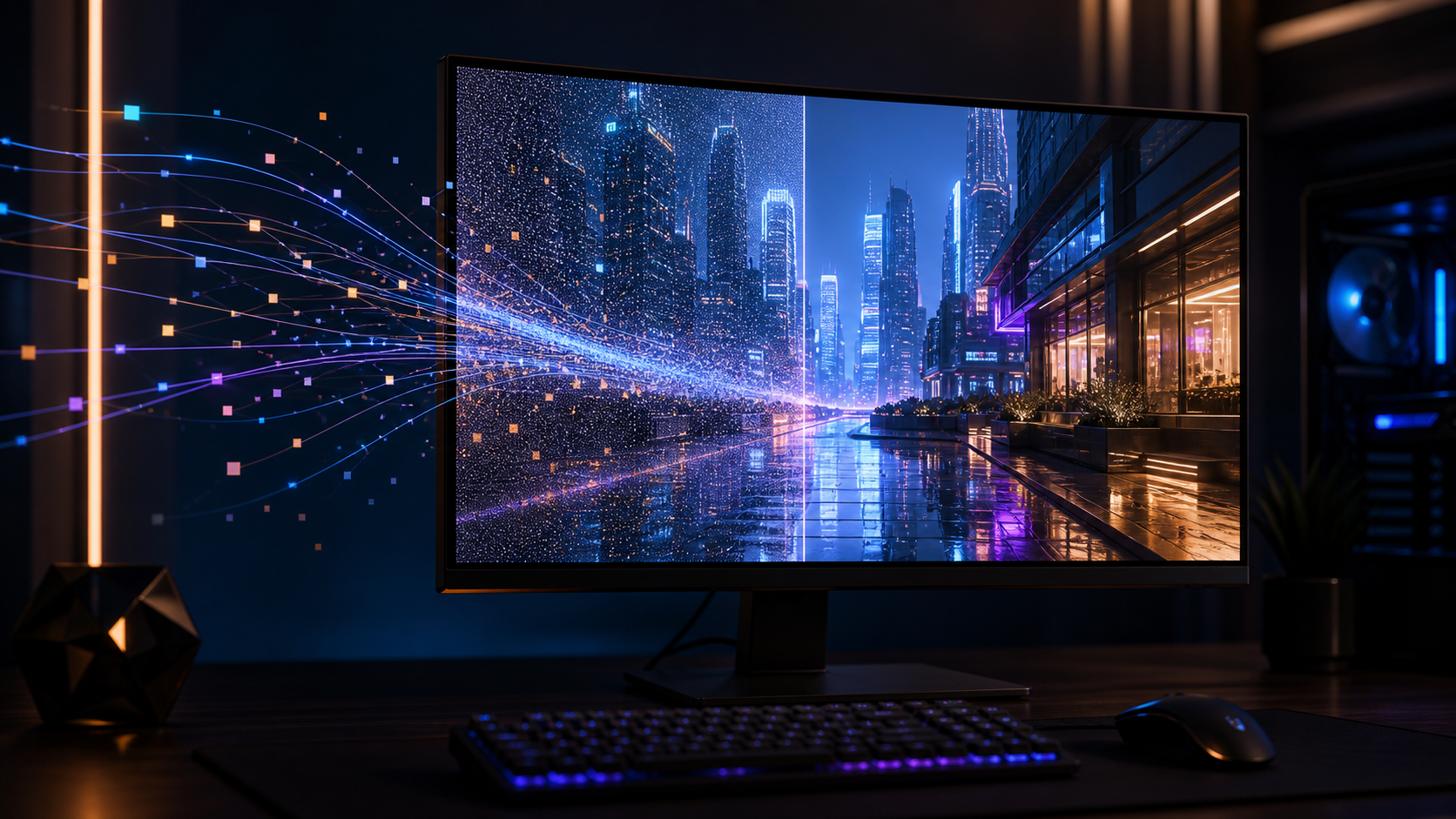
Path tracing can make a game look uncannily convincing, right up until a reflection smears, a shadow shimmers or a fine texture begins to crawl. NVIDIA’s DLSS 4.5 Ray Reconstruction targets that awkward gap. Rather than being another frame-rate headline, it is a new AI model for rebuilding the noisy lighting data that ray- and path-traced games start with.
That makes it one of the more practical Gamescom announcements. NVIDIA says DLSS 4.5 Ray Reconstruction is now available through an opt-in NVIDIA app beta for supported titles and works across GeForce RTX GPUs. The company points to improved lighting response, reduced ghosting and greater temporal stability from its second-generation Transformer model.
The early independent verdict is encouraging, with a necessary asterisk: this is a better reconstruction tool, not an excuse to stop judging a game’s implementation.
What Ray Reconstruction actually changes
Ray-traced lighting is expensive partly because a game cannot calculate unlimited light samples per pixel in real time. It must denoise an incomplete image. Ray Reconstruction replaces parts of that conventional denoising process with a trained neural model, using information from nearby pixels and earlier frames to infer a cleaner result.
| What it aims to improve | What it does not promise |
|---|---|
| Stable reflections, indirect light and fine detail | More raw GPU performance |
| Less ghosting around moving objects | A fix for every game’s artistic or engine issues |
| Cleaner path-traced scenes in compatible games | Support in games that do not implement Ray Reconstruction |
That distinction matters. DLSS frame generation and upscaling are often discussed as broad performance features. Ray Reconstruction is narrower: it only helps where a game already uses the relevant ray-tracing pipeline, and the result still depends on the game’s own integration.
The useful part is the pattern in testing
TechSpot found the new model to be a straightforward overall recommendation after testing, reporting that image quality rarely became worse. PC Gamer also saw a definite advance, but cautioned that path-traced fidelity remains unsolved in absolute terms. Tom’s Guide reached a similar conclusion after hands-on testing: the update addresses familiar instability, while leaving a reality check around the games and scenes that expose rendering’s hardest problems.
That is a healthier reading than either extreme. It is not a miracle switch that turns every RTX game into a reference image. Nor is it cosmetic. When temporal instability is the thing pulling a player out of a beautifully lit scene, reducing it can matter more than a small benchmark gain.
Compatibility is the real buying advice
NVIDIA’s announcement highlights 007 First Light receiving a September 15 update with path tracing and DLSS 4.5 Ray Reconstruction, alongside existing DLSS features. That is useful evidence of incoming support, but it is not a compatibility list for every RTX game. Players should check the release notes for the individual game and the NVIDIA app beta before expecting the setting to appear.
For a current RTX owner, the sensible route is simple:
- Update only if a game you play supports Ray Reconstruction.
- Compare the setting in a demanding scene, especially reflections, foliage and moving lights.
- Keep the old option available if the new model produces a title-specific artifact you dislike.
Bottom line
DLSS 4.5 Ray Reconstruction looks like a real quality upgrade, particularly for games that ask lighting to do most of the visual storytelling. The interesting achievement is restraint: NVIDIA is improving the part of ray tracing that most often betrays the illusion, rather than pretending that a cleaner image makes hardware limits disappear.
For PC players, it is worth trying in compatible games. For everyone else, it is a reminder that modern graphics quality is increasingly decided by how well a game reconstructs what it cannot afford to render outright.