
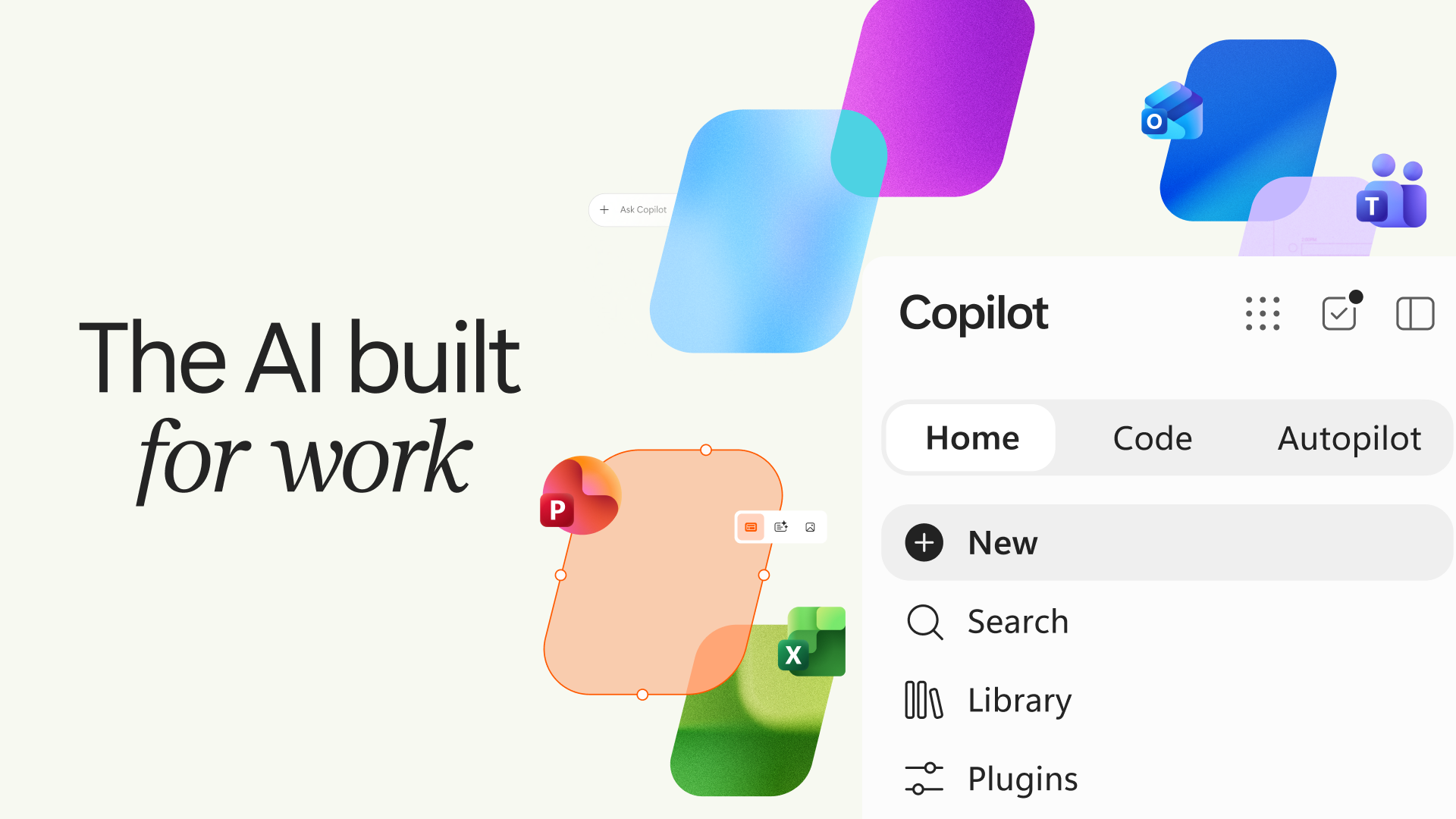
Microsoft has spent years putting the Copilot name on a bewildering assortment of chat boxes, assistants and add-ons. Its September 25 update finally makes the product shape legible: one workspace for asking, making and delegating.
The new Copilot app is organized around Home, Code and Autopilot. Home combines ordinary Copilot Chat with Cowork, Microsoft’s task-delegation mode, while bringing real Word, Excel and PowerPoint files into the same workspace. Code is the plain-language route to an internal app, tracker, dashboard or automation. Autopilot—previously called Scout—is the long-running agent that can keep working after its owner has stepped away.
That sounds like another AI bundle until you look at the operating model. Microsoft is drawing a line between the familiar per-user Copilot subscription and agentic work that consumes resources over time. Cowork, Code and Autopilot use usage-based billing; IT gets policies, approvals and spend controls alongside the features. In other words, the interesting product decision is not just giving an assistant more autonomy. It is making the cost and governance of that autonomy visible.
One app, three very different commitments
| Area | What Microsoft says it does | What to verify before relying on it |
|---|---|---|
| Home | Brings Chat and Cowork together; Word, Excel and PowerPoint can be created or edited inside Copilot | Whether it is enabled for the relevant account and whether your data permissions are correct |
| Code | Builds apps, dashboards, trackers and automations from natural-language instructions, using GitHub Copilot technology | Security review, data access, ownership and the cost of running the resulting app |
| Autopilot | A cloud-hosted agent with its own identity, memory, workspace and ongoing task | Its allowed actions, audit trail, escalation rules and the meter for long-running work |
Microsoft says Code runs in a sandbox and can be hosted inside a customer’s tenant. The companion Copilot Managed Runtime is now in public preview, aimed at giving apps made in Copilot a Microsoft-operated home with identity, governed data access and lifecycle controls. That is a sensible response to the unglamorous part of AI-generated software: a useful prototype still has to be hosted, shared, secured and maintained.
The catch is that “sandboxed” does not replace judgment. A dashboard built from a prompt may still expose the wrong data, formalize a bad workflow or create an application no team feels responsible for. The better use case is a bounded one: start with a small internal tool, named data sources, a clear owner and an expiry plan if it does not prove useful.
Autonomy is the point—and the risk
Autopilot is Microsoft’s strongest claim here. The company describes an agent that can watch channels, handle recurring work and resume a project without another prompt. GeekWire reports that each Autopilot operates in the customer’s Microsoft 365 environment with its own identity, memory and email address, and can be mentioned in Teams or Outlook like a colleague.
That is materially different from asking a chatbot to summarize an email thread. It could reduce the clerical drag around routine follow-ups, status collection and preparation. It also means teams need to decide what an agent may observe, what it may send, who gets notified when it takes action, and when a human must approve the next move.
Microsoft’s tenant, permission and audit story is important precisely because an always-on agent is more consequential than a draft generator. A clean boundary beats a clever demo: give it a narrow role first, limit its reach, and inspect its output before letting it affect customers, money or commitments.
Rollout and pricing are deliberately uneven
Do not read this as a universal launch. Microsoft says Home and Code will begin rolling out through its Frontier early-access program in the coming weeks. Autopilot is due to expand to private preview at the end of September, while Code is expected in preview for Microsoft 365 Premium and Pro subscribers later this year. The Verge likewise reports a staged release, rather than an immediate feature switch for every Copilot user.
The billing split deserves as much attention as the feature list. The regular user subscription license covers everyday Copilot usage in Chat and the core Office apps. Microsoft places Cowork, Code, Autopilot and certain frontier-model work on usage-based billing. The company has announced management controls, but it has not supplied a simple universal cost for a long-running job; that will depend on the deployment and the work being done.
This is the natural continuation of the platform transition we noted in Windows 11 version 26H1: the operating system is increasingly the delivery layer, while the meaningful choices move into services, models, permissions and hardware. Copilot now makes that trade-off explicit inside the work app itself.
Bottom line
Microsoft’s best move is not trying to sell every AI capability as a magical chat feature. By putting conversation, document work, app creation and persistent agents in distinct places—and attaching governance and consumption costs to the latter—it gives teams a more honest way to decide what should be automated.
For most organizations, Home will be the low-friction entry point. Code and especially Autopilot merit a slower rollout: choose a boring workflow, establish human checks and budget limits, then see whether the saved time survives contact with real operations. That is a much better test than asking an agent to look impressive for ten minutes.