
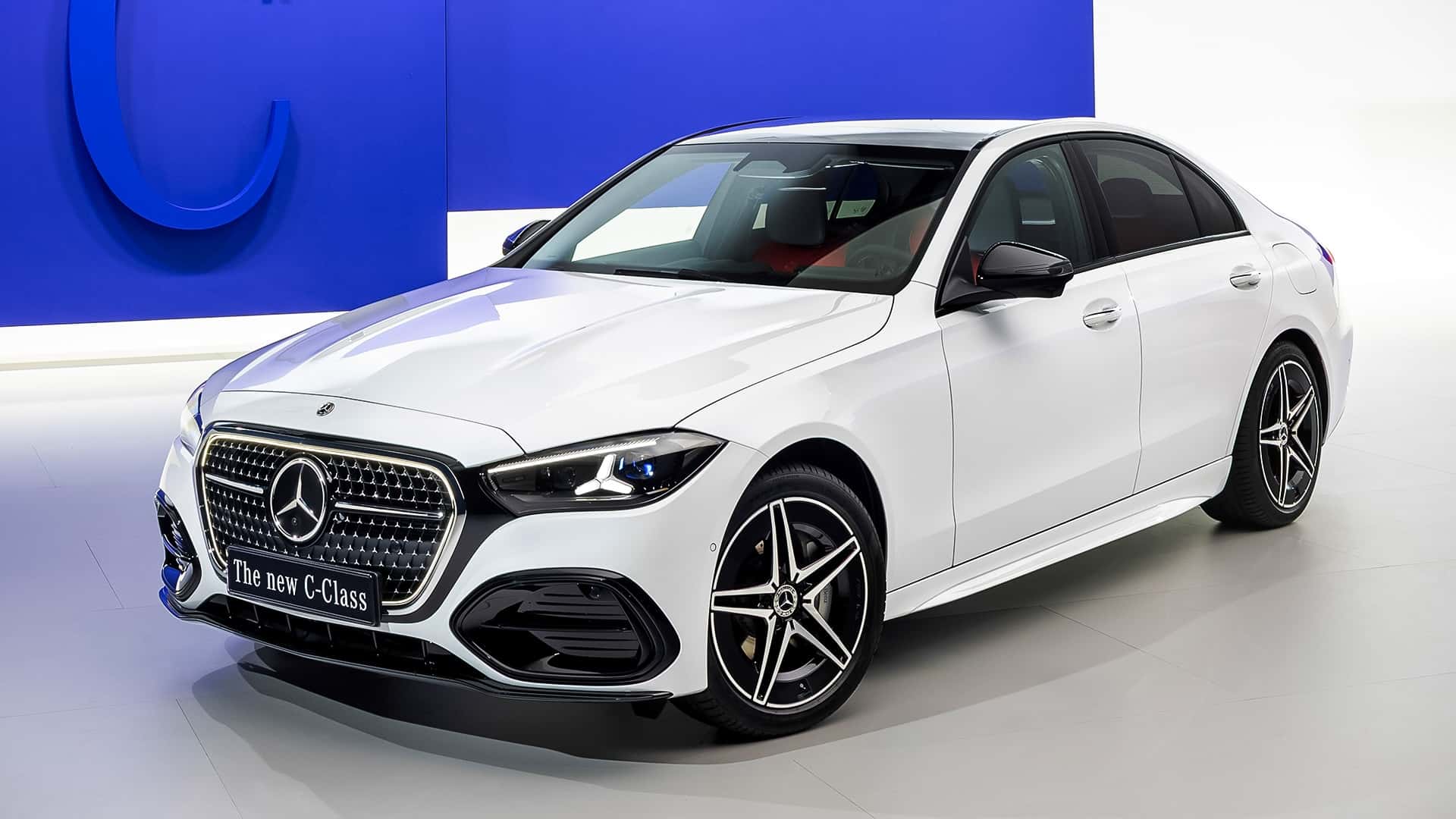
The brightest part of the refreshed Mercedes-Benz C-Class is its illuminated grille. The most important part is a small electric compressor that most owners will never see.
That is the useful way to read this 2027-model-year update. Mercedes has not reinvented its combustion compact sedan, nor has it found another 100 horsepower. Instead, it has attacked the moments when a turbocharged four-cylinder luxury car can feel least luxurious: the pause before boost arrives, the awkwardness of low-speed parking and the lag between a spoken request and a useful answer.
For U.S. buyers, the revised C-Class is due at dealers in the first half of 2027. Pricing has not been announced. The current 2026 rear-drive C 300 starts at $49,650 before destination and options, according to Mercedes-Benz USA, but that is context rather than a forecast. A facelift with more standard hardware rarely becomes cheaper.
The engine number stays put, but the response changes
The U.S.-market car retains a turbocharged 2.0-liter four-cylinder rated at 255 hp and 295 lb-ft. Those are the same headline combustion-engine figures Mercedes lists for the current C 300. The new hardware around that engine is where the story moves.
Motor1 and Carscoops report a 48-volt mild-hybrid system with an integrated starter-generator capable of contributing up to 23 hp and 151 lb-ft. A new electrically driven auxiliary compressor is intended to build response before the exhaust-driven turbo is fully awake. Mercedes also adds an overboost mode worth a reported 27 hp for roughly 20 seconds.
Those figures should not be added together as though the C-Class permanently makes 305 hp. Mild-hybrid assistance and temporary overboost are conditional contributions, not a new steady-state engine rating. The honest promise is sharper response, not an AMG transformation.
| U.S. C-Class detail | Current 2026 C 300 | Refreshed 2027 C-Class |
|---|---|---|
| Gas engine | 2.0-liter turbo four | Updated 2.0-liter turbo four |
| Gas-engine output | 255 hp | 255 hp |
| Gas-engine torque | 295 lb-ft | 295 lb-ft |
| Hybrid assist | Up to 20 hp listed by Mercedes USA | Up to 23 hp reported |
| Temporary overboost | Not listed | 27 hp for about 20 seconds reported |
| U.S. arrival | On sale now | First half of 2027 |
| U.S. price | $49,650 starting MSRP | Not announced |
This is sensible engineering for the C-Class audience. A compact luxury sedan spends far more time pulling away from lights, merging and threading through garages than chasing a lap time. If the auxiliary compressor makes the accelerator feel more immediate and predictable, it will improve every drive without turning the spec sheet into fiction.
MB.OS moves the facelift beyond new lights
The cabin retains the familiar 12.3-inch instrument display and 11.9-inch portrait center screen, but the software beneath them moves to Mercedes’ MB.OS architecture. Reporting on the announcement says the MBUX Virtual Assistant can maintain context across a conversation and draw on services from Google, Microsoft Bing, ChatGPT and Gemini.
The list of providers is less important than execution. A driver does not need four brand names glowing in the dashboard; a driver needs one request to produce the right route, temperature or audio without a menu-diving detour. The updated architecture also expands over-the-air update capability, which could make the car improve after delivery. It also creates a longer obligation for Mercedes to keep features reliable and supported.
That software emphasis echoes the broader move toward cars whose useful life depends partly on vendor support. As we noted in our look at digital ownership and the Stop Killing Games campaign, connected products need clearer expectations about what remains functional years later. A luxury-car assistant is convenient; durable basic controls and long-term service are essential.
The more immediately persuasive additions are practical. Carscoops reports eight cameras, five radar sensors and 12 ultrasonic sensors supporting the assistance suite. A 360-degree parking view is standard, while a reverse-maneuvering function can retrace part of a recently driven path. That sounds modest beside generative AI, but it is exactly the feature an owner remembers after escaping a narrow driveway without scraping a wheel.
Europe gets the broader powertrain menu
The U.S. announcement centers on the 255-hp mild hybrid. Europe gets petrol and diesel choices, an Estate body and a C 400 e 4MATIC plug-in hybrid. The PHEV is reported with 19.53 kWh of usable battery capacity, as much as 62 miles (100 km) of WLTP electric range, 11-kW AC charging and 55-kW DC charging.
WLTP range should not be treated as an EPA estimate, and Mercedes has not said that this configuration will come to America. The same regional caveat applies to rear-axle steering, which can turn the rear wheels by up to 2.5 degrees and reportedly cuts 17 inches from the turning circle.
Visually, Mercedes has leaned hard into its emblem. There are star-shaped daytime-running lights and taillights, chrome stars in the grille and an illuminated central star and surround. Optional Digital Light headlamps use micro-LED technology; Mercedes claims a larger, higher-resolution light field with up to 50 percent lower energy use than before. New bumpers, wheels and colors complete the facelift.
The star treatment will divide opinion because it is supposed to. It makes the refresh instantly identifiable without paying for new sheet metal. I would trade some of that visual insistence for more physical controls, but the underlying update is more disciplined than the face suggests.
Bottom line
The refreshed C-Class is not compelling because it glows. It is compelling because Mercedes has concentrated on response, software foundations, parking visibility and refinement while leaving a proven rear-drive sedan architecture intact.
There are still reasons to wait: U.S. pricing is unknown, the final standard-equipment list is incomplete, and no road test has yet shown whether the electric compressor genuinely smooths the engine’s behavior. Buyers who prefer simpler software may also see MB.OS as another dependency rather than an upgrade.
But on the available evidence, this is a substantive mid-cycle update disguised by a flashy grille. The 255-hp number does not change. The way the C-Class delivers its performance—and the amount of friction it removes from ordinary driving—just might.