
Friday practice spoilers follow.
Madring’s first Formula 1 Friday did something slightly more interesting than deliver the anticipated new-track chaos. It drew a line between cars that could make the circuit work and cars that merely survived it.
Mercedes made the strongest early case. George Russell led FP1 in 1:34.077, 0.286 seconds ahead of Kimi Antonelli, while Charles Leclerc and Lewis Hamilton followed for Ferrari. That front order needs its proper asterisk: the FIA says the Mercedes pair used soft tyres for their final benchmarks, whereas Ferrari’s quickest FP1 laps were on mediums. By FP2, the picture had tightened rather than settled. Cadena SER reports Antonelli first in 1:33.662, Leclerc only 0.113s behind and Hamilton a further 0.036s back, all on softs.
Those numbers are too close, and the programmes too different, to crown a favourite. They are close enough to identify the weekend’s real premium: a car that is immediately predictable at a circuit with almost no tolerance for a half-formed lap.
The quiet first hour was useful evidence
The prelude had encouraged an expectation of stoppages. Formula 3 testing had generated 19 red flags, and AS notes that Friday’s support action brought three more in F2 qualifying as well as a morning car fire. Formula 1’s opening session was different. The FIA records no red flag across FP1, with 21 of the 22 drivers setting meaningful laps and Carlos Sainz completing a session-high 30.
That does not make the track benign. It says the leading drivers and teams spent their opening hour learning in the right order: build references, understand the surface and only then ask more of the car. On a new layout, a clean session is not empty entertainment; it is the raw material for a usable setup direction.
The contrast with the support categories should be kept in proportion. Formula 1 cars, tyres and drivers are not Formula 2 or Formula 3 equivalents, and no one should turn their experience into a direct forecast. Still, the outcome matters. It gave the front-running teams more continuous running to compare tyre behaviour, ride response and energy use than a red-flag-heavy debut would have allowed.
Turn 13 put the caution back into the picture
FP2 supplied the essential correction. Arvid Lindblad was fourth quickest, within two tenths of Antonelli, before crashing at Turn 13 and causing a red flag of a little more than 10 minutes, according to Cadena SER. AS places the impact on the exit of the huge banked section and reports damage to the Racing Bulls car against the outer Tecpro barrier.
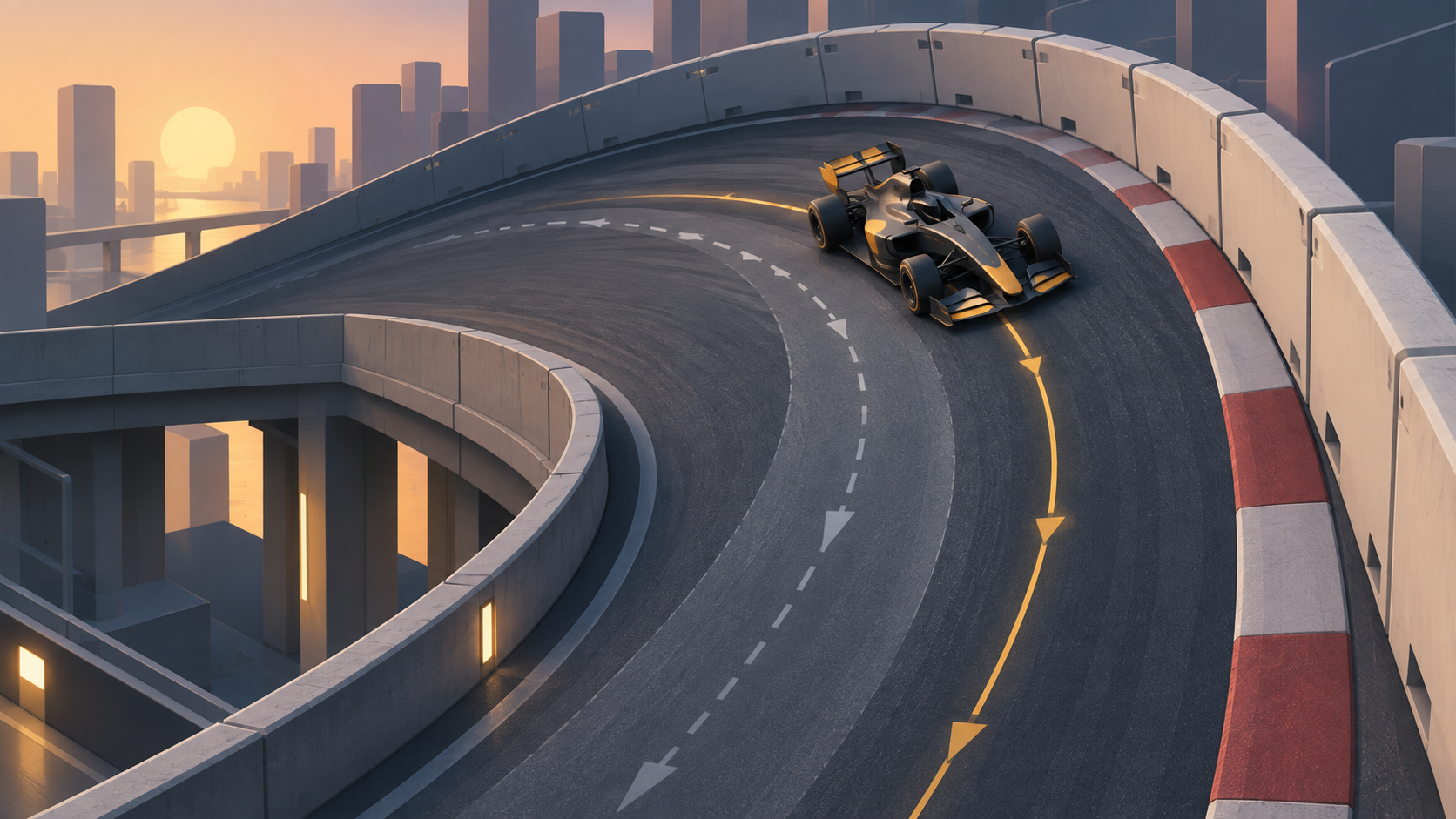
It is tempting to treat the incident simply as a rookie’s mistake. That is too easy, especially when the evidence does not establish its cause. Its value is what it revealed about the layout. Formula 1’s circuit guide describes a 5.414km, 22-corner hybrid circuit: after La Monumental’s long 24%-banked curve, the lap becomes flatter, faster and then progressively more enclosed before a tight final corner. The F1 debut has therefore validated the basic design proposition. Drivers can find serious speed here, but the passage from banking to the technical, walled section is a sequence rather than a collection of separate corners.
That is a car-control problem as much as a bravery problem. A setup that feels secure through the banking can still leave a driver with a nervous platform when the wall arrives. A driver who gives away a few centimetres on exit can lose the next braking reference. The loss is not always a crash; more often, it is a lap that cannot be repeated when the track is quickest.
Reliability has already shaped the homework
The Friday order also hides three very different workloads. The FIA reported a power-steering issue that ended Yuki Tsunoda’s FP1 early and Fernando Alonso stopping just after the chequered flag. AS and Cadena SER then reported that Alonso lost roughly the first 25 minutes of FP2 to an AMR26 clutch problem, while Lando Norris did not run in the second session because of a gearbox issue.
On an established circuit, lost Friday mileage is irritating. At Madring it is more expensive because there is no old race-weekend baseline to fall back on. Every car begins with simulation, pre-event models and drivers’ visual work, but the first day is where those tools encounter the actual grip, kerbs and traffic. Norris and Alonso have lost different amounts of track time for different reasons; neither case tells us where they will qualify. It does mean both camps have less real-world evidence on which to choose Saturday’s compromises.
That is why the Ferrari story is more interesting than the headline order. Its medium-tyre speed in FP1 and tight soft-tyre proximity in FP2 give the team a credible Friday, not a verdict. The Madring load problem we highlighted before the weekend — evolving grip combined with serious tyre and vertical loads — still needs longer runs and a full competitive session to be understood. Mercedes’ ability to begin with two clean, fast cars is just as useful, but its reward is a larger data set, not a provisional pole position.
Bottom line
Madrid’s first F1 Friday has made Madring look properly alive: fast enough to compress Mercedes and Ferrari into a few hundredths, demanding enough to punish a small loss of precision, and unfamiliar enough that a gearbox or clutch delay can alter a whole weekend’s preparation.
The clean FP1 should be read as encouraging operational discipline, not a guarantee of a quiet Grand Prix. Lindblad’s FP2 crash supplied the necessary caveat. The team that converts Friday’s promise into qualifying pace will be the one that keeps its car in the same usable window through banking, walls and changing grip — lap after lap, rather than once when the timing screen is ready.