
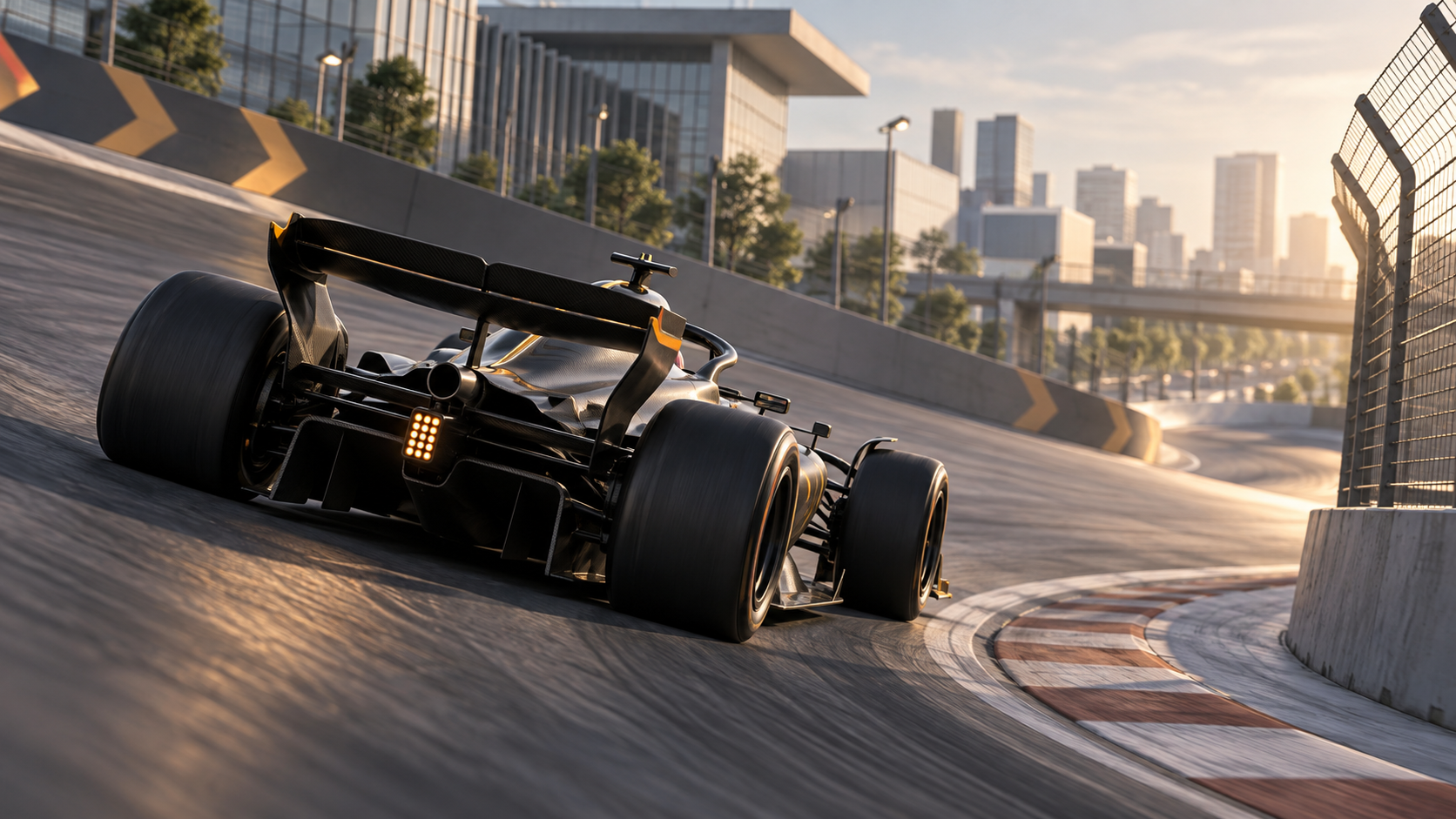
Madrid’s first Formula 1 weekend will not be decided by who has spent the most time staring at the circuit map. It will be decided by who can turn the map into a car that survives its first proper contact with reality.
Madring opens as Round 14 with all the usual new-venue intrigue: no historical setup book, fresh asphalt and a field still learning what the 2026 cars want from each circuit. But Pirelli’s pre-event work gives the weekend a sharper technical shape. It ranks the new layout among the five most demanding circuits of the season for tyre energy, and calls Turn 12 — the long, steeply banked La Monumental — the corner with the highest vertical load on the calendar.
That makes Madrid less like a conventional opening act for a new track and more like a systems test. The fastest team may be the one that best manages a strange combination: a smooth surface that could initially look gentle on tyres, sustained lateral loading that decidedly is not gentle, and a grip level that should move rapidly as Formula 1 lays rubber over a weekend.
Smooth does not mean easy
Pirelli has brought the C2, C3 and C4 compounds — hard, medium and soft — and says tyre management is likely to be a major talking point because of Madring’s smooth surface. That might sound like a recipe for a quiet one-stop race. It should not be read that way.
A new, smooth surface can reduce mechanical abrasion at the beginning of the weekend, but it also leaves teams guessing at how quickly grip will build, how much the tyres will slide before the racing line rubbers in and whether the car can stay in its temperature window through a lap that asks several different questions. The first sector is fast; the middle section combines medium- and low-speed corners; the last part contains 90-degree corners of the kind more familiar from Baku. Those phases do not reward one-dimensional setup thinking.
Then comes Turn 12. Pirelli says its banking and length create the season’s highest vertical load, while lateral forces around the circuit are comparable with Barcelona and Silverstone. A team can reduce a car’s tendency to overheat its tyres in slow corners and still discover that it has made the platform too nervous for the banking. It can chase stability through the banking and then ask too much of the fronts on Madrid’s stop-start exits.
The sensible target is not a magic setup. It is a car that does not become a different problem at every third corner.
A first weekend turns correlation into competition
Pirelli did not arrive blind. Its engineers used the final layout to model trajectories and loads, later measured the completed asphalt’s macro- and micro-roughness, and shared a technical briefing with the teams. That is serious preparation. It is not the same thing as an hour of practice with 22 cars depositing rubber, wind moving through the barriers and drivers finding which kerbs they can actually trust.
AS reports that Formula 3’s running at Madring included red flags, three damaged chassis and six broken suspensions. Its account also carries Williams team principal James Vowles’ warning about the sustained G-load through the banking and Aston Martin trackside chief Mike Krack’s view that the walls and rapid track evolution will be central to the challenge. Those are not race-result forecasts; they are the right reminders that a circuit becomes a different object once drivers start taking real margins from it.
That is why the first practice sessions matter more than their order. Everyone will be looking for the headline lap. The more valuable work may be hidden in repeatable things: whether a change in ride height calms the car without cooking a tyre, whether the rear remains predictable as grip improves, and whether the drivers can build braking references without repeatedly paying for a small error with a wall.
It is a useful sequel to Ferrari’s early Madring filming-day laps, but the competitive question has changed. A controlled promotional run could tell a team how the place looks and feels. A full Grand Prix field will reveal how the track behaves when every car is close to its limit.
The venue has to work away from the kerb, too
Madring is not merely testing new asphalt. It is testing a city-event model built around access by public transport rather than a vast perimeter of spectator parking. The promoter’s mobility plan divides the venue into separate North and South zones without a pedestrian connection between them, with ticket-specific access advice, strengthened Metro and Cercanías services, 15 pre-screening areas, 18 access points and more than 150 entry lanes.
That operational detail belongs in the story because a new Grand Prix earns its place through more than a good television shot of a banked corner. Formula 1 and the FIA can sanction a date; the event still has to move people safely and predictably through an unfamiliar, split-site venue. The promoter says the cars will take to the circuit for the first time from September 11 to 13. The circuit’s first judgement will therefore be simultaneous: on track, at the gates and across the transport network.
Madrid has the raw ingredients for a memorable debut. La Monumental gives the layout a feature no other venue can quite copy, while the mix of fast commitment, walls and low-speed exits should keep engineers busy. The caveat is equally obvious. New circuits can produce excellent racing, but they can also punish shallow preparation and make an early red flag the dominant storyline.
Bottom line
The Madrid Grand Prix is not a mystery because no one has seen the track. Teams have simulations, Pirelli has load models and Ferrari has already put a Formula 1 car on the venue during a filming day. It is a mystery because none of that substitutes for a live weekend on a new surface with tyres, traffic, evolving grip and cars loaded to the edge of their operating window.
Pirelli’s top-five energy warning is the clearest clue. Madring’s debut should reward discipline more than theatre: a stable car, tyre temperatures kept under control, and a team that learns quickly enough to avoid being surprised by the circuit it came to inaugurate.