
Race spoilers follow.
Madring has not waited for a second race to identify the problem with its first. The Spanish Grand Prix’s organisers say they will work on changes for 2027 after Formula 1’s debut in Madrid made one weakness plain: an impressive qualifying lap does not automatically make an enjoyable Grand Prix.
That is more meaningful than the usual post-event promise to “review” things. Luis García Abad, the event’s managing director, told Autosport that the FIA had made clear how the layout could improve and that the promoter was open to acting when the temporary circuit is installed next year. El País separately reports the same direction of travel: more opportunities to attack are now a specific objective, rather than an abstract wish.
It is the right diagnosis. Madring’s opening weekend had visual scale, a bold banked corner and the useful uncertainty of a new venue. Its 5.4km, 22-turn layout also produced exactly the race-weekend warning its pre-event briefings had foreshadowed: cars could get close, but too often arrived at the critical braking zones already committed to a single-file line. The FIA’s race report records the VSC and strategic split that shaped the podium; it does not turn that unusual interruption into evidence that the circuit itself offered a healthy supply of passing.
The fix is not simply “add a straight”
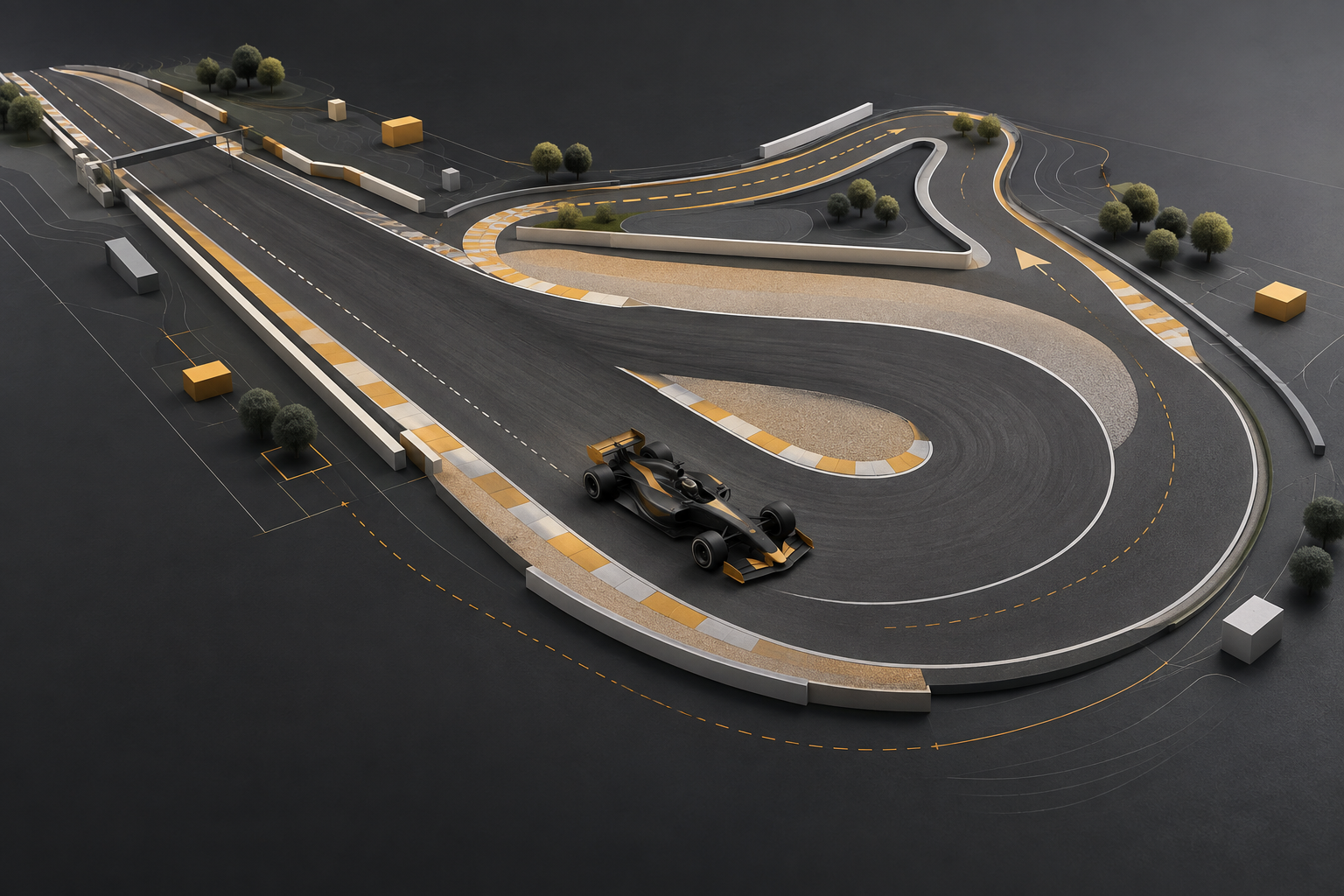
The easy response to a quiet race is to demand more top speed. That misses the geometry of racing. A useful overtaking zone needs three things working together: a meaningful approach, a braking point wide enough for a defending car and an attacking car to choose different lines, and an exit that does not immediately funnel the pair back into one narrow trajectory.
Madring’s intended opportunity after its longest straight ran into the awkward Turn 5 sequence. As the official circuit guide showed before the weekend, the track mixes a heavy braking zone with elevation change and a blind apex. Those features can be thrilling for one lap. In a pack, though, braking while turning is a gift to the leader: the car behind has less scope to brake later without either running wide or compromising the next corner.
This is why a hairpin is not automatically a cure, either. The goal is a contestable corner—a late, broad entry with enough run-off or usable width for one driver to defend the inside and another to carry a different arc. That is the difference between a genuine attempt and a move that exists only in a simulation.
A temporary circuit has an unusual advantage
Most circuits must work around permanent grandstands, drainage, access roads and decades of heritage. Madring is partly assembled for the event, and García Abad’s point that the promoter has both space and the ability to reinstall the venue matters. It gives Madrid a chance that many established tracks do not: it can treat its first race as a prototype rather than a final verdict.
That should not become a blank cheque for constant redesign. The circuit’s high-speed sections and La Monumental banking are part of its identity, and they gave drivers a demanding lap. The sharper brief for 2027 is to preserve that character while making one or two places where a driver can turn pressure into position. A stronger entry to Turn 5, a reworked 5–7 complex, or a more generous braking zone elsewhere would be more valuable than a wholesale redraw.
Our first-weekend analysis argued that Madring would make execution unusually visible. The race reinforced the other half of the equation: if the layout makes track position nearly absolute, execution turns into conservation. The action moves to pit timing and neutralisations—not because strategy is uninteresting, but because the drivers are denied enough tools to alter the order themselves.
The test for 2027 is simple
The best sign of progress will not be a headline number of passes inflated by first-lap chaos or tyre offsets. It will be whether a quicker car can draw alongside under braking, choose an alternative line and still have a legitimate chance through the following corner.
Madring’s first Grand Prix earned credit for arriving with a recognisable challenge and strong facilities. Now it has the more exacting job: converting that challenge into racing room. The organisers’ willingness to change the layout is encouraging. The value of the promise will be decided by whether its next version gives Formula 1 somewhere real to fight.