
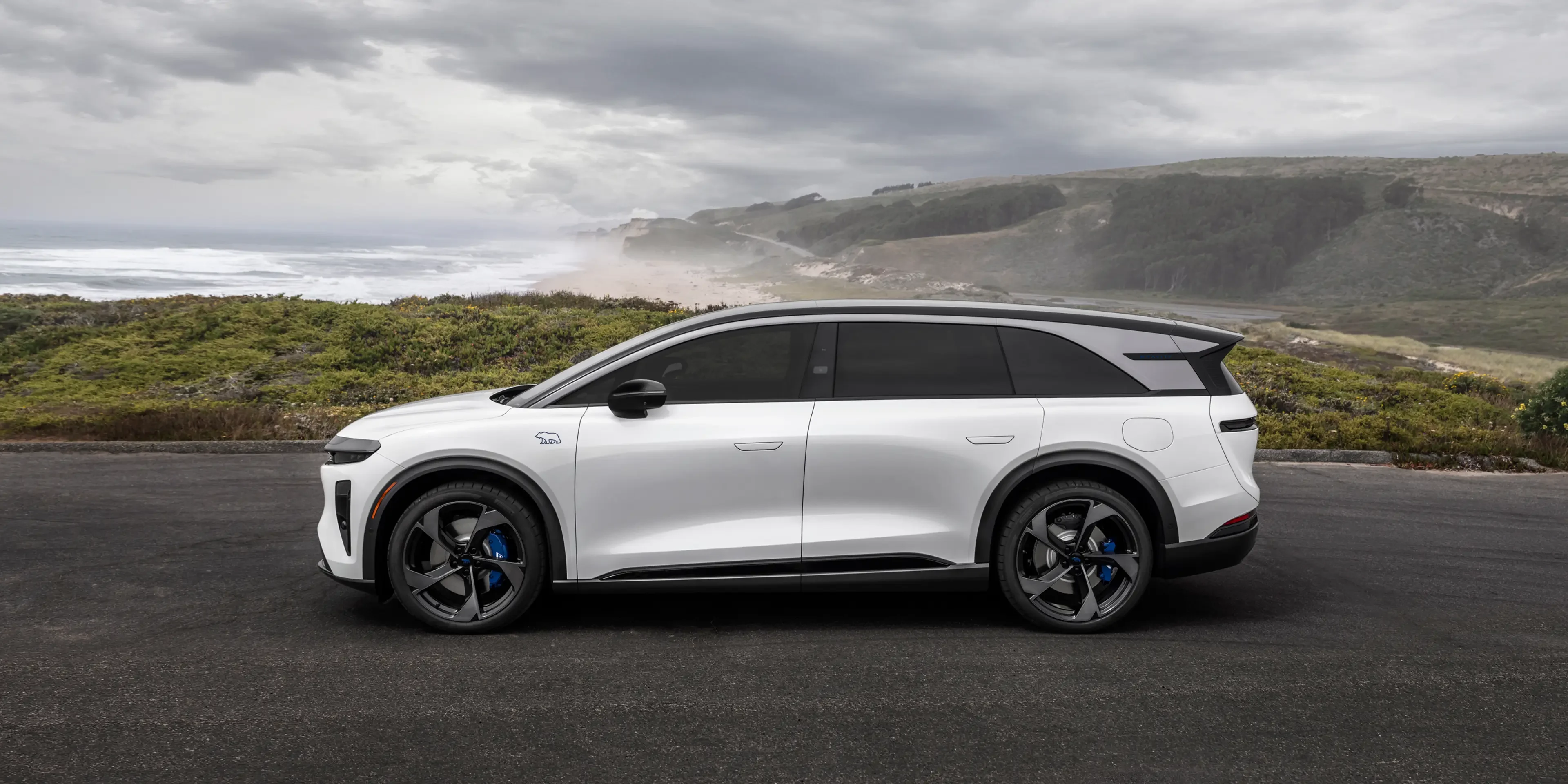
The Lucid Gravity GT-S sounds ridiculous in the way only modern electric performance cars can sound ridiculous: 1,070 horsepower, three rows, 0-60 mph in 3.1 seconds and enough family-SUV packaging to make the number feel almost impolite.
Lucid announced the GT-S on August 13 ahead of its Monterey Car Week debut, positioning it as a Sapphire-inspired performance version of the Gravity. Orders are open in the United States. The official starting price is $125,900 before tax, title, license, options, destination and documentation fees. Lucid lists destination and delivery at $1,850, which is why Car and Driver’s all-in starting figure lands at $127,750 before other options.
My read: this is Lucid at its most Lucid. The company is not trying to make an electric SUV merely quick. It is trying to make the family vehicle feel like an engineering flex: space, software, suspension, packaging and absurd acceleration all occupying the same driveway.
That is relevant because the premium EV market is moving past the old party trick. Instant torque is no longer special by itself. The useful question is whether an EV can be fast without becoming silly, spacious without becoming numb, and expensive without feeling like it exists only to impress a valet.
The GT-S numbers
Lucid’s official release supplies the core figures, and its Gravity specification page gives the lineup context.
| Lucid Gravity trim | Model year | Starting price before destination | Max power | 0-60 mph | EPA-estimated range |
|---|---|---|---|---|---|
| Touring | 2027 | $79,900 | 560 hp | 4.0 sec | Up to 337 mi |
| Grand Touring | 2027 | $98,900 | 828 hp | 3.4 sec | Up to 450 mi |
| GT-S | 2027 | $125,900 | 1,070 hp | 3.1 sec | Not yet listed on Lucid’s comparison table |
The missing range figure for GT-S matters. Lucid says Gravity overall offers up to 450 miles depending on configuration, but the live comparison table does not list the GT-S range where the Touring and Grand Touring figures appear. Until Lucid publishes the GT-S EPA estimate, any assumption that the performance trim keeps the Grand Touring’s range would be too generous.
What is confirmed is the hardware direction. GT-S gets Lucid’s Dynamic Handling Package as standard, including independent rear-wheel steering and adaptive three-chamber air suspension. Lucid says the air suspension lowers the vehicle at speed. The design changes are more restrained than the power figure: blue exterior accents, blue brake calipers, blue stitching, blue seatbelts, a blue steering-wheel marker and Lucid Bear embossing on the front headrests.
The family-car part is the point
The easy joke is that no parent needs 1,070 hp for a school run. True. Also irrelevant.
Performance SUVs have never been about need. They are about the strange emotional bargain buyers make when they want one vehicle to do too much: commute, carry children, haul gear, look expensive, embarrass sports cars and still be calm enough for a rainy Tuesday.
Lucid’s advantage is that Gravity was already a packaging story before GT-S arrived. The standard Gravity pitch is room for up to seven adults, up to 120 cubic feet of cargo space depending on configuration and a long-range electric platform that does not treat efficiency as an afterthought. We have been watching the same tension across EVs all summer, from GM and LG restarting Ohio battery production to Rivian’s R2 production ramp: the EV market is not short on ambition, but it rewards vehicles that make a practical argument.
GT-S makes Lucid’s practical argument louder. Maybe too loud. But that is part of the charm.
Where the price lands
The GT-S is expensive, but it is not priced like the Air Sapphire halo sedan. That is the quiet strategy here. Lucid appears to be borrowing some Sapphire theater without turning Gravity into a quarter-million-dollar collectible.
Motor1, Car and Driver, Road & Track and Autoweek all landed on the same basic framing: this is the Dream Edition’s huge-power idea returning as a normal performance trim, with handling hardware and a Monterey-friendly look. That makes the GT-S easier to understand. It is not a limited launch trophy. It is a new top rung in the Gravity lineup.
The tradeoff is obvious. A $125,900 starting price before destination still asks buyers to believe deeply in Lucid’s brand, service footprint and long-term execution. That is a bigger ask than loving the spec sheet.
What needs proof
Launch specs are promises. A 1,070-hp three-row SUV creates three real-world questions.
| Question | Why it matters |
|---|---|
| How repeatable is the performance? | Big EV power can fade if thermal management is not excellent. |
| What is the GT-S range? | Buyers need to know the cost of the extra power. |
| Does rear-wheel steering make it feel smaller? | A huge SUV can be fast and still feel awkward on tight roads. |
| How calm is the ride on 22- or 23-inch wheels? | Luxury SUVs live or die in normal driving, not just launch control. |
Until independent reviews test production cars, the GT-S should be treated as a gorgeous, expensive claim. A very credible claim, but still a claim.
Bottom line
Lucid Gravity GT-S is interesting because it refuses to separate the sensible EV from the theatrical one. It wants to carry a family, swallow cargo, turn sharply, ride expensively and run to 60 mph like a supercar.
That is excessive. It is also exactly the kind of excess that gives a young carmaker a personality. If Lucid can back up the numbers with range, ride quality and reliability, the GT-S could become the first Gravity that people remember by name.