
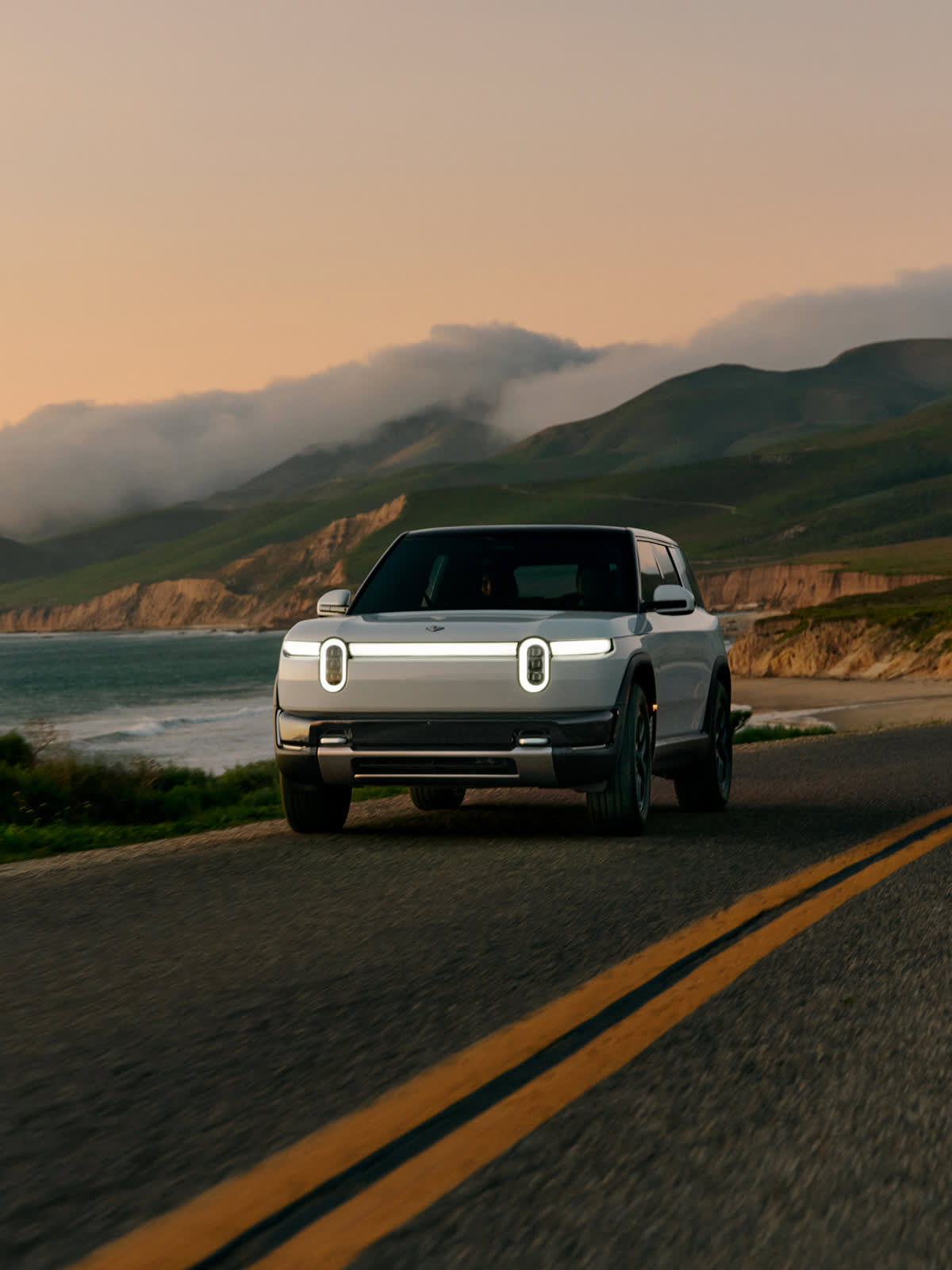
Rivian’s R2 is no longer just the pretty midsize SUV that saved the investor deck. It is becoming factory work.
That is the useful signal behind the second-shift news from Normal, Illinois. InsideEVs and local WMBD reporting, republished by AOL, say Rivian is preparing to add another shift by the end of the third quarter as it tries to increase R2 output. Rivian’s own second-quarter materials put the bigger context around that move: R2 deliveries began in the quarter, revenue rose to $1.658 billion, the company reported $179 million of gross profit, and management pointed to R2 as the product that can carry long-term growth.
GearPulse’s read: this is relevant because the R2 is Rivian’s Model 3 moment, just in SUV form and in a much rougher EV market. The vehicle already has the shape, personality and price ladder to attract people who admire Rivian but never seriously considered a six-figure R1S. Now the question becomes less romantic: can Rivian build enough of them, at the right cost, without burning through the patience that got it this far?
What changed at Normal
Rivian has used its Normal plant as the bridge between the expensive R1 era and the broader R2 era. The R2 was designed around that reality. It is smaller, simpler and less exotic than the R1S, but it still needs to feel like a Rivian rather than a cost-cutting exercise.
The second shift matters because production ramps do not become real in press photos. They become real when staffing, suppliers, quality checks, software readiness, service capacity and logistics all survive repetition.
| Piece of the ramp | Current signal | Why it matters |
|---|---|---|
| Factory | Normal, Illinois adding R2 capacity | Rivian needs volume before Georgia adds more scale later. |
| Product | R2 deliveries began in Q2 2026 | The SUV has moved from launch promise to customer reality. |
| Demand signal | Rivian says it hosted a record number of demo drives in Q2 | Interest is useful, but deliveries and margins decide the business. |
| Cash pressure | Rivian still reported a large quarterly net loss | The ramp has to improve the business, not just the showroom. |
| Future capacity | Georgia remains part of the long-term production plan | Normal has to carry the near-term transition. |
The personal part of this, at least for EV watchers, is that Rivian is one of the few American EV brands that people still want to root for without needing a tax-law lecture first. The R1T and R1S made the brand desirable. R2 has to make it durable.
Why R2 is the right kind of pressure
The official R2 page positions the SUV around five-seat practicality, thoughtful storage, software-first ownership and adventure-friendly design. Rivian lists useful family-SUV details such as a 40/20/40 folding rear seat, generous rear-seat space and total storage volume that makes the R2 feel more like a real daily vehicle than a lifestyle prop.
That is the charm. The R2 is not trying to be the fastest, weirdest or most luxurious EV in America. It is trying to be the Rivian that normalizes Rivian.
Independent reviews and launch coverage add the sharper context. Car and Driver’s test coverage praised the R2’s capability and positioning while placing it squarely against mass-market electric crossovers. Business Insider framed the launch road map around staged trims and pricing, with higher-spec early models arriving before the lowest-priced versions.
That sequencing is normal in the car business, but it creates a trust gap. Early R2s may show what Rivian can build. Later, less expensive R2s have to prove Rivian can keep the promise that made the vehicle matter in the first place.
| Reader question | What looks encouraging | What still needs proof |
|---|---|---|
| Is R2 desirable? | The design is clean, the size is right, and early reviews are warm. | Demand must stay strong after the launch crowd is served. |
| Is it affordable enough? | Rivian has a lower-price road map than the R1 family. | The most attainable trims are not the first versions most buyers see. |
| Can Rivian scale it? | A second shift suggests the factory is moving. | Quality and margin discipline matter more than press-release volume. |
| Is it a Model Y rival? | The format is exactly where the market lives. | Tesla’s cost structure, charging familiarity and scale are still brutal advantages. |
The risk is not only demand
The lazy version of the R2 story is that Rivian finally has the right product, therefore the hard part is over. That is backwards. The right product is what allows the hard part to begin.
Rivian’s Q2 release still shows the financial strain. The company improved several operating measures, but it also reported a large net loss and heavy cash use. It noted inventory buildup tied to the R2 launch. That is not automatically bad. A vehicle ramp consumes cash before it pays back. But it does mean the next few quarters will be judged with less romance.
The company also has to manage expectations around autonomy, software, service and long-term manufacturing capacity. Rivian’s forward-looking discussion mentions future autonomy systems, AI-supported architecture, the Volkswagen joint venture and Uber-related robotaxi plans. Those may become valuable, but R2 buyers first need the basics: a good SUV, delivered when promised, serviced without drama and updated without making owners feel like unpaid beta testers.
This is where the story connects to recent GearPulse EV coverage. Toyota’s electric Hilux was interesting because it priced an EV like a tool. Walmart’s charging rollout mattered because infrastructure has to meet drivers where they already stop. Rivian’s R2 sits in the same practical lane: the EV market needs fewer halo objects and more products that feel easy to recommend.
Why buyers should care now
If you are considering an R2, the second-shift signal is encouraging but not a green light by itself. It suggests Rivian is preparing for more volume. It does not tell you final delivery timing for your configuration, real-world service availability in your area, insurance cost, lease terms, long-distance charging habits or how early-build quirks shake out.
The sensible move is to treat early owner data as seriously as early reviews. Watch for build quality, software bugs, charging-curve consistency, service appointment delays, winter range and how quickly Rivian addresses recurring issues.
That sounds cautious because it should. Buying from an ambitious EV company is partly a product decision and partly a confidence decision. The R2 gives Rivian its best argument yet. The factory has to keep backing it up.
Bottom line
The R2 ramp is exciting because it gives Rivian a credible path from admired niche brand to serious American EV maker. The second shift at Normal is not glamorous, but it is exactly the kind of unglamorous detail that matters.
My take: R2 is the Rivian I would watch most closely this year. Not because it is flawless, and not because the company has suddenly solved the economics of EV manufacturing. Because it is the first Rivian that looks capable of turning affection into scale.
That is a rare thing in the current EV market. Now Rivian has to build it, again and again, with fewer excuses each quarter.
Support independent GearPulse articles at buymeacoffee.com/gearpulse.site.