
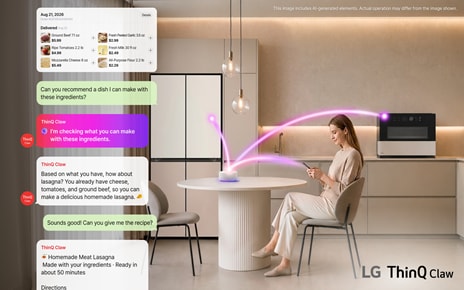
The smart home has spent years asking people to think like junior systems administrators. Pick a trigger, select a device, create a scene, diagnose why the scene failed, then quietly stop using it when life changes. LG’s newly announced ThinQ Claw is interesting because it aims at that awkward layer, not because it adds another chat box to an appliance app.
LG says it will demonstrate the text-chat agent at IFA 2026 in Berlin, which runs September 4–8. The company describes ThinQ Claw as an AI Home experience that can interpret an intent and its context, then coordinate connected devices and services. In its examples, a grocery purchase can become a recipe suggestion, a calendar event can prompt a departure routine, and a return home can prompt a comfort adjustment.
That is a promising direction. It is also, at this stage, a demonstration rather than a product promise. LG has not announced a consumer launch date, price, supported countries, a full device-compatibility list, or the precise permissions and review steps behind these actions. Those omissions matter more than the chatbot’s name.
The useful change is from rules to outcomes
The distinction sounds small, but it is the whole story. Traditional home automation asks for an instruction: at 7 p.m., turn on this light. LG is proposing an outcome: we are leaving for the weekend.
| Old smart-home job | ThinQ Claw’s claimed alternative | What still needs proving |
|---|---|---|
| Build a scene from triggers and actions | Describe the situation in text | Whether it chooses the right actions consistently |
| Keep schedules current | Use routine, calendar and home context | How much data is accessed and how permission works |
| Juggle separate appliance controls | Coordinate relevant devices and services | Which brands, services and regions actually work |
| Discover a failed automation afterward | Make proactive suggestions | Whether suggestions are helpful rather than intrusive |
That outcome-first approach is why Xataka’s independent coverage sees a possible shift away from programming the home manually. Newsis, meanwhile, reports the IFA debut as a chat-based AI-home agent rather than a conventional new appliance. Both readings get at the same audience relevance: the valuable audience is not people who want to talk to a refrigerator; it is people who gave up on making their connected devices cooperate.
LG has a credible foundation for trying it. Its IFA presentation is built around Homey, the multi-brand smart-home platform developed by Athom, which LG acquired in 2024. The company says the demo will include smart meters, solar panels, home batteries and EV chargers as well as LG appliances. That potentially makes ThinQ Claw more consequential than another app feature: energy coordination is where a well-timed automation can be genuinely useful.
Context is the feature—and the privacy challenge
LG’s own examples depend on unusually personal inputs: schedules, routines, grocery purchases, appliance usage, indoor conditions and preferences. A home agent cannot anticipate much if it knows nothing. But the more it knows, the more clearly a user needs to see what it knows, what it can do, and what it will do next.
The announcement says LG Shield applies across the ecosystem and calls the experience secure. That is a useful commitment, not yet a complete answer. Before treating ThinQ Claw as a buying reason, GearPulse would want four practical details:
- A device-and-service compatibility matrix, including whether the agent works beyond LG hardware.
- Explicit confirmation before consequential actions, especially energy, security and purchase-related tasks.
- Clear retention, sharing and deletion controls for conversational and household data.
- A plain fallback when a service is offline or the agent misunderstands a request.
This is familiar territory for the category. As we noted in our look at robot-vacuum value, home devices earn their place through dependable, legible behavior—not merely a clever feature list. An agent that saves a few steps but leaves its decisions opaque will make a home feel less calm, not more intelligent.
Do not confuse an IFA demo with availability
LG is specific about the event and the concept, but deliberately early on the consumer details. ThinQ Claw will be shown in LG’s AI Home Zone at IFA; ThinQ Pro, a separate management offering for multi-family and commercial settings, is also slated for a European debut. Neither statement establishes when a household can download ThinQ Claw, what it will cost, or what setup it requires.
That caveat is not nit-picking. Smart-home products often arrive in a smaller set of markets or integrations than the keynote suggests. Dynamic energy tariffs, for example, differ widely by utility and country; LG itself notes that results vary with local conditions and tariffs. A capable demo involving solar, batteries and an EV charger is not the same as a turnkey system in every home.
Bottom line
ThinQ Claw has the right target. The most stubborn smart-home problem is not connecting devices; it is translating ordinary life into reliable automation without asking a household to become its own IT department. A conversational layer could help, if it treats intent carefully and remains transparent when the answer is uncertain.
For now, this is a sharp IFA announcement rather than a recommendation to buy anything. The signal worth watching is whether LG follows the demo with mundane but decisive specifics: compatibility, geography, permissions, price and a way to say no. If it does, ThinQ Claw could make the smart home feel less like a dashboard and more like a useful household tool.
Support the site at buymeacoffee.com/gearpulse.site.