
Kimi K3 is the kind of AI release that makes the room go quiet for a second.
Not because every claim should be swallowed whole. They should not. Moonshot AI’s own material is dense with benchmark caveats, third-party harness notes, model-specific setups and pending technical-report promises. The full weights are also not due until July 27, 2026, so the open-model story is still partly a promissory note.
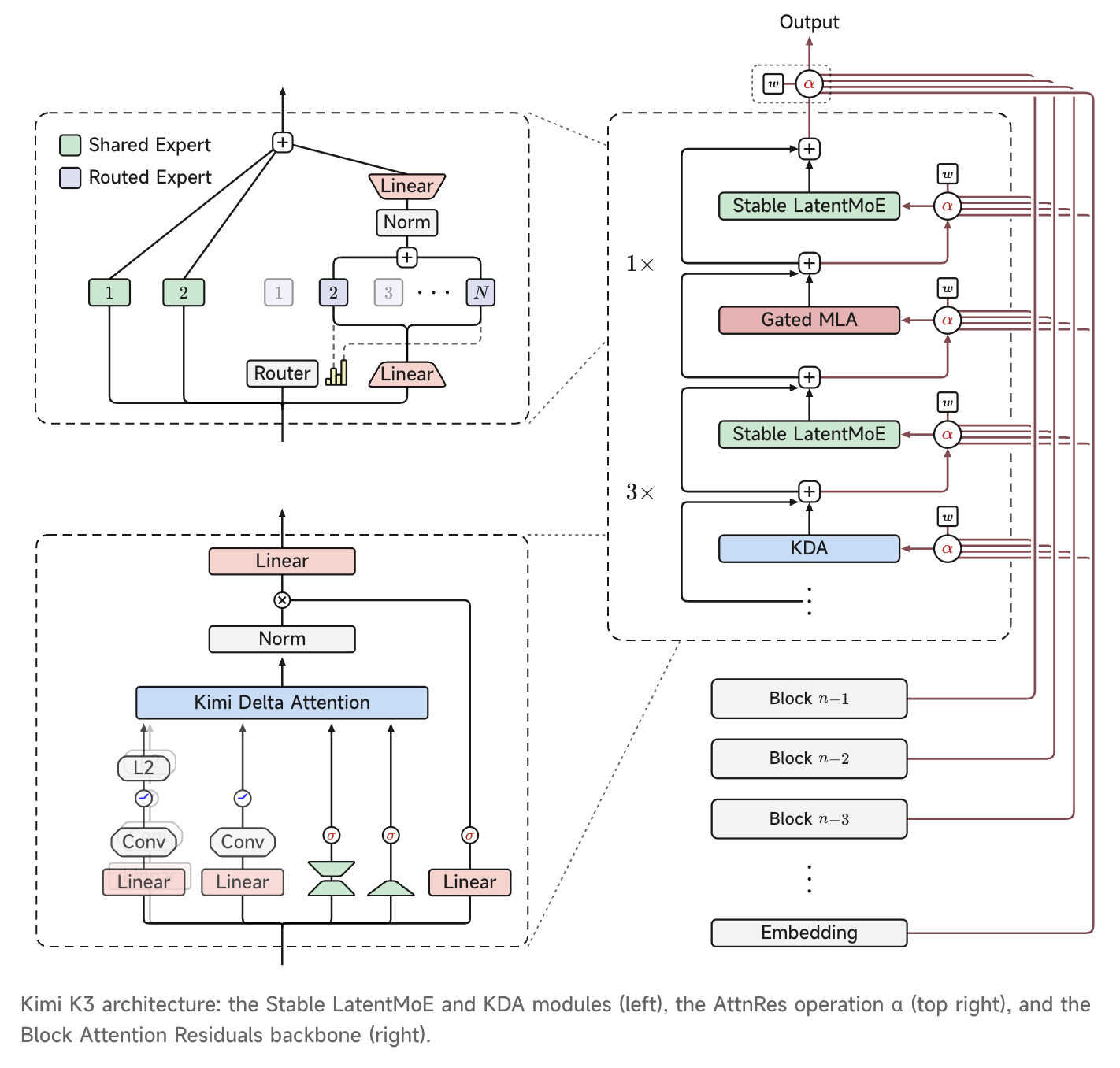
But the shape of the release is hard to ignore. Kimi says K3 is a 2.8-trillion-parameter open 3T-class model with native vision, a 1-million-token context window, 16 active experts out of 896, Kimi Delta Attention, Attention Residuals and official API pricing that runs from $0.30 per million cache-hit input tokens to $15 per million output tokens.
GearPulse’s read: Kimi K3 matters because it turns frontier AI from a prestige race into a negotiation. If a company can get most coding, research and knowledge-work tasks from a cheaper open-weight system, the most expensive closed model has to justify every trip to the invoice.
That connects directly to what we covered yesterday in NVIDIA Vera Rubin. NVIDIA is preparing for agents that need constant post-training. Kimi K3 is the other side of that pressure: buyers want capable agents without treating every internal workflow like a frontier-lab moonshot.
What Kimi is actually offering
Moonshot’s official blog says Kimi K3 is available now through Kimi.com, Kimi Work, Kimi Code and the Kimi API. The company says full weights will be released by July 27, with more architecture, training and evaluation detail to come in a technical report.
The interesting part is not only the parameter count. It is the way Moonshot is packaging the model for agent work.
| Kimi K3 claim | Why it matters | Caveat |
|---|---|---|
| 2.8T total parameters | Puts K3 in a scale class usually associated with the biggest closed models. | Total parameters do not equal active compute or real user quality. |
| 16 of 896 experts active | Lets a huge MoE model run more selectively. | Routing quality and infrastructure still decide actual efficiency. |
| 1M-token context | Makes large repositories and document corpora more plausible. | Long context can still become expensive, slow or messy without retrieval discipline. |
| Native vision | Useful for UI, CAD, screenshots and multimodal agent loops. | Vendor demos need independent reproduction. |
| Full weights due July 27 | Could make serious local or hosted customization possible. | The release is not complete until the weights and report are public. |
Kimi’s own limitations section is unusually useful. It warns about sensitivity to thinking-history handling, excessive proactiveness in ambiguous tasks and a remaining user-experience gap versus Claude Fable 5 and GPT-5.6 Sol. That is exactly the right kind of caution for an agentic model. Raw capability is not enough if the model improvises past the guardrails.
The price pressure is the point
The headline number gets the attention, but pricing is where the business story gets sharper.
Moonshot’s API docs list $0.30 per million tokens for cache-hit input, $3 per million for cache-miss input and $15 per million output. It also claims a cache-hit rate above 90% in coding workloads through Mooncake’s disaggregated inference architecture.
Those figures need real-world confirmation. Cache behavior depends on workload shape, prompt reuse, codebase churn and vendor implementation. Still, the pitch is obvious: long-running coding agents are only interesting at scale if teams can afford to let them run, fail, inspect, retry and improve.
That is why Axios framed the broader market shift around cheaper, customizable Chinese open-weight models. Most company work is not a heroic one-shot reasoning problem. It is code cleanup, test writing, data extraction, support triage, report drafting and internal workflow glue. A model that is “good enough” and far cheaper can be more disruptive than a model that wins the last five percent of leaderboard prestige.
This is not a free pass for hype
There are three reasons to stay sober.
First, Kimi’s strongest claims are still mostly vendor claims. Tom’s Hardware notes the same basic tension: K3 looks technically significant, but full independent testing has to wait for the full release. Benchmarks run through different harnesses can measure different products as much as different models.
Second, the geopolitics will not stay in the background. AP and Axios both place Kimi K3 inside a wider US-China AI race, with open weights, export controls, distillation accusations and enterprise dependence all tangled together. That matters for developers because “can we run it?” is only one question. “Can we legally, safely and reputationally build on it?” is another.
Third, agent behavior matters more than demo charisma. Kimi itself says K3 may act too proactively when intent is ambiguous. For a coding assistant, that can mean useful initiative. For a production agent with credentials, deploy access or customer data, it can be a serious control problem.
| Buyer question | Sensible answer before adopting K3 |
|---|---|
| Is it cheaper than top closed models? | Likely for many API paths, but measure your own cache hit rate and output volume. |
| Is it open today? | Access is live, but full weights are promised for July 27. |
| Can it replace a premium model? | Maybe for routine coding and knowledge work; not proven for every high-stakes workflow. |
| Is it safe to deploy as an autonomous agent? | Only with explicit permissions, logs, evals, rollback paths and human review. |
Why developers should care
The personal part of this story is simple: a lot of developers are tired of AI model choices feeling like luxury car shopping.
You want the agent to read the repo, understand the issue, write tests, explain the tradeoff and stop before it does something foolish. You do not want to build your entire workflow around whichever closed model has the highest price and the most dramatic launch video that week.
Kimi K3 does not magically solve that. But it makes the choice more interesting. If open-weight systems get close enough for real engineering chores, teams can split work more intelligently: cheaper open models for bulk iteration, premium closed models for hard review, security-sensitive reasoning or tasks where the extra reliability is worth the cost.
That is not “full AI communism.” It is normal platform competition arriving in a market that badly needs it.
Bottom line
Kimi K3 should be treated as a serious model release with unfinished proof, not as a miracle.
The full weights, independent benchmarks, real API behavior and enterprise governance questions still matter. But the direction is clear. Frontier AI is becoming less of a single-vendor trophy and more of a price-performance argument. For developers and companies, that is good news. The more credible options exist, the harder every model provider has to work for the next token.