
The exciting phrase is “roads that charge EVs while they drive.” The credible phrase in Honda’s new announcement is much plainer: start with commercial vehicles, then prove the road survives.
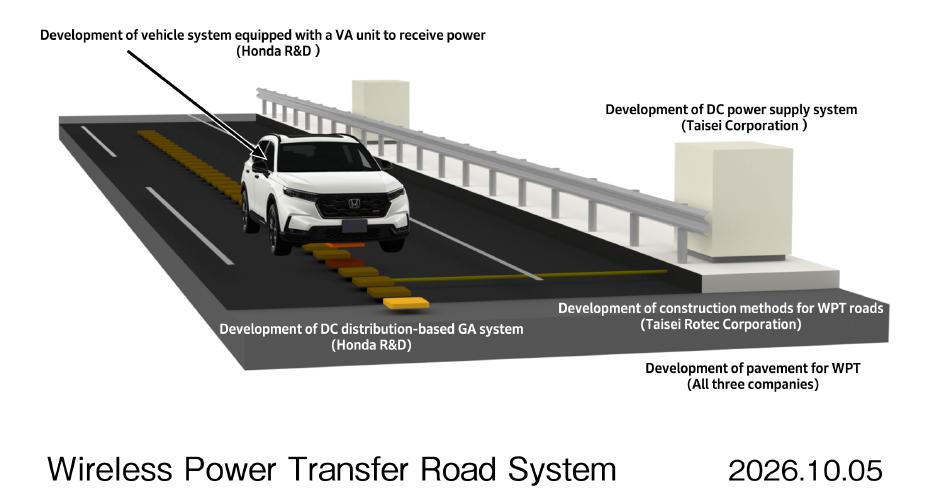
Honda R&D, Taisei and Taisei Rotec say they have developed the underlying technology for a magnetic-coupling wireless-power-transfer road system. A vehicle-mounted receiver draws energy from equipment embedded under the road surface without a physical connection. Their next milestones are a test roadway late this year and public-road demonstration work from Japan’s 2027 fiscal year, which begins April 1, 2027.
That is not a consumer launch, a promised range figure, or proof that an ordinary family EV will soon charge itself down the motorway. It is a road-infrastructure programme. And that is why its stated focus on logistics is the most interesting part of the story.
GearPulse’s take: dynamic charging makes the most sense where vehicles repeat routes, carry heavy batteries and lose money while parked. That describes trucks and commercial fleets far better than the private-car fantasy usually attached to charging roads.
The claim, stripped of the sci-fi gloss
Honda says its system combines its transmitting and receiving equipment, compatible with DC distribution, with Taisei’s high-response DC power system and Taisei Rotec’s road-embedding construction method. The companies began their joint work in 2025. Honda says it has been researching dynamic wireless power transfer since 2021.
The planned test programme is refreshingly physical. At Taisei Group’s T-FIELD/TAMURA facility, the partners intend to test the pavement under an equivalent of one million wheel loads at 49 kN per wheel, evaluate power transfer with actual vehicles, and assess electromagnetic-field leakage measures. They also plan to evaluate output of up to 150 kW for large commercial vehicles and reliability at higher speeds.
| What is confirmed | What it means | What is not yet proved |
|---|---|---|
| Magnetic coupling between road and vehicle hardware | The vehicle can receive energy without plugging in. | Real-world transfer efficiency across weather, debris, ride height and alignment. |
| Test track construction from late 2026 | The partners are moving beyond lab and component work. | A durable, maintainable public-road installation. |
| Up to 150 kW targeted for future verification | The programme is thinking about commercial-vehicle power, not only small cars. | Sustained 150 kW delivery in moving traffic or the impact on a truck’s energy use. |
| Public-road demonstrations from fiscal 2027 | There is a defined next step, including the Tateyama Expressway project in Chiba. | Cost, operating model, standards and a route to commercial deployment. |
EV Engineering & Infrastructure, Nippon.com/Jiji Press and electrive independently report the same broad plan: road-embedded charging, an expressway-oriented public trial after fiscal 2027 begins, and a practical target in freight and transport. That agreement makes the timeline credible as a development plan. It does not turn it into a finished network.
Why trucks are the sensible first bet
For a personal EV, putting power in the road is an extravagant way to avoid a charging stop. Most privately owned cars sit still for long stretches and can recover energy at home, work or a fast charger. The better question is usually whether the driver has convenient access to a reliable plug.
For a delivery truck, bus or shuttle that repeats a corridor, the calculation changes. Battery capacity displaces payload, depot charging windows can be tight, and long stationary fast-charge stops take a vehicle out of service. A short electrified segment on a predictable route could deliver value even if it never becomes a nationwide blanket of powered asphalt.
That is the important distinction. Dynamic charging need not provide every kilowatt-hour a vehicle consumes to be useful. It could help a fleet reduce the battery reserve it must haul around, smooth energy use on a steep or congested segment, or keep a vehicle working through a demanding duty cycle. Those are fleet-operating questions, not showroom magic tricks.
Honda’s public description aligns with that logic: it says it first aims for practical use in logistics and transportation, where it expects the benefit to be highest. This is a more disciplined premise than treating the technology as a universal replacement for ordinary fast-charging stops.
The road is now part of the charger
A conventional DC fast charger is an expensive piece of equipment, but it is still a discrete asset. It can be fenced, serviced, upgraded or replaced at one location. A charging road puts the equipment underneath the thing every vehicle pounds on all day.
That makes Honda’s million-wheel-load test more revealing than the words “wireless charging.” The problem is not only moving electricity across an air gap. It is keeping embedded ground assemblies safe and electrically consistent after heavy traffic, thermal expansion, water, resurfacing, road repairs and years of abuse.
The operating questions are equally unforgiving:
| Fleet manager’s question | Why it matters |
|---|---|
| Does it still transfer useful power when a truck is loaded or slightly misaligned? | Commercial vehicles do not hold laboratory-perfect ride height and lane position. |
| What happens when pavement needs repair? | A road closure can disrupt a route; embedded electronics add a second maintenance system. |
| Who pays for peak electricity and grid upgrades? | A high-power road segment shifts cost from a depot asset into shared infrastructure. |
| Can different vehicle suppliers use it? | A freight corridor cannot become useful if it works only for one specially equipped fleet. |
| How is leakage managed and independently verified? | Public acceptance depends on safety being demonstrated, not merely asserted. |
Honda deserves credit for naming several of those tests rather than skipping to a consumer-ready conclusion. The company specifically lists durability, electromagnetic-field-leakage measures, high-output performance and high-speed reliability as future work. Those caveats are not footnotes; they are the programme.
A 150 kW target is a test point, not a charging promise
It would be easy to compare Honda’s planned 150 kW verification figure with the maximum rating on a stationary fast charger. That comparison is mostly unhelpful. A vehicle driving over an energized lane has a changing air gap, alignment and dwell time; the road system has its own grid and thermal limits; and a truck’s battery may be accepting power differently from moment to moment.
The more useful question is whether the system can deliver dependable energy across a defined stretch under representative freight conditions. Honda has not disclosed an on-road efficiency figure, cost per kilometre of installed road, vehicle-equipment price or a supported-speed range. It has also not said that the system will charge every compatible EV at 150 kW.
Those missing details keep the project firmly in research-and-demonstration territory. They do not make it irrelevant. They simply define the standard it has to meet before a fleet operator should care.
Japan is giving the idea a route to reality
The partners say they will participate in a dynamic-wireless-power-transfer demonstration led by East Nippon Expressway Company on the Tateyama Expressway in Chiba from fiscal 2027 onward. That matters because it ties a component announcement to an actual road context, rather than an auto-show concept.
It is still a trial, and the schedule should be read carefully. “From fiscal 2027 onward” is not a delivery date for a public service. It leaves open the installation timetable, the size of the electrified segment, the vehicles involved and what result would justify a larger deployment.
But it is enough to make the next evidence easy to recognise. Watch for published details on route length, vehicle type, measured energy transfer, pavement condition, maintenance procedure and the division of responsibility between road operator, energy supplier and fleet. If the programme produces those numbers, it will be much more informative than any animation of a glowing road.
Bottom line
Honda’s announcement is not evidence that plug-in charging is about to disappear. It is evidence that dynamic charging is being asked a tougher, more useful question: can a real road supply worthwhile energy to hard-working commercial vehicles without becoming a maintenance nightmare?
That is the right test. Passenger EVs will keep benefiting most from better home, workplace and public charging. A freight corridor is where embedded power has a chance to earn its extraordinary infrastructure cost.
If Honda and its partners can show durable pavement, safe operation and repeatable truck energy delivery on the Tateyama project, the technology will have moved from a clever demonstration to a serious logistics tool. Until then, the honest story is not that the road can charge an EV. It is whether the road can keep doing it after the real world has driven over it a million times.