
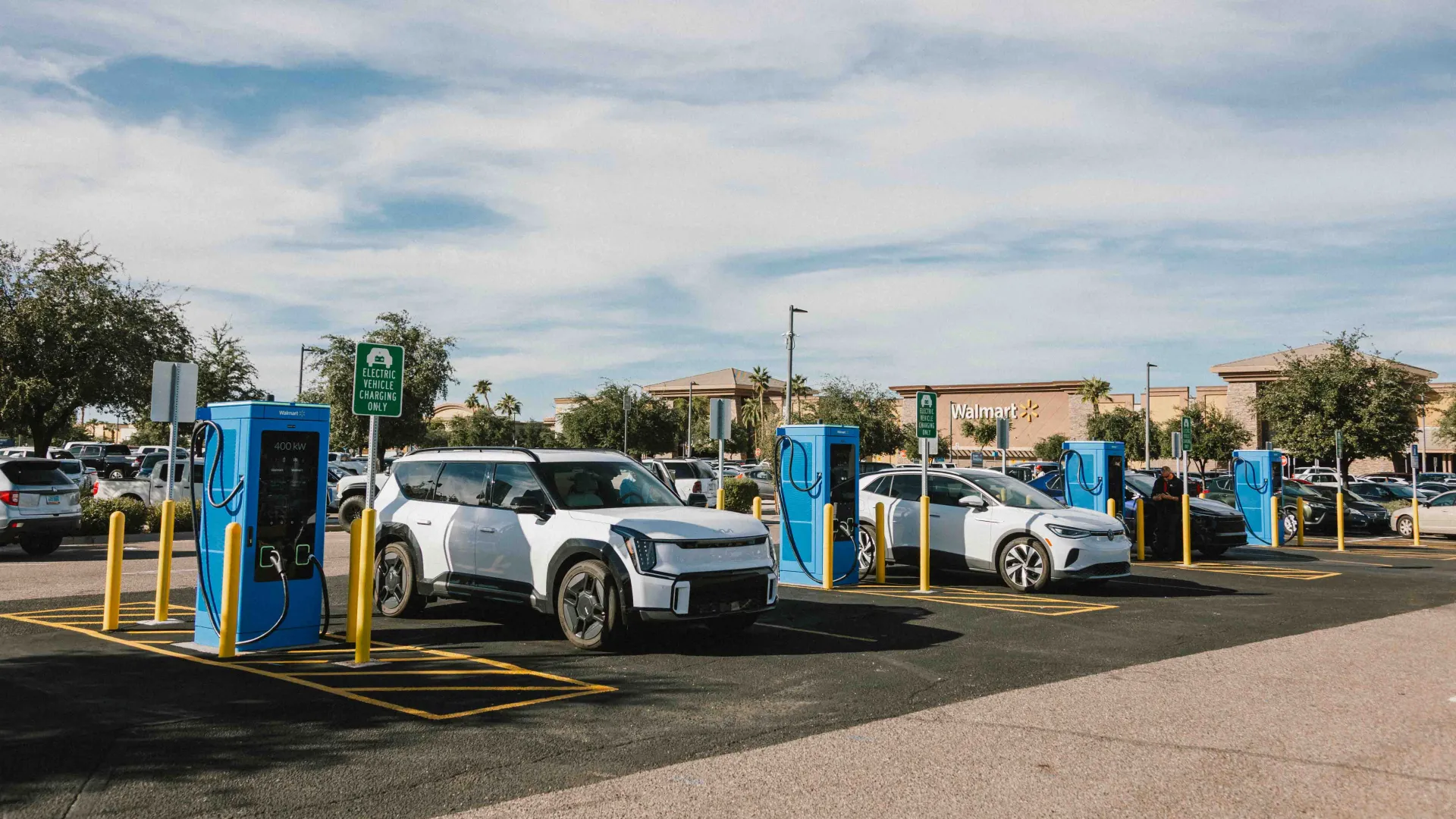
Walmart’s EV charging plan is starting to look less like a sustainability slide and more like a road-trip product.
ABB E-mobility says Walmart has launched ABB A400 All-in-One fast chargers at seven Phoenix-area Walmart locations, with sites in Colorado, Florida and Georgia among the early rollout. OPIS reported on July 1 that Walmart’s in-house network has grown to around 560 energized DC fast-charging ports across nearly 70 locations in 15 states, with more sites under construction or permitting.
GearPulse’s view: this matters because EV charging is not only a charger spec problem. It is a location problem. Walmart has parking, bathrooms, food, predictable lighting, highway-adjacent stores and an app relationship with a huge number of American shoppers. If the reliability is there, retail charging can make a long EV stop feel less like infrastructure roulette.
What Walmart is building
Walmart announced in 2023 that it intended to build its own fast-charging network at thousands of Walmart and Sam’s Club locations by 2030, in addition to the third-party chargers already at many stores. The ABB partnership is one of the clearest signs that the plan is becoming physical infrastructure.
The official ABB release says the Phoenix-area sites use A400 All-in-One chargers and that the broader rollout is planned for Walmart properties nationwide.
| Detail | Current public information | Why it matters |
|---|---|---|
| Charger supplier | ABB E-mobility for early sites | Gives the rollout a known hardware platform. |
| Charger model | ABB A400 All-in-One | Up to 400 kW in a dual-outlet cabinet. |
| Connector support | CCS and NACS | Important as Tesla-style NACS becomes common on new EVs. |
| Early markets | Arizona, Colorado, Florida, Georgia | Shows Walmart is not treating this as one local pilot. |
| Network scale reported by OPIS | About 560 energized DC fast-charging ports | Suggests meaningful momentum, not just a press event. |
| Walmart long-term target | Thousands of Walmart and Sam’s Club locations by 2030 | The big promise is national convenience. |
The caveat is obvious: a network is only as good as uptime, pricing, payment flow and cable ergonomics. A 400 kW charger does not help if the stall is blocked, the payment flow fails, the cable cannot reach the port, or the site is down during peak travel.
The A400 spec is strong, but not magic
ABB’s A400 page lists configurable 400 kW, 300 kW or 200 kW output, dual outlets, 150 to 980 V output voltage, and dynamic power sharing in 50 kW granularity. ABB’s Walmart release says the chargers can deliver 200 kW to two vehicles in parallel or the full 400 kW to one vehicle.
That is the right class of hardware for a public fast-charging network in 2026. It is enough headroom for high-voltage EVs, useful for short dwell stops, and flexible enough to serve a mix of vehicles.
But EV owners should not read “400 kW” as “every car charges at 400 kW.” The real speed depends on the vehicle, battery temperature, state of charge, voltage architecture, cable rating, power sharing, site configuration and the charger actually working as intended.
| Driver question | What the rollout answers | What still needs proof |
|---|---|---|
| Can my EV plug in? | CCS and NACS support is the right direction. | Port placement and cable reach still matter. |
| Will it be fast? | A400 hardware has serious power headroom. | Real sessions depend on vehicle and site conditions. |
| Can I pay easily? | Walmart says charging will integrate with its app. | App-only or app-first flows must still work under travel stress. |
| Is it cheaper? | Walmart says affordability is part of the pitch. | Local kWh pricing will decide whether drivers feel it. |
| Is it dependable? | ABB claims the platform is built for uptime. | Network reliability has to be proven site by site. |
The best version of Walmart charging is boring. You pull in, plug in, walk inside, buy coffee or groceries, and leave with enough range. The worst version is familiar to every EV road-tripper: a high-power station that looks good on a map and wastes 20 minutes in real life.
Retail is the strategic advantage
Walmart does not need to invent a charging destination from scratch. It already owns one.
That changes the charging experience. A dedicated highway charger can be faster to enter and exit, but many sites still feel exposed, isolated or thin on amenities. A Walmart stop has restrooms, snacks, prescriptions, pet supplies, road-trip basics and staff nearby. For families and non-enthusiast drivers, that matters as much as peak kilowatts.
The scale also matters. Walmart says more than 5,200 Walmart and Sam’s Club stores operate in the U.S. and that about 90 percent of Americans live within 10 miles of one. That does not mean every store is right for fast charging. Grid connection, traffic patterns, parking layout, utility work and local demand will filter the list. Still, the store footprint gives Walmart a charging map most startups would spend years trying to approximate.
GearPulse’s opinion: retail charging is one of the cleaner answers to the EV adoption problem because it fits how people already behave. Drivers do not want to plan around infrastructure. They want infrastructure to appear in places they already stop.
The friction points are practical
Walmart and ABB are promising convenience, but the next phase will be judged on mundane details.
Cable placement is one. OPIS reports Walmart has adjusted NACS and CCS cable positions on chargers to better accommodate Tesla and newer EV port layouts. That sounds minor until a driver discovers a cable is too short or a stall forces awkward parking.
Pricing is another. Design News found Phoenix-area Walmart charger pricing that appeared competitive overnight but less distinctive during daytime hours. Local rates can change, and one spot check is not a national pricing policy. Still, it underlines the real challenge: Walmart cannot win on convenience alone if drivers feel the kWh price is just another expensive public fast-charge session.
Uptime is the largest test. Electrify America already put chargers at many Walmart locations, and drivers have long associated some public fast charging with broken screens, failed sessions and support calls. Walmart’s in-house network has to convince people that a Walmart-branded charger is not merely another logo on the same reliability problem.
What to watch next
The rollout has three useful signals to watch through the rest of 2026.
First, site density. A few flagship stores are nice. A corridor of reliable stores is useful. EV owners need networks, not scattered monuments.
Second, mixed-connector performance. NACS support is essential as the U.S. market shifts, but CCS vehicles will remain on the road for years. Walmart’s network has to serve both without making either group feel like an afterthought.
Third, payment behavior. An app-integrated charger can be convenient for regular Walmart customers, but road-trip charging should not collapse if a driver has weak signal, a new phone, a company card or no patience for account setup at 11 p.m.
That is where Walmart’s retail discipline could help. The company understands scale, signage, store operations and customer flow. Charging is a technical business, but it is also a service business.
Bottom line
Walmart’s fast-charging rollout is relevant because it pushes EV infrastructure into one of America’s most ordinary travel stops. The hardware specs are credible, the store footprint is powerful, and the reported network growth suggests the plan is moving beyond early press releases.
The hard part starts now. Walmart has to make the chargers reliable, reachable, reasonably priced and easy to use across thousands of messy real-world parking lots.
GearPulse’s read: if Walmart gets that right, it will not just add another charging network. It will make EV charging feel more like running an errand, and that is exactly the kind of boring progress the market needs.