
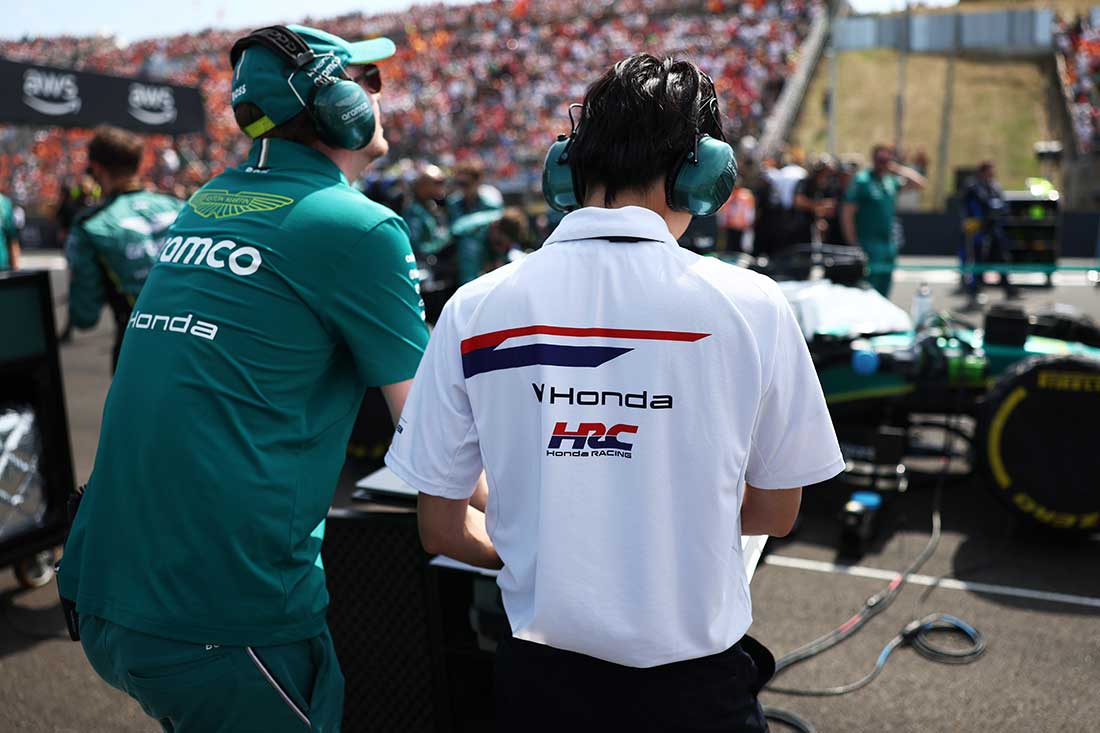
Honda arrived at Zandvoort with the engine upgrade Aston Martin badly needed. Its first competitive running showed why the phrase “engine upgrade” is never the whole story.
Honda says the updated RA626H brings more power from internal-combustion work, plus smaller battery and component changes. Formula 1 reported that the work includes a revised pre-chamber, piston shape and lubrication changes intended to speed combustion and reduce friction. On Friday, however, the Aston Martin drivers found that the new behaviour could complicate the exact place where a driver most needs trust: the braking phase.
Autosport reported Fernando Alonso describing an engine that was over-delivering while he was trying to stop the car in Sprint Qualifying; Lance Stroll separately said the pair had driveability problems to understand. That produced a grim first headline — Alonso was last and Stroll 19th in the session — but it should not be lazily read as proof that the update failed.
The sharper conclusion is that Honda has reached the difficult middle of a real development step. It has changed the combustion characteristics to make more performance. Now it must make that performance arrive in a way Aston Martin can use at the pedal, through the rear axle and over a race distance.
More power can change the whole corner
An F1 power unit does not simply switch from “less” to “more.” Its torque delivery, engine braking, energy recovery and deployment logic all shape what the driver feels while the car is rotating and slowing down. A change in combustion can therefore create a new calibration job even when it meets its target on the dyno.
Honda was unusually candid before the weekend. Its own preview said the updated unit increases power through improvements to the internal-combustion engine, with minor changes to the battery and other components. Honda Racing chief Shintaro Orihara also warned that the Sprint format gives the team only one practice session to evaluate the package.
That is a very small laboratory for a new engine-car relationship at Zandvoort. The circuit is short, narrow and fast-flowing, with heavy commitment through its banked corners. There is little appetite for a car that responds differently from one braking phase to the next.
| What changed | What Honda says | Why it can matter to the driver |
|---|---|---|
| Combustion hardware | Faster combustion from revised pre-chamber and piston work | Can alter torque and engine-braking behaviour around corner entry and exit |
| Lubrication | Changes intended to reduce friction | Helps efficiency, but needs to work with the rest of the power-unit controls |
| Battery and other components | Minor upgrades alongside the ICE work | Energy recovery and delivery still need to feel predictable |
| Calibration | Ongoing after the new specification changed combustion characteristics | A good dyno result must become a repeatable lap-time gain |
Honda has not published a horsepower figure, and neither should anyone invent one from one bad qualifying classification. The company says it hit its internal performance target; that is meaningful, but it is not a public lap-time promise.
The first competitive evidence is uncomfortable, not conclusive
The new unit was shaken down at a Hungaroring filming day after the Hungarian Grand Prix. Zandvoort is different: it is the first time drivers have had to use it in a competitive, compressed weekend.
According to Autosport, Alonso said the car was difficult to stop because the engine was still delivering while he braked. He also had a separate rear-wing-setting issue, which makes it especially important not to turn one session into a complete verdict on Honda. Stroll’s account still matters, though: both cars had a driveability concern, so this was not merely one driver adapting to one awkward lap.
That distinction tells us more than the raw positions. If the issue were only one isolated hardware failure, the assignment would be simple. If two drivers need the delivery behaviour revisited after a combustion-led update, Honda and Aston Martin have to reconnect several systems at once.
| Early Zandvoort signal | What it does not prove | What needs to happen next |
|---|---|---|
| Alonso reported braking-phase over-delivery | That the engine lacks power or is inherently unreliable | Refine engine and energy-management calibration |
| Both drivers flagged driveability | That the chassis upgrade was a mistake | Separate power-unit behaviour from wind, setup and car-specific issues |
| Poor Sprint Qualifying positions | That Aston will remain at the back all weekend | Find a usable operating window with almost no practice time |
| Honda met an internal target | A confirmed horsepower gain or points-scoring pace | Show the improvement across qualifying and race stints |
Why this matters more for Aston Martin than a normal update
Aston Martin does not have spare weekends to turn updates into research projects. Honda’s official preview says the team’s Hungarian chassis package pointed in the right direction, and the manufacturer expects the improved AMR26 and Spec 2 unit to work together in the midfield fight. The premise is sensible: a chassis that correlates better and a power unit that loses less ground can compound.
But compounding works in both directions. If a driver cannot lean on the car while braking, a horsepower gain can disappear in lost confidence, compromised apex speed and cautious throttle application. The exciting part of the technical change is also the dangerous part: the new unit is not an accessory bolted onto an unchanged car.
This is the live version of the question GearPulse raised when Honda explained the combustion focus before the break: could the new engine make Aston Martin raceable again? Friday’s answer is “not automatically.” The update has made the next problem visible.
That is still healthier than pretending the original package had no ceiling. In a season defined by a big rules reset, manufacturers that understand a weakness and expose it in public running have something concrete to tune. The alternative is a car that is slow for reasons nobody can separate.
The sensible read for the rest of the weekend
No one should sell this as either a Honda breakthrough or a Honda disaster yet. A Sprint weekend has a brutal cadence, and a fix may be limited by parc fermé constraints and the amount of learning that can happen between sessions. The longer-term test will be whether Aston Martin can remove the braking-phase surprise while retaining the intended combustion gain at a broader mix of circuits.
For fans, the useful things to watch are less glamorous than a claimed horsepower number:
| Watch for | Why it is revealing |
|---|---|
| Cleaner braking and corner entry from both cars | Indicates that the driver can trust the revised delivery |
| Comparable progress for Alonso and Stroll | Suggests a wider operating window, not a one-driver workaround |
| Race-stint consistency | Shows whether the solution survives temperatures, traffic and energy use |
| A clearer Honda/Aston explanation after running | Separates calibration work from unrelated car issues |
The wider audience relevance is straightforward. Modern F1 is a system-engineering sport, and this is a rare public example of why. A more efficient combustion event, a modified piston or less friction sounds like hidden factory work. At 300 km/h, it becomes a question of whether the driver can brake normally. That link between microscopic engine changes and a car’s physical behaviour is the real story.
Bottom line
Honda’s Spec 2 RA626H is not a simple “more power” upgrade, and Zandvoort has made that clear quickly. The opening competitive session exposed a drivability task that Aston Martin cannot afford to ignore, particularly in a one-practice Sprint weekend.
The persuasive case for patience is that this is exactly the type of work a meaningful combustion change creates: more potential, then a new calibration map to master. Honda has supplied a direct technical target and the first public feedback is specific. The next credible milestone is not a rumoured power figure. It is an Aston Martin that brakes, turns and deploys its new performance without asking its drivers to fight it.