
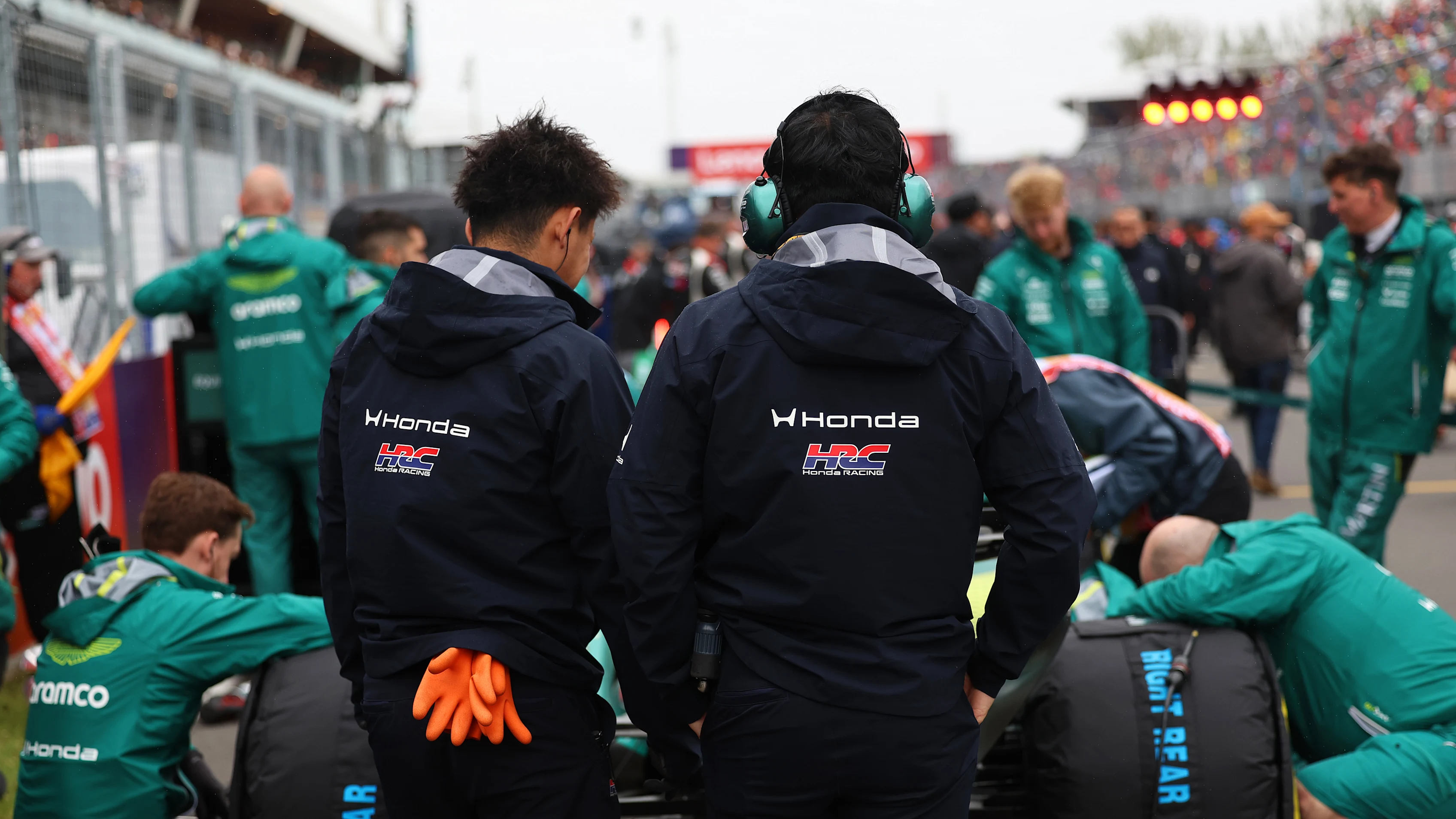
Honda’s first Formula 1 engine upgrade of 2026 is no longer just a calendar item circled for Zandvoort.
GearPulse covered the initial filming-day run on July 29, when Formula 1 confirmed Honda’s revised power unit had finally been installed in Aston Martin’s AMR26 at the Hungaroring. Today’s development is more useful because Honda has now put a technical shape around the upgrade. Motorsport.com published a fresh interview with chief engineer Shintaro Orihara, who framed the step around the internal combustion engine and warned that the new specification will require fresh drivability work.
That makes the Dutch Grand Prix more than a normal post-summer-break reset. Zandvoort is where Aston Martin’s chassis correction and Honda’s first power-unit step have to start behaving like one system.
GearPulse’s view: this is the most interesting F1 story of August 11 because it turns Aston Martin’s rebound from a one-package chassis story into a works-team integration test. If the new Honda unit improves power but reopens drivability problems, Aston is still diagnosing. If it improves power and gives Alonso and Stroll a more natural car, the second half starts to look like a real technical reset.
Why this rose today
This is not a thin summer-break rumour. The source stack is unusually useful for a technical story.
Motorsport.com has the same-day detail from Orihara: Honda’s priority is combustion-engine performance, not a cosmetic software tweak. Formula 1 has the official confirmation that the new-spec power unit already ran on track in a controlled filming-day environment. Honda.Racing supplies the primary team-side context from Hungary, including Aston’s upgraded AMR26, Alonso and Stroll finishing 14th and 13th, and the public target of using the Dutch round for the next step. The Race and Crash.net add specialist corroboration around the timing and the drivability question.
The trend signal is also practical. Motorsport.com placed the story high in its August 11 F1 news flow, social/RSS pickup followed quickly, and the timing lands neatly before the shutdown ends and before Zandvoort’s August 21-23 Sprint weekend. It is a better Daily Dose than another generic mid-season grade because it asks a clear question: can Honda move Aston Martin from “improved” to “raceable”?
The number is less important than the shape
There will be plenty of attention on horsepower estimates. Some coverage has floated optimistic figures around the size of Honda’s step, while Motorsport.com is careful to treat those as estimates rather than a confirmed target.
That caution matters. A power-unit upgrade can look large on a dyno and smaller on a race weekend if it changes cooling needs, throttle response, deployment balance or the way the rear tyres take load on corner exit. In the 2026 rules era, straight-line speed and electrical strategy are tightly linked to active aero and chassis attitude. You cannot simply add power and assume lap time drops cleanly.
Orihara’s key point is more revealing: Honda believes its biggest current weakness is the combustion engine. GearPulse reads that as refreshingly direct. It means Honda is not pretending the answer is only drivability mapping, energy deployment or driver adaptation. The factory thinks it needs more fundamental engine performance before the smaller optimisations become meaningful.
| Honda/Aston question | Why it matters at Zandvoort |
|---|---|
| Combustion-engine output | Aston needs enough base power for small setup gains to count. |
| Drivability | Zandvoort’s flowing corners punish an engine that gives the driver inconsistent torque. |
| Chassis correlation | Hungary suggested Newey’s package matched simulation better than earlier parts. |
| Cooling and packaging | More engine performance can create new compromises in a tight bodywork window. |
| Sprint format | One practice session leaves less time to tune a new engine-car combination. |
The Sprint format is the quiet complication. Formula 1’s Dutch GP schedule has one practice session on August 21, then Sprint Qualifying the same day, a Sprint and Grand Prix qualifying on Saturday, and the race on Sunday. That compresses Aston’s learning window exactly when Honda is introducing a new power-unit specification.
Hungary made this possible
The Honda update would be less interesting if Aston Martin had learned nothing from Hungary.
But the Hungarian GP did change the baseline. Formula 1 reported that Aston brought 16 developments to the AMR26, and Honda’s own report says Alonso reached the team’s first Q2 appearance of the season before Stroll finished 13th and Alonso 14th in the race. Those are not headline results. They are still important because Aston had often looked detached from the normal midfield conversation earlier in the year.
Adrian Newey’s post-Hungary framing, carried by Honda.Racing, was that the package behaved in line with the team’s data predictions. That is the sentence Aston needed more than any miracle lap time. A slow car with bad correlation is lost. A slow car with improving correlation is at least pointing in a direction.
Now Honda has to add its part of the answer. If the AMR26 was previously too slow because the chassis and power unit were both outside their intended windows, a chassis gain alone can only go so far. The Dutch GP will be the first public test of whether Aston has reduced one weakness enough to expose and attack the other.
Alonso and Stroll need different proof
Fernando Alonso’s role is obvious: he will feel the details first. A veteran driver can make a flawed car look sharper for one lap, but he is also ruthless when a power unit makes the corner-entry or corner-exit phase awkward. If the new Honda engine has more power but forces Alonso back into compensation driving, the stopwatch may hide the problem for only so long.
Lance Stroll is the equally useful test. If Aston has genuinely widened the AMR26’s operating window, Stroll should also find a more settled car. If Alonso alone extracts the gain, Aston may have made the package faster without making it broadly easier to use. That would still be progress, but it would be a narrower kind.
Zandvoort will make those differences visible. The circuit is 4.259 km, with 72 race laps and banking at Tarzan and Arie Luyendijkbocht that loads the car in ways drivers notice quickly. Formula 1 describes the layout as fast, undulating and old-school. That is not the easiest place to hide a power unit that delivers torque roughly or leaves the rear axle nervous.
The standings keep the ambition honest
Official F1 standings have Aston Martin 10th in the constructors’ championship on one point, ahead only of Cadillac. That is the brutal context. This is not a secret podium project waiting to be unveiled after the summer break.
The realistic short-term target is the back of the points fight. Alpine, Racing Bulls, Haas, Audi and Williams all have more evidence on the board, and the leading teams are developing too quickly for Aston to dream in straight lines. A successful Honda update does not turn Alonso into a Dutch GP podium favourite. It should make Q2 less exceptional, give the race car more defendable speed, and let Aston collect data that is not drowned by a known power deficit.
GearPulse probability read, as editorial analysis rather than betting advice:
| Outcome | Likelihood | Read |
|---|---|---|
| Aston looks visibly closer to the midfield at Zandvoort | 55-65% | The chassis step plus Honda update should help, even if the Sprint format limits optimisation. |
| The Honda spec creates fresh drivability work | 60-70% | Orihara has already flagged changed combustion behaviour as something Honda must tune again. |
| Alonso reaches Q2 on merit in the Netherlands | 35-45% | Plausible if the package travels, but still dependent on clean Sprint-weekend execution. |
| Aston scores points immediately | 15-25% | Possible in a messy race, but the team starts from too far back to treat it as expected. |
| This becomes a genuine 2027 momentum marker | 65-75% | Correlation plus Honda integration matters more than one race result. |
Why Honda’s honesty matters
There is a useful cultural signal in Honda admitting the engine side has work to do.
Manufacturer programmes sometimes talk around deficits because power-unit numbers are sensitive and reputational. Honda has chosen a more direct line: the combustion engine needs a step, and the drivability work will need fresh attention once the new specification changes the way the engine behaves. That makes the update easier to judge and harder to oversell.
The caveat is that we still do not have official lap-time guarantees, full power figures or access to Aston Martin and Honda’s internal comparison data. Any exact horsepower claim should be treated as reported expectation until the car runs across representative sessions. GearPulse is not trackside and has no live telemetry. The public evidence supports a meaningful upgrade; it does not prove the size of the gain.
Fun facts with a point
Honda’s F1 history makes Zandvoort a neat place for a confidence test. The company won its first Formula 1 race as a constructor at the 1965 Mexican Grand Prix, then later became synonymous with dominant McLaren-Honda seasons in the late 1980s and early 1990s. The modern works tie-up with Aston Martin is a different challenge: sustainable fuels, no MGU-H, far more electrical power, active aero and a cost-capped development race.
Zandvoort has its own old-school edge. It first hosted a world championship Grand Prix in 1952, disappeared from the calendar after 1985, and returned in 2021 after a long absence. Its dune setting and banked corners make it more than a power track, which is exactly why this Honda upgrade has to be judged by feel and lap-time consistency, not just top speed.
Bottom line
Honda’s Zandvoort engine update is interesting because it gives Aston Martin a cleaner truth test.
Hungary suggested the AMR26’s chassis direction is no longer guesswork. The Netherlands will show whether Honda can reduce the power-unit deficit without handing Alonso and Stroll a new drivability puzzle. A points finish would be a bonus. The bigger prize is more basic: getting Aston Martin back into the racing field, where 10 or 20 milliseconds of normal F1 development work can finally matter.
GearPulse’s bottom line: this is not Aston Martin’s comeback yet. It is the first weekend where the comeback story has to involve the whole car.
Support the site at buymeacoffee.com/gearpulse.site.