
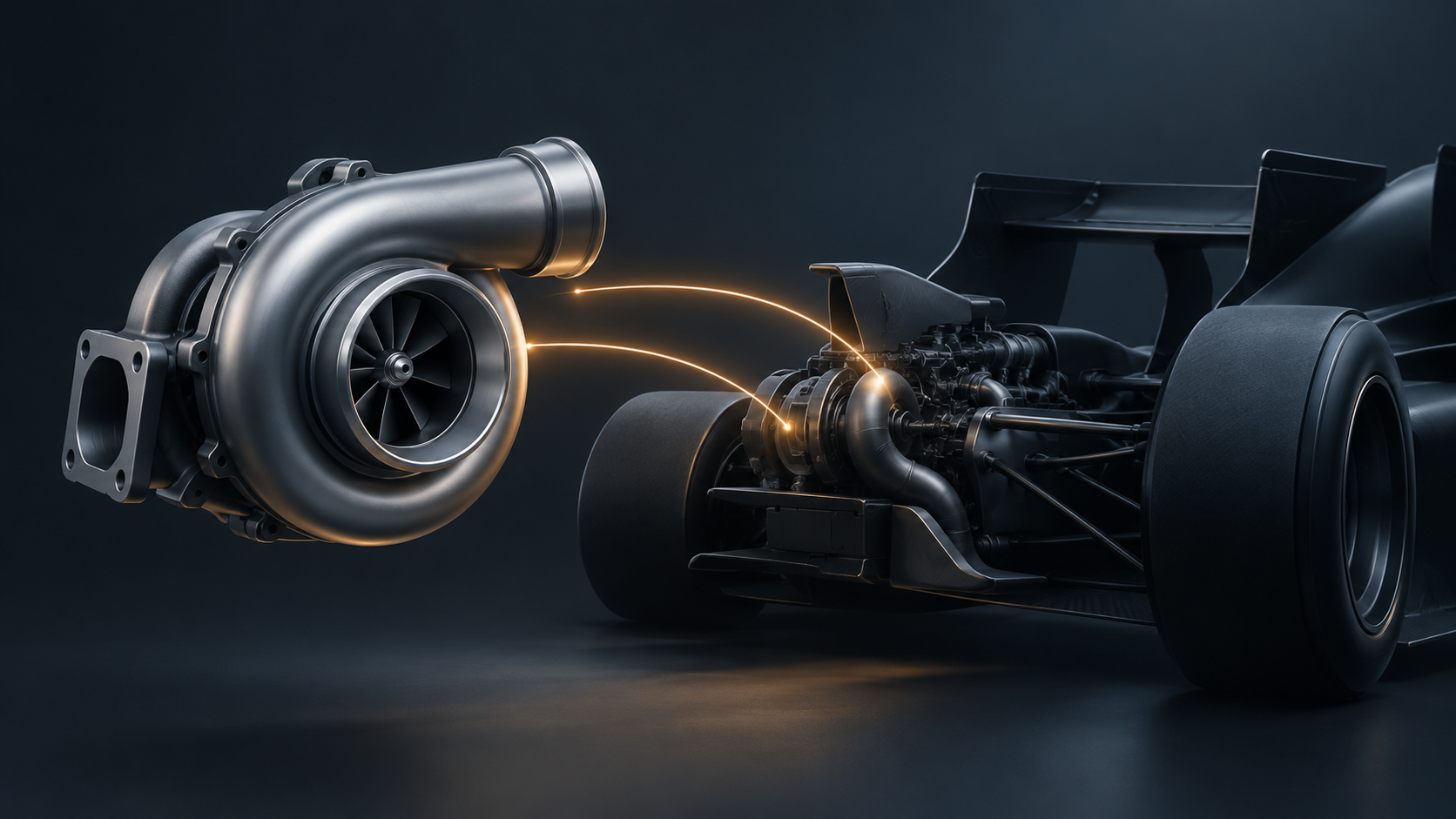
Honda’s second engine lifeline was already on the car. We simply did not know it.
Honda Racing Corporation president Koji Watanabe has now disclosed that the manufacturer used its second 2026 Additional Development and Upgrade Opportunity—ADUO, in Formula 1 shorthand—on a revised turbocharger introduced at the Madrid Grand Prix. Motorsport.com and Autosport report that Lance Stroll received it there; The Race says Fernando Alonso subsequently ran the updated unit in Azerbaijan.
That matters because Honda had presented the Zandvoort power unit as its only in-season ADUO upgrade. The new account does not magically recast Aston Martin’s form since then. It does, however, turn the story from “Honda has one big answer coming” into something more recognisable to anyone who has watched a difficult works programme rebuild itself: the answer is being parcelled out through an already strained component pool.
The second step is a turbocharger, not a headline-grabbing new engine. In the 2026 formula, that makes it more interesting, not less.
A catch-up system is only useful if it reaches the race car
ADUO exists to stop a new engine cycle hardening into an unfixable hierarchy. Formula 1’s official explainer says the FIA measures manufacturers’ internal-combustion-engine performance during designated windows; the size of the deficit determines how much extra development room they receive. Honda’s own regulations guide describes the same principle: a supplier sufficiently behind can gain upgrades and additional dyno scope even after normal homologation has frozen the specification.
Honda qualified for two opportunities this season after the FIA’s assessment put its combustion engine more than 4% below the benchmark, according to the reporting. What Watanabe has revealed is that the allowance did not produce one neat, public “spec three” moment. One ADUO step appeared at Zandvoort; another turbocharger had already entered the rotation at Madrid.
That distinction is not semantics. A power-unit upgrade begins to matter only when a team can fit it, understand it and use it often enough to make setup and strategy decisions around it. The public record gives no reliable basis for assigning a horsepower figure—or for claiming that the revised turbo has solved any particular failure mode. But it does show why the path from concession to lap time is rarely clean.
| Stage | What is public | What remains unknowable from outside |
|---|---|---|
| FIA concession | Honda had two ADUO opportunities under the 2026 system | The full internal comparison that produced the measurement |
| First visible step | Honda’s updated unit arrived around Zandvoort | Its precise contribution to pace, deployment or drivability |
| Newly disclosed step | A revised turbo was introduced from Madrid, initially on Stroll’s car | The component’s exact specification and gain |
| Current task | Aston Martin must turn fresh hardware into repeatable weekends | Its component-life decisions, calibration and reliability fixes |
That last row is the one with teeth. A team cannot race the press release. It races the hardware available for the weekend.
The Baku penalties make the timing awkward
The Azerbaijan component penalties supplied the visible problem: both cars had been pushed into fresh power-unit elements and back-of-grid starts. The FIA documents showed a broad allocation burden, not one isolated item.
The turbo disclosure adds useful texture without pretending to diagnose that burden. A new turbocharger can be part of a performance programme; a new turbocharger can also enter a car’s pool because the timing makes sporting sense. Public sources do not tell us the private logic for each individual installation, and it would be reckless to turn a components list into a failure report.
Still, there is an obvious tension. Honda has been granted a mechanism meant to close a performance gap, while Aston Martin needs enough dependable mileage to learn what the new parts actually do. If a fresh unit arrives alongside allocation pressure, the team’s engineers face a narrower operating window: preserve useful hardware, absorb penalties when they are least expensive, and keep gathering data without making a difficult season still harder.
That is why the second ADUO reveal is more than a delayed technical footnote. It shows that the headline upgrade and the component-management story were never really separate.
Why the turbo is a logical place to spend the allowance
Honda’s official rules guide lists the turbocharger as a core element of the new 1.6-litre V6 era and notes a crucial 2026 complication: the MGU-H is gone. That does not mean a revised turbo alone decides whether a car is quick. It does mean the turbo sits close to the trade-offs that drivers notice—response, combustion-air delivery, thermal behaviour and how an engine’s torque arrives as the car exits a corner.
The FIA’s technical regulations explicitly include the turbocharger in the elements available for ADUO upgrading. In other words, this is not a loophole or a surprise category. It is a permitted area in a deliberately narrow catch-up mechanism.
The temptation now will be to declare the turbo either a hidden breakthrough or proof that Honda’s first plan failed. Neither claim survives basic caution. An F1 power unit is inseparable from cooling, electrical deployment, control systems, fuel, chassis packaging and the driver’s ability to use its response. An upgrade can improve one part of that equation while exposing another compromise.
We have already seen the broader Honda-Aston story move in stages. In August, Honda’s revised combustion-engine focus made clear that better base output could bring fresh drivability work. The later turbo disclosure strengthens that lesson: development is not a single switch from weak to fixed.
Sepang is a test of usability, not a dyno contest
This weekend’s Malaysian Grand Prix at Sepang is the first chance to read the latest disclosure against a full new event, but it should be read with restraint. A long lap combines high-speed sections, heavy braking and tropical heat; it asks plenty of the whole package. It does not reveal a turbocharger’s isolated value.
The useful questions are simpler:
- Can Aston Martin complete a normal weekend with both cars following their intended programme?
- Does the team look less exposed when it has to defend, attack and manage energy across a long race rather than produce one clean lap?
- Do the two drivers receive enough consistent behaviour to make setup progress carry from session to session?
Those are tougher standards than chasing a one-off top-speed screenshot. They are also fairer. One encouraging circuit might flatter a package; a run of uncomplicated weekends would show that Honda and Aston Martin are acquiring a usable foundation.
Honda’s second ADUO upgrade may ultimately prove modest, meaningful or somewhere in between. The public evidence cannot settle that today. What it does settle is that Honda has used the development room available to it, and that the next phase is no longer about waiting for a lifeline. It is about making the lifeline last.
Bottom line
The important Honda news is not that a turbocharger appeared in Madrid. It is that the manufacturer’s catch-up plan has already become a staged race-operations problem.
ADUO gives a struggling supplier permission to improve. It cannot grant a clean component pool, a perfect setup window or a trouble-free Sunday. For Aston Martin, the measure of Honda’s second upgrade will not be a claimed horsepower number. It will be whether the cars can use what they have been given often enough for ordinary F1 development to start compounding.
Support the site at buymeacoffee.com/gearpulse.site.