
Honda’s change at the top of its Formula 1 power-unit project is officially a planned transition. The timing makes it more consequential than that gentle phrase suggests.
Yoichiro Fukao, currently the deputy F1-project leader and head of the software division, will become Large Project Leader on October 1, taking over from Tetsushi Kakuda. Honda says the purpose is to accelerate development and transfer knowledge to the next generation of engineers. That is a sensible piece of succession planning. It is also arriving after Aston Martin’s first works-Honda season has exposed a tougher truth: the RA626H cannot be treated as an engine in isolation.
Aston Martin needs a power unit that produces speed, of course. But it also needs one whose combustion behaviour, electrical deployment, energy recovery and braking-phase controls let the AMR26 behave consistently enough for drivers and engineers to chase a setup. That is the real job Fukao inherits.
A controls specialist arrives at the point where integration matters most
Honda’s own biography for Fukao is unusually revealing. He joined the company in 2002, began in F1 engine and gearbox control-system development, worked on hybrid systems and MotoGP controls, then returned to the F1 project in senior control roles. In other words, the incoming leader is not being asked to sprinkle a little software magic over a finished engine. His background sits precisely where this generation’s difficult problems meet.
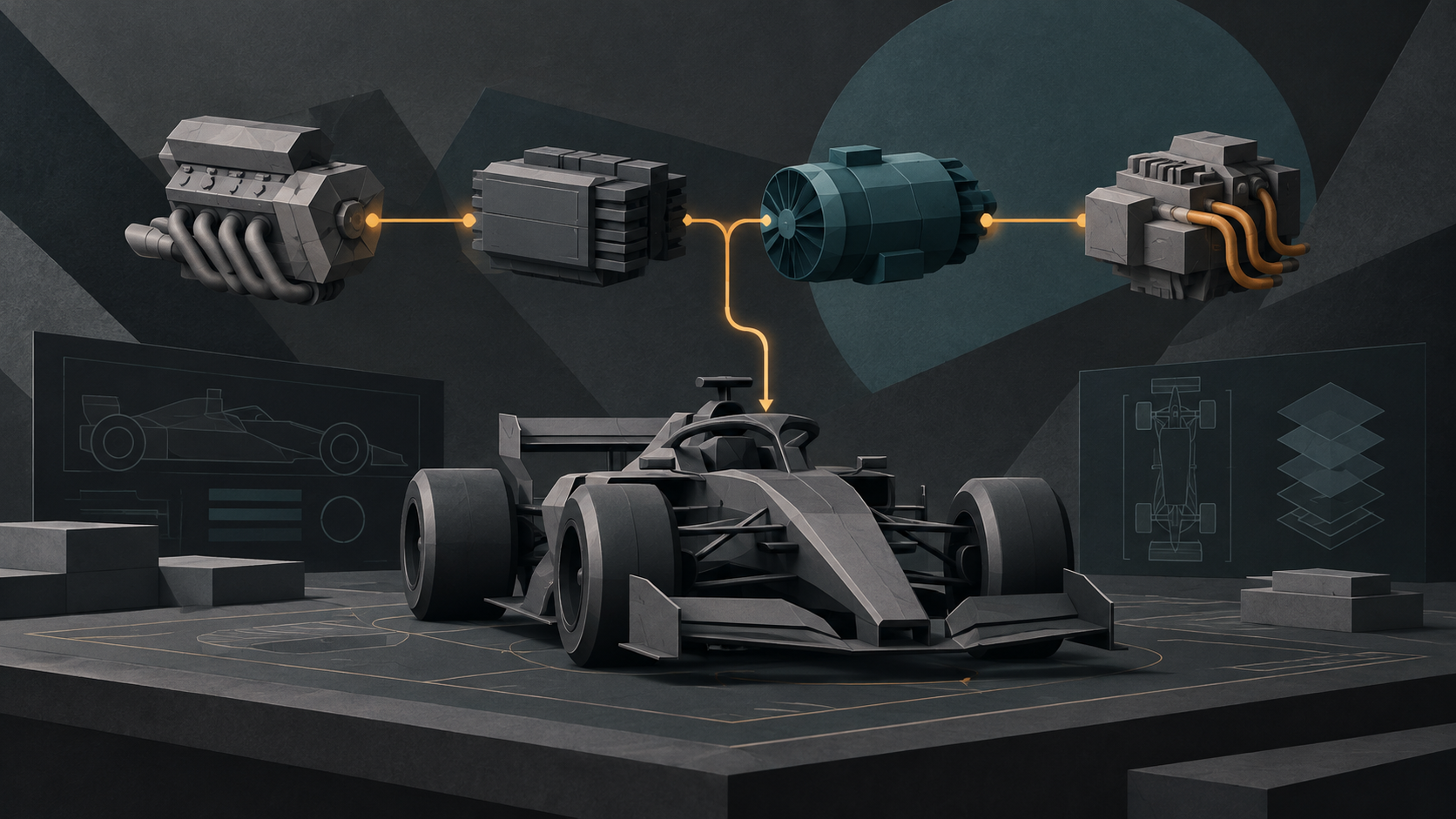
The 2026 rules have made that junction more important. Honda’s RA626H pairs a turbocharged internal-combustion engine with a much more powerful MGU-K; the electrical and combustion sides contribute equally to the new-car concept. Aston Martin’s official technical description makes clear that energy recovery, deployment, fuel, gearbox and power-unit design are interdependent. A gain that looks clean on a dyno can still create a difficult car if its delivery or engine-braking character does not cooperate with the chassis.
That was visible after Honda’s recent upgrade. Motorsport.com reported that chief engineer Shintaro Orihara said the new combustion characteristics had met Honda’s internal performance expectations, while also requiring more work on driveability. He identified combustion stability, shifting, engine braking and torque pickup as linked parts of the problem; Aston Martin’s Mike Krack stressed that drivability is a chassis-and-power-unit question, not a supplier-only one.
That is why this appointment deserves more attention than the familiar “Honda changes engine boss” headline. The hard task is not choosing between power and refinement. It is finding a working relationship between them.
| What Honda has to join up | Why it matters at the circuit |
|---|---|
| Combustion and control software | More effective combustion is useful only if torque delivery and engine braking stay predictable. |
| Energy recovery and deployment | A driver has to trust the car’s response on entry and exit, not merely see a better number in a simulation. |
| Power unit and chassis setup | Ride, braking balance, rear stability and energy targets can change the usable operating window together. |
| Development speed and correlation | A change that works in Sakura must remain useful across different circuits and ambient conditions. |
The concession room is real, but it is not a shortcut
Honda has development opportunity available. The FIA’s August ADUO decision placed Honda in the group granted two additional power-unit homologations in both 2026 and 2027, plus corresponding cost-cap and dyno-testing allowances, after its first review period. That was the mechanism working as designed: a new supplier with a measured deficit gets more room to catch up.
It does not turn the next update into a guarantee. The FIA explicitly keeps the detailed measurement confidential, and the allowance says nothing public about Honda’s exact deficit, its next specification or the lap-time benefit Aston Martin might see. More importantly, the reported driveability work shows why a homologation is only the beginning of the race-car task. Hardware, calibration and car behaviour still have to agree.
AS’s account of the leadership shift adds a useful reality check. It notes that Aston Martin’s chassis progress since Hungary has not erased the power-unit challenge, and quotes Krack on how the high-grip Madrid surface put power back at the centre of the limitation. Formula 1’s report of the Spanish Grand Prix gives the current consequence its bluntest form: Fernando Alonso finished 17th, two laps down, and Lance Stroll retired with brake trouble.
One ugly weekend does not diagnose an entire programme. Nor does a new leader erase the work already done under Kakuda. Honda calls this a planned transition, and there is no public evidence that it is a reaction to one result or a single failure. But a planned transition can still be the right moment to sharpen priorities.
Aston Martin needs repeatability before a headline gain
The tempting promise is a dramatic horsepower rescue. The more credible target is repeatability.
If Aston Martin can give both drivers a car that is calmer under braking, clearer in torque pickup and less dependent on a narrow set of energy settings, its engineers can make better setup decisions on Friday and preserve them through Sunday. That will not make the AMR26 a front-runner by decree. It would, however, give the team a more usable platform on which future Honda gains can count.
There is a useful contrast with our look at Honda’s Zandvoort upgrade. Then, the question was whether a new combustion-led specification could make the car faster without making it harder to place. The evidence since has made the next question sharper: can the people responsible for the whole control loop turn that first step into a reliable development method?
Fukao’s appointment cannot answer that on its own. It does make Honda’s answer more coherent. The project is acknowledging, through the profile of its next leader, that modern F1 power-unit performance is a system property.
Bottom line
Honda has not announced a miracle cure, and Aston Martin should not be measured against one. Its leadership handover is meaningful because it puts a controls and hybrid-systems specialist in charge at the moment the programme needs the car and power unit to stop behaving like separate recovery projects.
The first evidence to watch is not a rumoured horsepower number. It is whether Aston Martin’s next weekends produce a more repeatable, driver-trustworthy package. If they do, Honda’s development allowance and new structure can become genuine leverage. If they do not, more engineering opportunity will merely create more variables to reconcile.