
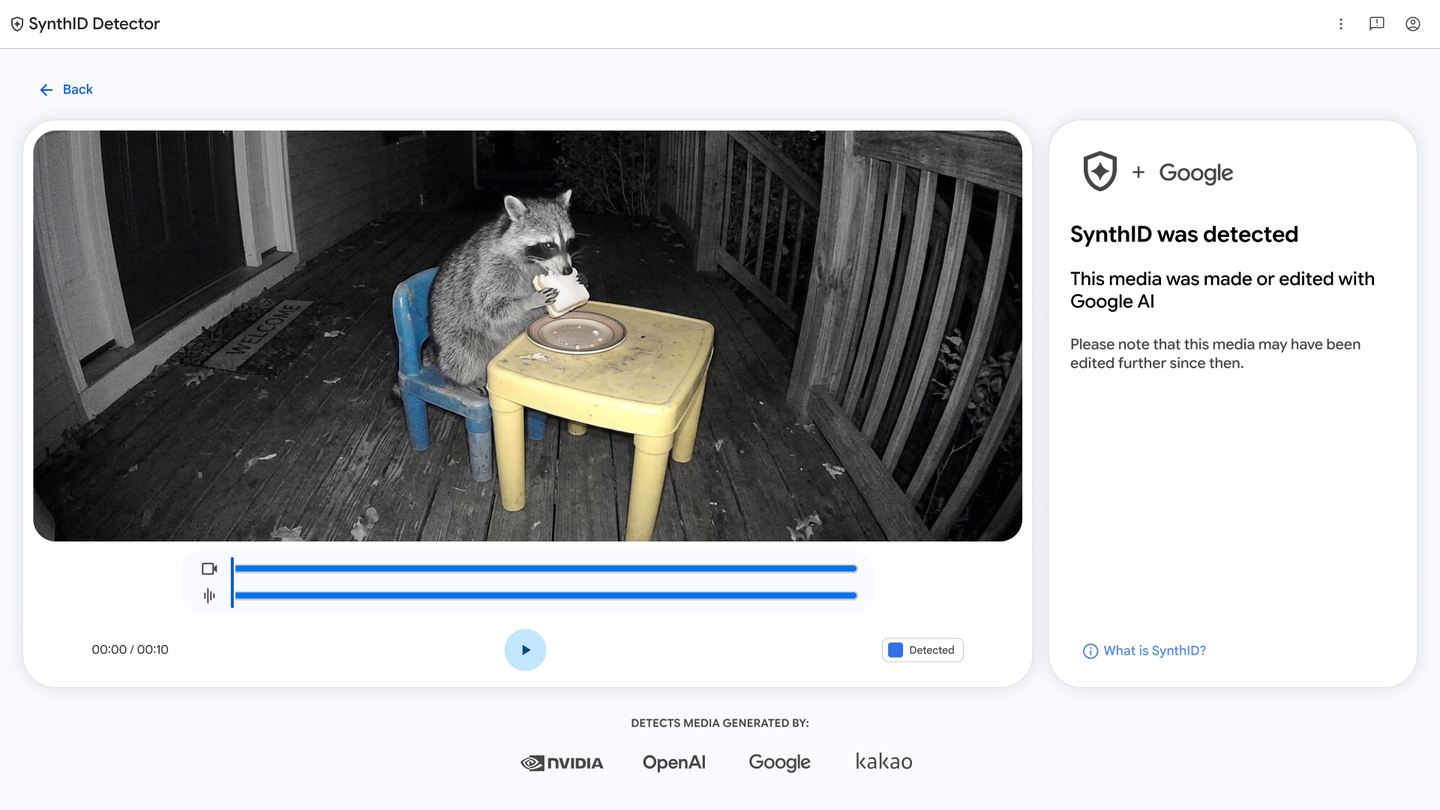
Google has taken SynthID Detector out of its media-professional preview and made it available globally in English. The site accepts an image, video or audio file and checks for a SynthID watermark associated with Google or participating partners including OpenAI, NVIDIA and Kakao; Google says Apple is coming later.
That is a useful consumer tool—but only if people understand the negative space around its answer. SynthID Detector is not a universal lie detector. It is designed to find a particular provenance signal. If it does not find one, the media may be human-made, made by a non-partner, or produced before a partner used the watermark. Those are radically different possibilities.
The right takeaway is narrower and more valuable: when a positive result appears, it can add a concrete fact to an investigation. When it does not, keep investigating.
What the detector can say
| Result or feature | What it means | What it does not mean |
|---|---|---|
| SynthID watermark found | The submitted file contains a detectable watermark from a supported ecosystem, according to Google | That every visible claim in the media is false, or that the work is low quality or harmful. |
| No matching watermark found | The service did not detect a supported SynthID signal | That the file is authentic, unedited or not AI-generated. |
| Global English access | The web tool is available more broadly than the previous media-professional preview | A universal detector for every model, every generator and every historical file. |
| Partner coverage | Google says the detector can check work from Google and participating partners | Complete cross-industry provenance coverage; participation and rollout timing matter. |
Google says it has watermarked more than 180 billion images and videos and 240,000 years of audio since SynthID began in 2023. Those are adoption-scale figures, not accuracy measurements. The practical test for a viewer remains much simpler: does the tool return a result for the file in front of them, and what else can be established about its source?
Why specificity beats a magic-answer detector
There is a real advantage to a system that is explicit about what it can identify. Broad “AI detector” labels encourage a bad habit: treating a confidence score as a verdict. A watermark checker has a more bounded job. It searches for evidence planted by a known system or partner.
PCWorld’s early testing highlights the limitation directly: content outside the partner ecosystem can produce a negative result even when it is AI-generated. That is not necessarily a failure of the detector. It is a reminder that absence of one signal is not evidence of absence of manipulation.
For ordinary users, that distinction can make media literacy less mystical. A positive SynthID result is a reason to read the surrounding context with care. A negative one should prompt other questions: who posted this first, is there an original file, does a trusted source corroborate the event, and are there Content Credentials or other provenance records to inspect?
The real audience benefit is a faster first check
Most people cannot perform a forensic analysis of an unfamiliar clip shared in a group chat. They can upload a file, inspect the answer and avoid overstating what the answer proves. That is a meaningful improvement over pure intuition, especially for media that looks polished enough to invite quick sharing.
The tool is most useful to people who treat it as one step in a chain: a reporter reviewing a submission, a teacher discussing source evaluation, a buyer assessing a suspicious product demo, or a family member checking a viral video before passing it along. It is not a substitute for trusted reporting, reverse-image searching, metadata review where available, or the plain old habit of waiting for independent confirmation.
That measured role connects to the broader provenance problem we examined in Google DeepMind’s SynthID Bio research. Whether the object is a video or a designed protein, a watermark can establish something about a participating workflow. It cannot make every unmarked object trustworthy.
A public tool also raises the bar for clarity
Google’s partner list is encouraging because a provenance signal becomes more useful as more systems support it. But interoperability is only half the problem. The result needs to be worded clearly enough that a non-specialist does not mistake “unlikely to have been made with a SynthID partner” for “real.” MacRumors and Ars Technica both emphasized that the detector’s scope is tied to the underlying technology, not every form of AI generation.
The next measure of success is therefore not just uploads or watermarked-file totals. It is whether people learn the difference between a provenance confirmation and a truth confirmation. Platforms and toolmakers should reinforce that difference every time they surface a label.
Bottom line
SynthID Detector is a welcome public utility because it offers a specific, inspectable signal in a media environment that too often asks users to trust a vague confidence score. Google deserves credit for making the tool available globally rather than keeping it inside a professional preview.
GearPulse’s view: use it when a file matters, believe a positive result for what it says, and never read a negative result as a passport to trust. The most responsible detector is not the one that promises to settle every question. It is the one that gives people a useful fact while making its boundaries impossible to miss.