
The next provenance fight may not be over an image or a paragraph. It may be over a protein sequence.
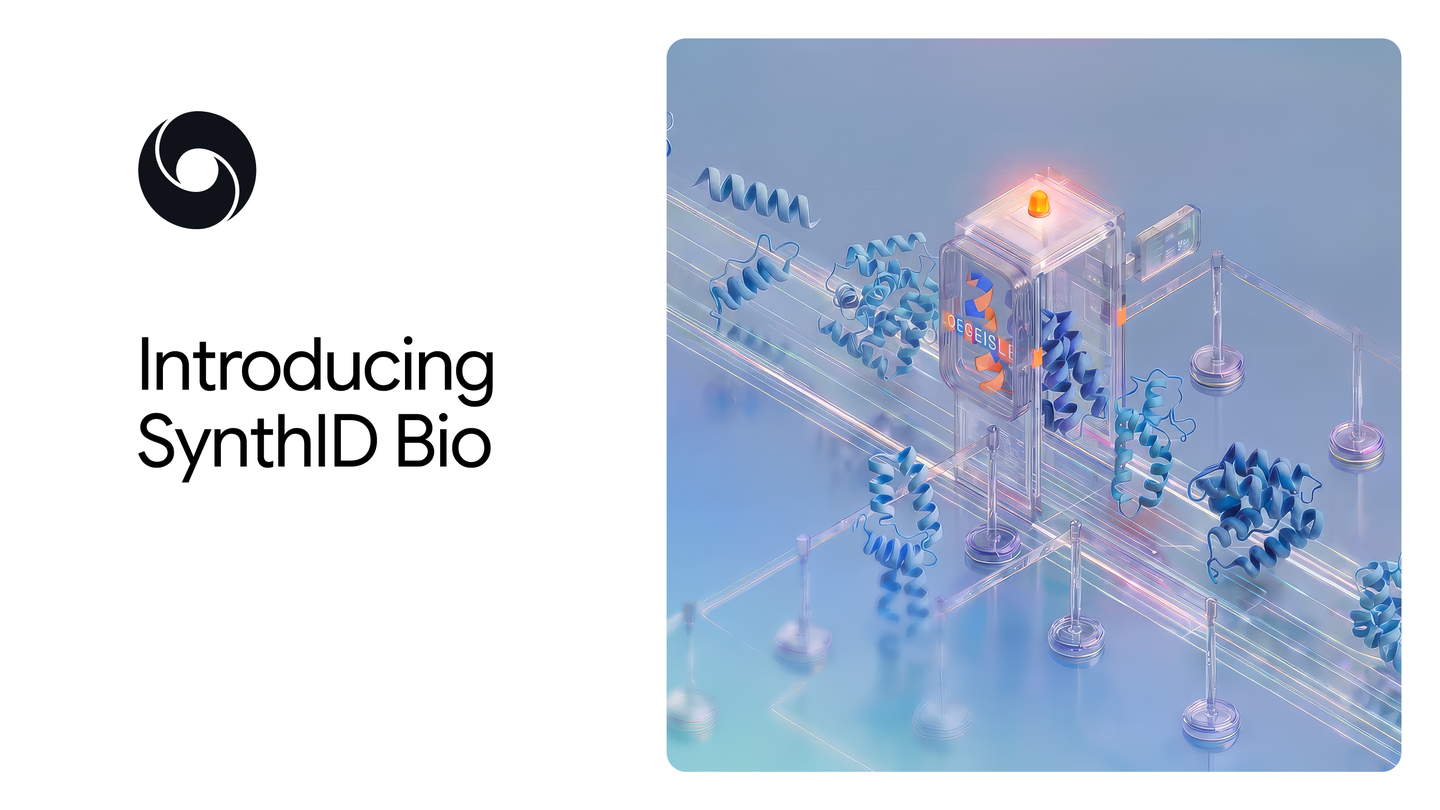
Google DeepMind has introduced SynthID Bio, a research system designed to put a detectable watermark directly into AI-designed protein sequences and AI-predicted structures. The important twist is that the mark is meant to survive while the molecule keeps doing its job. In the reported tests, watermarked protein binders had comparable binding affinity to their unwatermarked counterparts; the accompanying Nature paper calls the work a proof of concept, not a finished safety system.
That restraint matters. A watermark cannot tell a lab that a sequence is harmless, nor can it stop someone from altering a design. It can make provenance less of a guessing game when biological designs increasingly look unlike anything nature has catalogued.
Why a hidden mark is useful in biology
Protein-design models can propose sequences that bind a target or form a structure without looking much like familiar proteins. That is scientifically exciting—and awkward for the institutions that have to interpret, archive or synthesize those sequences.
A DNA-synthesis provider normally screens incoming orders against known hazards. An unfamiliar sequence can demand additional review precisely because its origin is unclear. DeepMind’s proposed signal could let an authorized verifier establish that a design originated in a participating model with a known safety posture. The Nuclear Threat Initiative, an independent policy organization, describes that as a potentially useful additional input to screening, rather than a substitute for screening.
| What SynthID Bio is designed to signal | What it does not establish |
|---|---|
| A sequence or structure originated from a watermarked AI-design workflow. | That the sequence is safe, benign or suitable for synthesis. |
| A database submission may deserve synthetic-origin labeling or review. | Who used the model, why they used it or whether every claim attached to the entry is true. |
| A screening workflow has a provenance clue in addition to sequence matching. | That an unmarked sequence is natural or trustworthy. |
That last caveat is especially important. A watermark is evidence about a marked output, not a clean bill of health for everything without one. In that sense, SynthID Bio has the same core limitation as the text and image provenance systems discussed in Claude’s watermarking rollout: a signal can strengthen an investigation, but it cannot replace judgment.
Two approaches, one unusually hard constraint
The research describes two related methods. SynthIDBio-sequence modifies sampling in a protein-design pipeline so a watermark is embedded in the amino-acid sequence. SynthIDBio-structure is a fine-tuned AlphaFold 3-based model that carries a watermark in predicted biomolecular structures.
The technical bar is much higher than hiding a pattern in an image. A small change in a protein can matter. The researchers therefore tested designed binders for three targets—PD-L1, the SARS-CoV-2 receptor-binding domain and VEGF-A—and report comparable binding affinity between watermarked and baseline designs. The paper also reports near-perfect detection under its evaluations and resistance to some basic manipulations, while explicitly discussing more capable attempts to remove the mark.
Those results are encouraging, but they are not a universal durability guarantee. The study’s authors say that putting such a system into operational biosecurity workflows will require further innovation, coordination and standards. That is the right reading: the project demonstrates feasibility in defined settings; it does not settle how the world should trust, govern or enforce biological provenance.
The open release is part of the story
DeepMind says it has released code, in-vitro validation data and access instructions for the model weights to the research community. Openness gives other researchers a chance to inspect the method and probe its failure modes—more valuable here than a glossy safety claim with no route to replication.
It also creates a practical tension. Detection relies on keeping certain verification capabilities controlled, while scientific adoption benefits from reproducible tools and shared benchmarks. The useful outcome would be interoperable checks at the places that need them: model developers, research databases and DNA-synthesis companies. A vendor-specific badge that nobody else can verify would be much less valuable.
For the wider technology audience, this is a reminder that AI provenance is moving from media into infrastructure. The familiar question—“was this generated?”—becomes “which system made this biological design, and what safeguards surrounded that process?” That is a better question, but it requires more than a detector to answer responsibly.
Bottom line
SynthID Bio is a meaningful piece of applied AI-safety research because it tries to preserve function while making AI-designed biology traceable. The lab evidence and peer-reviewed paper make it stronger than a vague pledge to watermark outputs.
Still, it is a provenance layer, not a biosecurity solution. The real test is whether independent researchers can reproduce the results and whether screening providers and scientific databases can turn the signal into a shared, careful workflow. If that happens, the watermark could become valuable precisely because it tells systems when not to rely on appearances alone.