
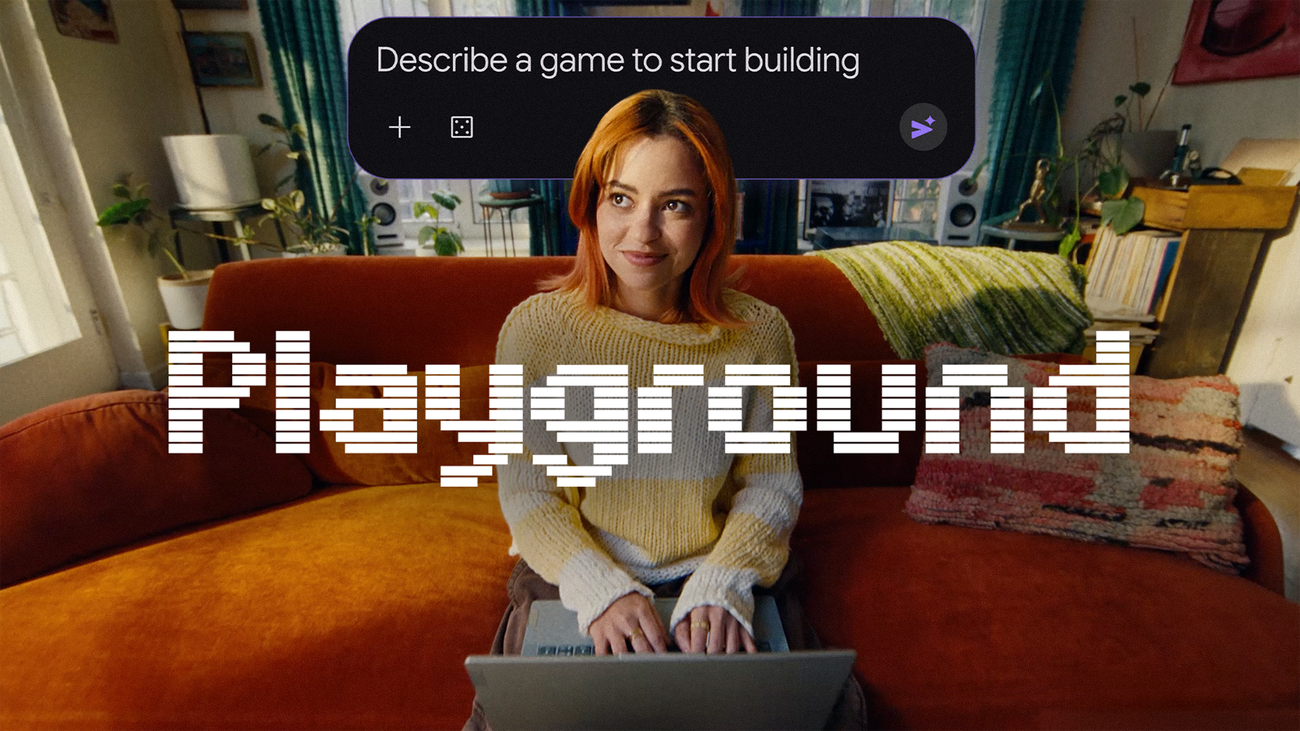
The tempting way to describe Google Playground is as a button that makes games from prompts. That is true, but incomplete. The launch matters because Google is putting the first, low-friction version of game creation in front of ordinary people while lining up Unity for the point where a delightful prototype needs real systems behind it.
Playground is available now in the U.S. for adults, according to Google. A user describes an idea in text, can play the result, share it with friends or publish it to a community gallery. Google says creation access will be tiered by Google One membership. The gallery has ratings, play activity, safety screening and reporting; Unity says its forthcoming Spark tools will add more professional-grade mechanics, 3D capability and Unity-runtime flexibility.
That split is the honest part of the pitch. A no-code prompt can lower the distance between an idea and a playable moment. It does not erase design iteration, balance, performance work, accessibility or the discipline required to ship a game people return to.
What launches today—and what does not
| Layer | What the companies say it does | The caveat |
|---|---|---|
| Google Playground | Creates, plays and shares custom games from natural-language prompts | It is an early experiment, U.S.-only at launch and restricted to users 18 and older. |
| Community gallery | Publishes games, surfaces them through ratings and activity, and supports user reports | A safety review is not a guarantee that every public game is good, suitable for every audience or free of edge cases. |
| Unity Spark | Planned tools for richer mechanics, high-fidelity 3D and the Unity runtime | Unity says it is in testing, with a closed beta coming soon—not a finished feature in Playground today. |
The distinction is worth keeping intact. Google’s announcement says anyone can start with a text prompt; Unity’s announcement describes an integrated platform arriving later this year. Those are adjacent promises, not the same release.
The audience benefit is a faster creative loop
For a student, a parent making a silly game for friends, or a designer trying to communicate a mechanic, the best case is not “AI replaces game development.” It is that a vague idea can become something another person can click and react to before the creator has invested a week in setup.
That is a useful change in medium. A written pitch forces people to imagine the loop; a rough playable can reveal within minutes whether the loop is funny, confusing, too hard or simply empty. The person with the idea gets a tighter feedback cycle, and the person responding has something more concrete than a mood board.
It is also why the Unity relationship matters more than a generic AI partnership logo. The transition from an interesting prompt result to a maintained game is where creators meet asset pipelines, input handling, device constraints, progression, monetization choices and community management. Unity’s expertise lives in that awkward, valuable middle ground.
A prototype is not a production pipeline
The industry has repeatedly learned that making a game visible is easier than making it coherent. Generative tools can accelerate concepting and produce surprising combinations, but they can also create a false sense of completion. A game has to explain itself, respond consistently and keep working after players discover the strange things they can do with it.
That makes Playground most appealing as a sketchbook with an audience, not an automatic indie studio. Google’s use of gallery ranking and safety checks suggests it understands that a platform full of generated games needs some editorial and moderation machinery from day one. The hard question will be whether that machinery can preserve playful experimentation without making discovery a race for disposable novelty.
There is a familiar consumer lesson here. The latest tools promise that an interface can disappear; the actual value comes when a person still has agency over the result. We made a similar point in our look at AI video arriving in Google Vids: moving creation into a familiar surface can broaden participation, but it does not turn a generated first draft into finished craft.
The limits are part of the launch, not fine print
Google calls Playground experimental. That label should be read as useful information rather than modesty. There are no announced global rollout dates, pricing details for the different creation tiers, or a public date for Unity Spark’s closed beta. Google and Unity also have not made a claim that prompts alone can produce commercially shippable games.
There are creative questions, too. If the gallery grows quickly, credit, ownership, impersonation and similarity disputes will matter just as much as the novelty of typing an idea. Google’s safety screening and reporting can reduce some problems; neither substitutes for clear creator policies and responsive enforcement once the catalog gets large.
Bottom line
Google Playground is interesting because it makes the first version of game-making social and immediate: describe an idea, make it playable, then see whether anyone wants to play it. The planned Unity connection keeps the announcement from pretending that this is the whole development process.
GearPulse’s view: the winning use case is not an AI-made blockbuster. It is a better bridge between imagination and prototype. If Google and Unity can make that bridge reliable—and give creators an understandable path from quick experiment to deeper control—Playground could become a genuinely useful on-ramp. For now, treat it as what Google says it is: a promising U.S. experiment, not a replacement for the hard, human work of making a game worth finishing.