
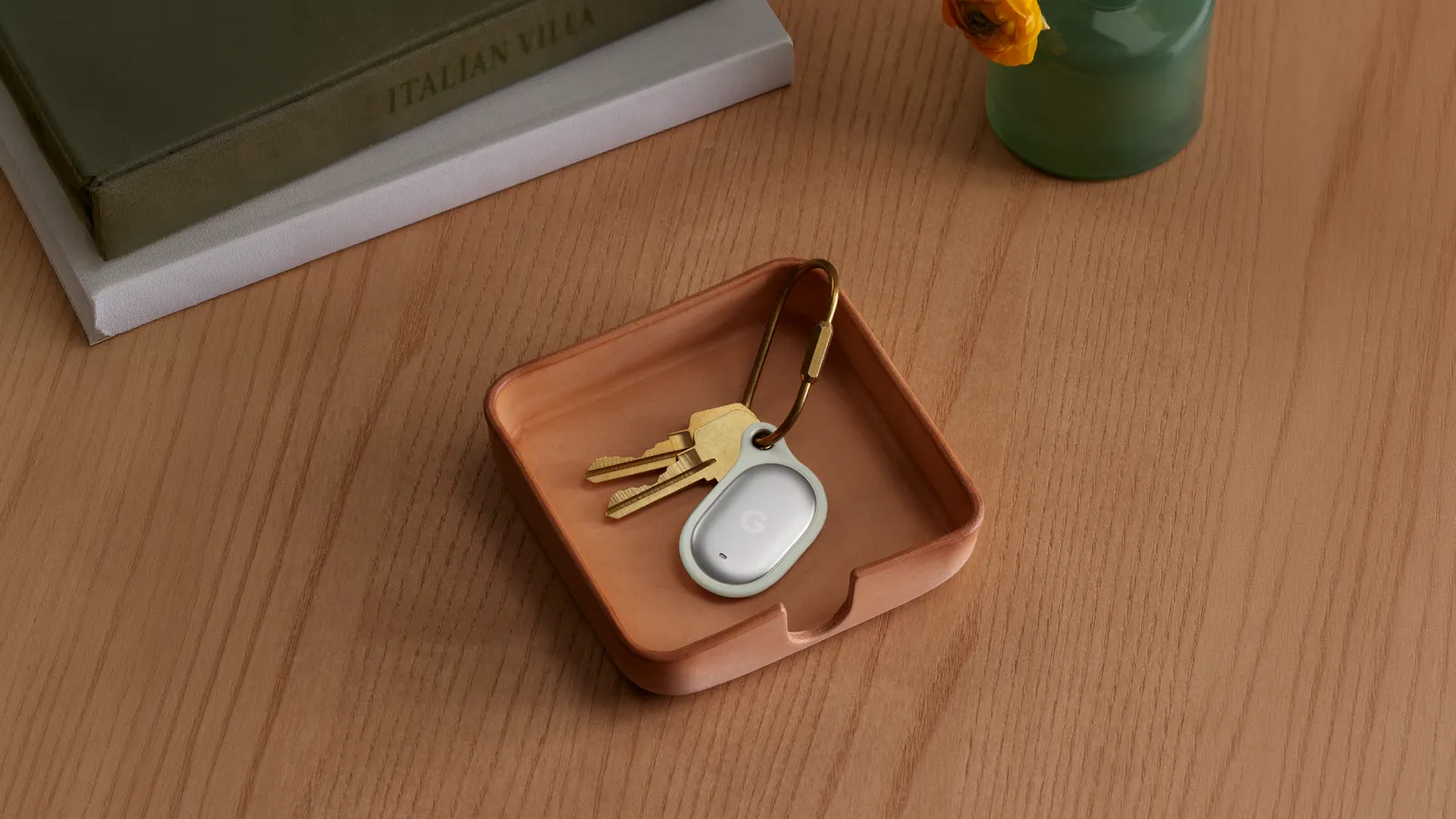
Google has finally made the thing Android travellers have been waiting for: a tracker that looks purpose-built rather than like an accessory company’s workaround.
Pixel Tag arrives at $29, with a replaceable CR2032 battery, IP67 protection, an onboard speaker and both Ultra Wideband (UWB) and Bluetooth Channel Sounding. It works with Find Hub, Google’s crowd-powered finding network, and goes on sale in November. On the table, that is a remarkably complete answer to an AirTag.
But this category is not won by the table. A tracker earns its keep at the airport carousel, in a taxi you have already stepped out of, or under a hotel bed—moments when the network, not the device in your hand, must do the work. Pixel Tag makes Android’s tracker proposition feel grown-up. It does not yet prove that Find Hub is as consistently useful as Apple’s mature Find My network.
The hardware solves the obvious objections
Google’s choices are sensible precisely because they avoid chasing novelty. The tag is a thin 11.8g stainless-steel-and-polycarbonate rectangle, not another sealed battery-shaped puck. Its button can make a paired phone ring, while the speaker lets the phone make the tag audible. That two-way finding sounds mundane; it is the feature set people actually use when keys vanish between the sofa cushions.
| Pixel Tag detail | What it means in daily use |
|---|---|
| $29 price | It lands at the familiar entry price for mainstream item trackers. |
| CR2032 battery, claimed to last over a year | You replace a coin cell instead of replacing the tracker. Actual life depends on alerts and precision finding. |
| UWB Precision Finding | Compatible Android phones can provide close-range directional guidance, rather than only a last-seen map pin. |
| Bluetooth Channel Sounding | A newer Bluetooth ranging technique intended to improve proximity awareness on compatible hardware. |
| IP67 rating | It is rated for dust and temporary immersion, not indestructibility or permanent water protection. |
| Find Hub network | Out-of-range location depends on nearby participating Android devices, not magic radio range. |
The compatibility footnotes are not decorative. Google says UWB precision finding needs an Android phone with UWB support; Channel Sounding needs a compatible device running Android 16 and Bluetooth 6.0 or newer. General tag compatibility begins with Android 9. That leaves many Android users able to locate a tag on the network, while reserving the best close-range experience for newer phones.
That is a fair trade if Google explains it clearly at checkout. It is a poor one if the word “precision” becomes a promise to people whose phones cannot deliver it.
The real product is Find Hub
Google says Find Hub can enlist more than a billion Android devices to help locate an out-of-range tag. That scale is the reason this launch matters: Android no longer has to concede the most legible tracker story to Apple or steer buyers toward a third-party brand.
Yet raw device counts are not the same as finding confidence. A lost bag needs a nearby participant at the relevant time; a missing key needs a useful last location and timely update; a tracker near someone else needs safeguards that discourage misuse. Those qualities depend on opt-in behavior, local device density, radio conditions and software decisions that a handsome piece of steel cannot fix.
Independent coverage makes the distinction worth keeping in view. The Verge highlighted the unusually full combination of UWB and Bluetooth Channel Sounding at this price. TechRadar, meanwhile, argued that Find Hub still has practical gaps to close against Apple’s equivalent. Neither point invalidates the other. Pixel Tag may be technically ambitious; its network experience still has to earn the same reflexive trust that makes people buy trackers in packs.
That tension is especially relevant for travellers. For a keyring around a dense city, even a merely good network may be enough. For checked luggage moving through sparse areas and restricted airport spaces, the gap between a recent location and a reliable live trail is the entire emotional value of the product.
Don’t mistake a launch claim for a recovery guarantee
Google’s own specification page provides the right caveats. The IP67 rating is tested at the factory and can diminish with wear, repair or damage. The over-one-year battery estimate uses pre-production hardware and an everyday-average pattern of sound playback and precision finding. A tag can help recover belongings; it cannot guarantee a location update or replace sensible travel labeling.
The safety context matters as well. Item trackers are useful because they can be found by devices that do not belong to the owner. That same architecture demands robust unwanted-tracking alerts and a simple way to identify and disable a suspicious tag. Google should be judged as hard on those protections as it is on the map experience. A tracker network is only convenient when it is also socially safe to carry around.
For readers already deep in Google hardware, Pixel Tag is a more grounded complement to GearPulse’s look at the Pixel 11 Pro’s attention-grabbing HiLight system. One feature tries to make a phone easier to ignore; the other helps find the things that should not have disappeared in the first place.
Bottom line
Pixel Tag is the Android tracker Google should have shipped years ago: affordable, replaceable, properly rugged and equipped with the right radios.
The buying advice is simple. If you use a recent Android phone and want a tag before the next big trip, Pixel Tag belongs on the shortlist when it reaches stores in November. Treat UWB and Channel Sounding as welcome hardware advantages, not proof that every lost item will return. The decisive test is whether Find Hub supplies fast, dependable sightings when your own phone is nowhere near the tag. Google has the hardware now. It needs the network reputation.
Support independent GearPulse articles at buymeacoffee.com/gearpulse.site.