
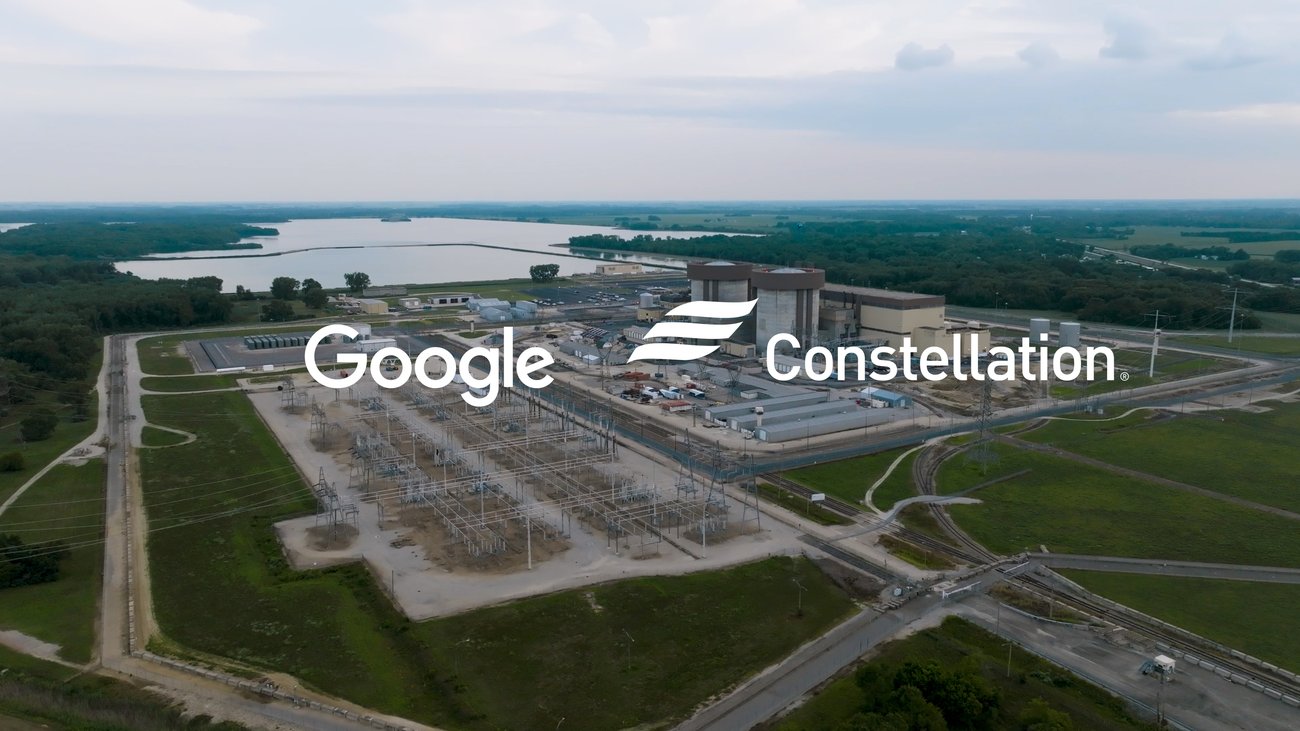
AI’s electricity problem is usually presented as a contest of giant, distant plans: new reactors, new transmission corridors and data centres arriving long before either. Google’s agreement with Constellation is more interesting because it starts with machinery that already exists.
The companies say their 20-year power-purchase agreement will support more than $4.3 billion of upgrades at 11 Constellation nuclear units in Illinois, Pennsylvania and New Jersey. The target is 890 MW of additional firm capacity on the PJM grid, with the first uprate expected in 2028. That is not an 890 MW private wire for a Google campus, and it is not a newly built reactor. It is a plan to extract more output from operating reactors—then sell that additional power into the regional market.
For people using cloud AI, the significance is less romantic and more useful: this is what a credible attempt to connect exploding digital demand to physical supply looks like. Capacity can still slip. Equipment work, regulatory approvals and outages still matter. But an uprate is a much shorter route to new generation than starting a reactor project from a blank site.
What Google and Constellation have actually agreed to
The headline contains several separate commitments that should not be blurred together.
| Element | Announced detail | What it means |
|---|---|---|
| New capacity | 890 MW from uprates at 11 existing nuclear units | More generation is intended for the PJM market, rather than a claim on existing output. |
| Contract length | 20-year PPA | Long-term revenue support gives Constellation a basis to fund the work. |
| First delivery | Expected in 2028 | A target, not capacity that exists today. |
| Existing-fleet deal | 2,700 MW for 15 years | A separate agreement aimed at keeping current Constellation generation in the PJM market. |
| Data-centre flexibility | Load-shaping and demand-response capabilities | Google says it will be able to reduce non-critical load during grid-stress events. |
The distinction between the 890 MW and 2,700 MW matters. The former is the incremental-output programme; the latter is a financial agreement around generation already operating. Combining them into a single “new nuclear” number would overstate the physical addition.
The companies describe the uprates as investments in equipment and technology that improve thermal and electrical efficiency. In plainer terms, the projects can include work on turbines, steam systems and controls so a licensed reactor produces more electricity from the same facility. The NRC’s public uprate schedule lists several Constellation filings as expected between late 2026 and 2030, a useful reminder that this announcement starts a regulatory and engineering programme rather than completing one.
Why an uprate matters more than another AI-power slogan
The easy version of this story is that Google has “bought nuclear power for AI.” That is not quite right. The agreement is tied to PJM, the regional grid serving all kinds of customers across 13 states and Washington, D.C.; electrons are not tagged and routed from a particular reactor to a particular chatbot.
The sharper point is that a major buyer is helping underwrite incremental, always-available generation in a grid region facing new load. That is important because cloud services feel virtual until capacity is constrained. Every image model, search result and agent request eventually meets a substation, a transmission queue and a power price.
We saw the same infrastructure arithmetic in Google’s Finland AI plan, where a long-term nuclear agreement was the hard detail beneath a very large data-centre investment number. This U.S. deal uses a different mechanism: upgrades at an existing fleet, rather than a life-extension agreement around one plant.
The appeal is time. Building a large new reactor takes years of licensing, financing and construction risk before it can add a megawatt. Uprates have their own technical and regulatory risk, but they work within operating sites, trained workforces and existing grid connections. That makes them one of the more plausible near-term ways to add firm low-carbon capacity—provided the promised performance is actually delivered.
The caveats are not footnotes
Neither Google nor Constellation has published a unit-by-unit capacity breakdown in the joint announcement. The 890 MW is therefore a portfolio target, not a consumer-facing specification sheet. It should not be read as a guarantee that every plant will add the same amount or that every project will arrive on the first expected date.
There is also a big difference between a signed PPA and an approved reactor modification. The NRC has to review applicable licence changes, and plant work must fit refuelling schedules, supply chains and operating requirements. The agency’s schedule shows expected applications, not approvals. It is evidence that uprates are a real regulatory category with a visible pipeline, not proof that this specific 890 MW has cleared every gate.
The broader affordability claims deserve the same discipline. Google and Constellation say the structure protects residential customers from the cost of Google’s demand growth. That is an objective built into their commercial arrangement, not something the public can verify on announcement day. Retail bills, transmission upgrades and PJM market outcomes will be decided across a much larger system.
Finally, the announced employment figures—roughly 4,400 existing jobs sustained and about 7,200 construction jobs—are company estimates. They help describe the scale of the work, but they are not a measure of completed economic benefit.
What to watch next
The first meaningful checkpoint is not another AI launch. It is the paperwork and equipment: identified units, NRC applications, approved modifications and the first verified increment of output in 2028. Then comes the harder test: whether the full 890 MW arrives without turning into a rolling sequence of revised dates.
Google’s demand-response promise is worth watching too. Flexible computing loads can help during a stressed grid event, but only if the company makes non-critical workloads genuinely interruptible when the grid needs relief. A press-release capability becomes valuable only when it is used.
Bottom line
Google has not solved AI’s appetite for electricity with a signature. But it has backed one of the few power strategies that can add substantial firm capacity before the next generation of new reactors could plausibly open: make existing nuclear plants produce more.
That makes the deal more consequential than a generic clean-energy claim and more grounded than a distant build promise. The test is now refreshingly concrete—permits, hardware and megawatts. If the first uprate lands in 2028 and the rest follow, the AI boom will have helped finance something the grid can use even when the data centres are not the only customers in the room.