
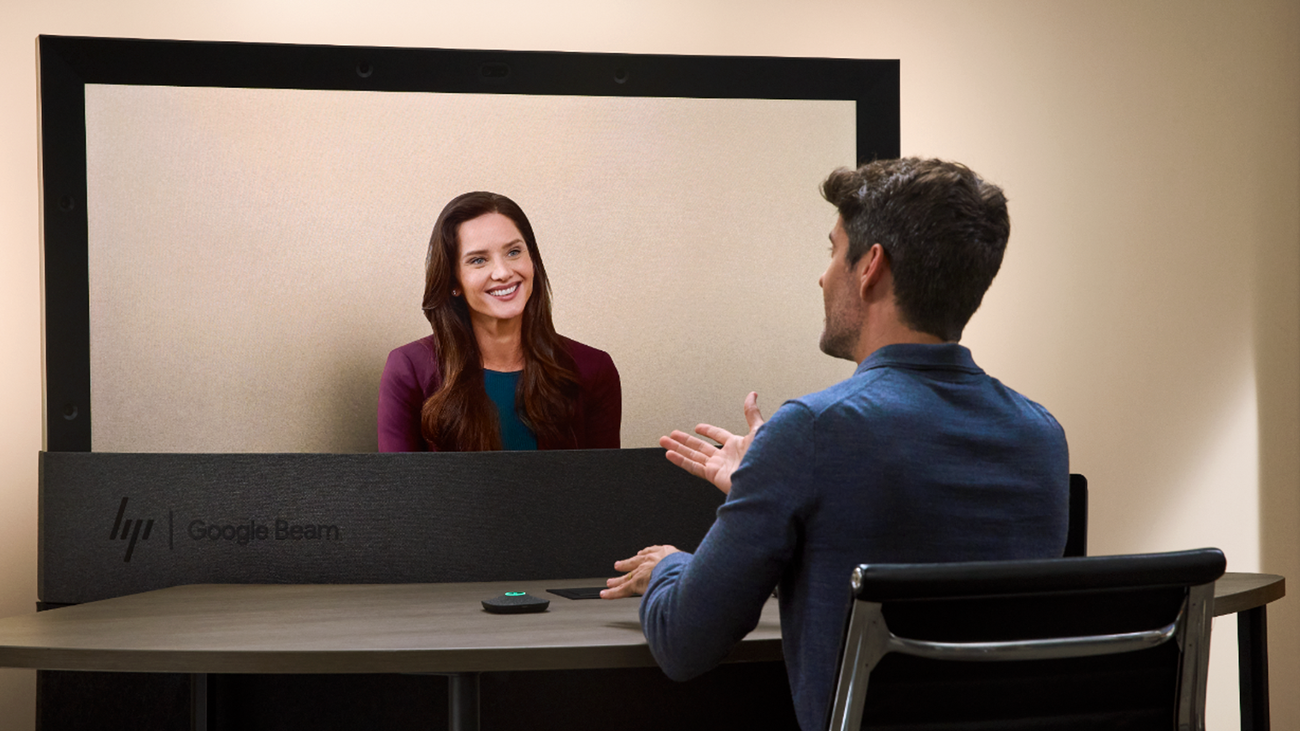
Google Beam has spent years as an impressive answer to a slightly theoretical question: could a video call feel three-dimensional without a headset? This week, the answer moves closer to an ordinary business decision. Google says HP Dimension with Google Beam is now shipping across the US, Canada, UK, France, Germany and Japan, while a partnership with co-working operator Industrious will put bookable units in selected US locations from October.
That is a more important milestone than another polished demo. The hardware is still a specialist, one-to-one meeting system rather than a replacement for every conference room. But putting it in a workspace network changes the question for smaller companies: instead of buying and installing a sizeable device, they may be able to reserve one when an interview, design review or delicate client conversation genuinely benefits from it.
The hardware is substantial—and deliberately narrow
HP Dimension combines a 65-inch light-field display, camera array, spatial audio and Google Beam’s processing to render a remote person with apparent depth and natural eye contact. It works with Google Meet and Zoom. HP’s product brief lists 600W active-call consumption, a minimum 50 Mbps symmetrical connection with under-100 ms latency to each unit, and a 119.4 kg system. That is a useful antidote to the “just software” framing around AI-era collaboration: this is physical workplace infrastructure.
| What HP Dimension brings | What it is for | The boundary to remember |
|---|---|---|
| 65-inch light-field display | Life-size depth in a one-to-one conversation | It is not an every-seat laptop feature |
| Cameras, 12-mic beamforming and four speakers | Capturing gestures and placing voices spatially | Room placement, bandwidth and acoustics still matter |
| Google Meet and Zoom support | Joining common business workflows | A normal 2D meeting remains the practical default for groups |
| Industrious extended network | Trying the format without owning the hardware | Initial locations are limited to Atlanta, Chicago, New York City and Palo Alto |
Google describes an eight-week internal study in which Beam users felt 50% more connected, found feedback 33% easier to understand and needed 21% fewer follow-up meetings. Those are promising signals, but they come from Google’s own study, not an independent comparison, so they should be read as a reason to test the format rather than proof of a return on investment.
Booking access is the interesting part
The six-country sales expansion is real progress, especially with 18 channel partners slated to deploy and support the systems. Yet the Industrious partnership is the strategic move to watch. High-end meeting hardware tends to stumble on utilization: a room built for a rare important conversation can sit empty on regular Tuesdays.
A shared-workspace network offers a way around that. A startup could use Beam for a candidate interview, an agency for a client briefing, or a distributed product team for a decision that relies on subtle reactions—without treating the equipment as a permanent office fixture. 9to5Google reports the first bookable locations are expected in October, so availability is still an announced rollout rather than a service people can use everywhere today.
This is where Beam is more convincing than the loose promise of “making calls feel real.” It is not trying to turn status updates into cinema. It is targeting the smaller set of meetings where body language, trust and shared attention have disproportionate value. That aligns with our earlier look at Google Meet’s Gemini notes: automation can reduce the admin around a meeting, but it does not automatically improve the conversation itself.
Buy the use case, not the sensation
There are practical cautions. HP says the 3D experience is for one-to-one calls; ordinary group calls remain 2D. The system has demanding space, power and network requirements, and Google’s announced reach does not include a public retail price. A team should also be skeptical of any productivity metric that has not been reproduced in its own workflow.
For an organization with repeated high-stakes remote conversations, a pilot is now more feasible: define the meeting type, compare it with a conventional video call, and measure whether decisions, follow-ups or candidate experience improve. If the value only appears in a staged demonstration, it is not value yet.
Bottom line: Google Beam is becoming less of a futuristic conference-room curiosity and more of a limited shared service. The next test is not whether the 3D effect impresses people—it clearly can—but whether bookable access turns that effect into better outcomes often enough to justify the space and cost.