
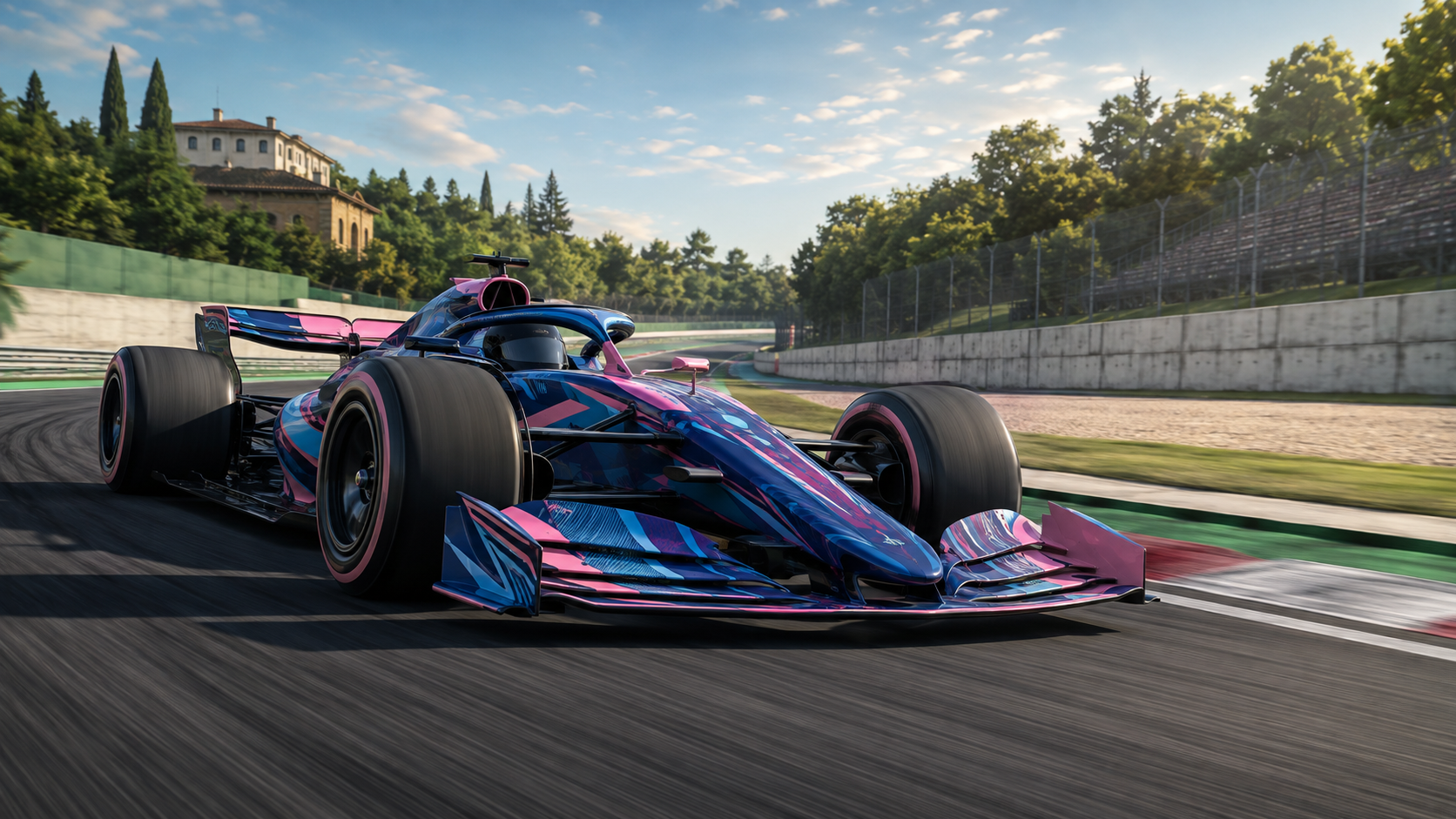
Qualifying spoilers follow.
Pierre Gasly’s 1:21.786 at Monza did not merely put an Alpine at the front of the Italian Grand Prix grid. It supplied the kind of answer a midfield team almost never gets so cleanly: its upgraded car can be quick enough to beat the established order when the conditions suit.
Formula 1’s official classification has Gasly 0.060 seconds ahead of George Russell, with Oscar Piastri third. The more revealing number for Alpine may be eighth: Franco Colapinto was 0.434s from his team-mate in the second A526. That is not parity, and no serious reading pretends otherwise. It is, however, a two-car Q3 result at a circuit that punishes a weak powertrain, draggy aero and uncertain braking platform with unusual honesty.
This matters because Alpine came to Monza to complete the comparison it began at Zandvoort. GearPulse’s earlier look at Colapinto receiving the same upgrade was about removing a variable before drawing conclusions. Saturday supplied the first dramatic result of that experiment: a pole lap from Gasly, with Colapinto close enough to show the underlying package was not living on one freak timing-screen flash.
The fastest Alpine was not supposed to be the obvious Alpine
Friday did not advertise this outcome. Gasly sat out FP1 for Paul Aron and finished FP2 14th, 0.154s behind Colapinto. Alpine’s own report was measured rather than prophetic: Gasly said the leaderboard did not reflect the car’s actual performance, but positioned Q3—not pole—as the realistic target.
That distinction is valuable. An underdog pole is often explained away as weather, a red flag, a fortunate tow or a single driver finding something magical. Those ingredients can all matter at Monza; a 5.793km lap with long straights and heavy braking zones magnifies small gains. But Gasly’s progression through qualifying was hard to dismiss as one lucky swing: 1:22.612 in Q1, 1:22.077 in Q2 and 1:21.786 in Q3. He improved every time the circuit and tyre programme demanded more.
The final margin was tiny, which is the correct way to hold this result. Russell’s 1:21.846 was close enough that one different preparation lap, tow or brake release could have changed the headline. AS and Cadena SER each describe Gasly overturning Russell at the end of Q3, while Formula 1’s classification preserves the unarguable bit: the Alpine completed the lap first.
That is a better story than declaring Alpine suddenly a regular front-row team. It has found a window in which its package can contend—and, unlike the old romantic version of a surprise pole, it did so with another car in the top eight.
Colapinto’s eighth is part of the evidence, not an inconvenient footnote
Gasly’s lap deserves the spotlight. Colapinto’s result protects it from becoming a solo myth.
The qualifying gap between the Alpine drivers was 0.434s, large enough to preserve the familiar truth that exceptional drivers can make exceptional laps. Yet Colapinto’s 1:22.220 placed him ahead of Lando Norris and inside a Q3 field where the first 10 cars covered only half a second. He was not close to pole; he was decisively involved in the session.
That gives Alpine a more useful engineering read than a P1 alone. When only one car appears at the front, a team must ask whether it has uncovered a transferable setup direction or simply enjoyed a perfect alignment of track position and driver confidence. Two cars in Q3 cannot settle that question, but it narrows the excuses. The same-specification trial now has a strong baseline for how the car behaves in the low-drag, high-braking condition that Monza makes so exposed.
It also revises the scale of Alpine’s season. Gasly arrived 10th in the Drivers’ Championship on 44 points; Colapinto had 19. Their combined 63 is not the scoreboard of a conventional front-running programme. That is precisely why pole means more than a pleasant Saturday statistic. It tells the team that the distance between its usual ceiling and the front is not purely a matter of ambition.
Pole position is an invitation, not a Sunday guarantee
There is a temptation to turn Monza pole into a prediction. Resist it.
The Italian Grand Prix will ask a different question: whether Alpine can preserve tyre life, manage energy and defend through repeated braking zones against cars with established race pace. A one-lap configuration may be brilliant at switching on the soft tyre and still be awkward over a long stint. Gasly’s 2020 Monza victory makes the setting irresistible as a story, but it adds no points to Sunday’s account.
The constructive consequence is that Alpine does not need a fairy-tale result for this qualifying to be meaningful. A composed race that turns one or both Q3 starts into points would reinforce the technical read. A difficult Sunday would not erase a qualifying lap that required pace through three separate segments, on a circuit unforgiving of fragile performance.
Bottom line
Gasly’s pole is a major personal lap and an earned Alpine moment. Its deeper value is that the team now has two cars on the same upgraded footing and a result that makes the development conversation concrete.
Monza has not declared Alpine a new permanent member of Formula 1’s elite. It has done something more credible: shown that, on the right kind of circuit, the team’s car can enter the fight on merit. For a programme that came here looking for an equal-spec answer, that is the cleanest proof it could have wanted.