
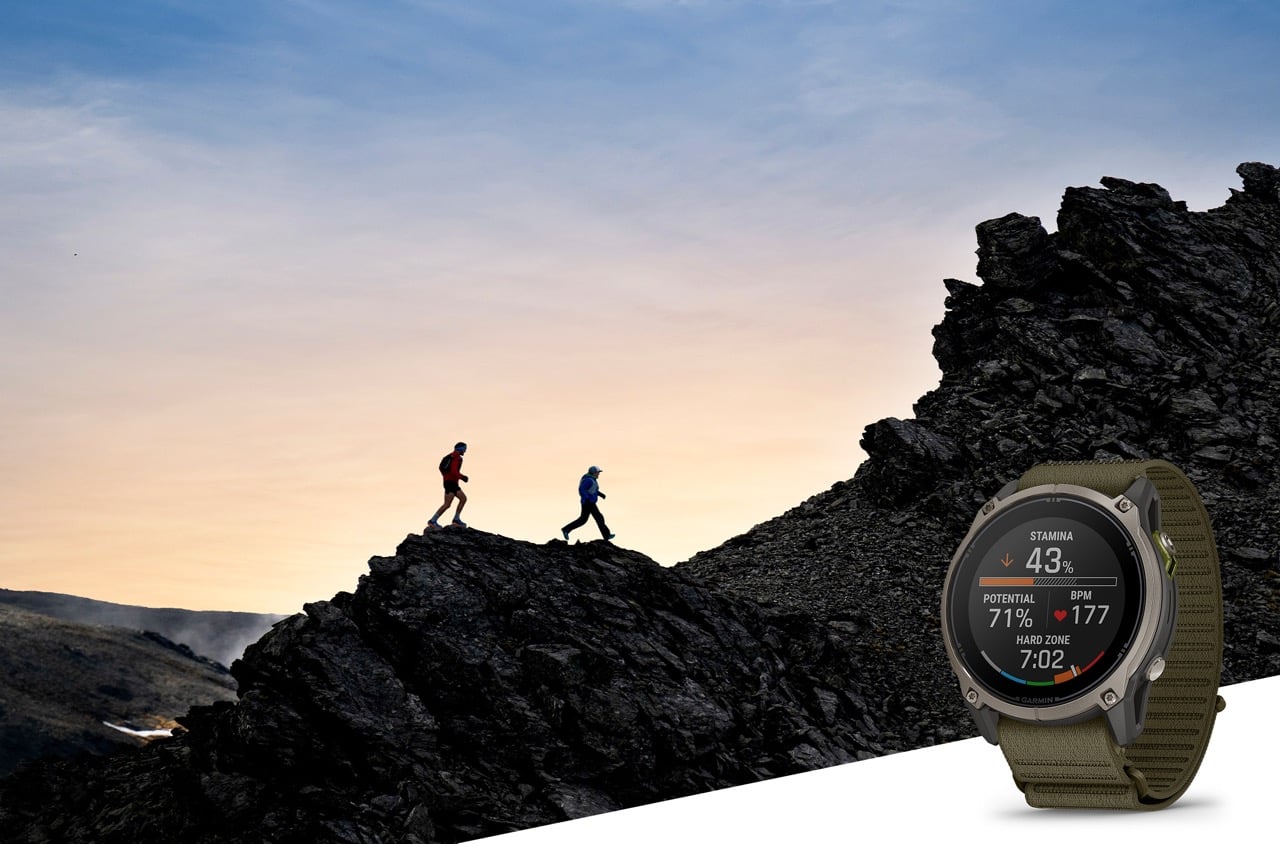
There are plenty of watches that can survive a weekend. Garmin’s Enduro line is for the person who would rather not think about a charger while the weekend becomes a route, then a weather problem, then a story worth retelling.
The new Enduro 4 does not try to turn that idea into a general-purpose smartwatch. It stays a 51mm, solar-assisted endurance watch with a memory-in-pixel display, a titanium bezel and a $899.99 US list price. The interesting upgrade is more practical: Garmin adds a quicker map engine, 64GB of storage, grade-aware pacing tools and a way to group a multi-day effort into one record.
That is a sensible place to spend a generation. On a long run, hike or bikepacking trip, the difference between having a map and being able to move around it quickly is not cosmetic.
The headline number needs its asterisk
Garmin rates the Enduro 4 for up to 320 hours in activity mode with solar charging, or up to 90 days in smartwatch mode. Those are large numbers, but they are not unconditional battery promises. Garmin’s footnotes assume 50,000-lux conditions for the full activity period, and three hours outside per day for the smartwatch estimate. The 320-hour figure also uses its extended-battery activity mode.
That does not make the watch less capable. It tells you how to read the claim: solar exposure, GPS settings, maps, sensors, music and the chosen power mode all matter. Garmin has at least made the trade-off explicit with presets called Max Accuracy and Max Battery.
| Enduro 4 detail | What is confirmed | Why it matters outdoors |
|---|---|---|
| Battery claim | Up to 320 hours in activity mode with solar; up to 90 days in smartwatch mode | The point is less charging during multi-day use, not a guarantee in every setting. |
| Case and display | 51mm case, 1.4-inch MIP display and solar lens | MIP remains the right choice for sunlight readability and miserly power use, even if it lacks AMOLED drama. |
| Storage | 64GB | More room for onboard maps, music and data; Wareable and Tweakers both report this is double the Enduro 3 capacity. |
| Navigation | 50% more RAM than Enduro 3; Garmin claims 30% faster map panning and adds Perspective view | Faster map movement is a quality-of-life upgrade when you are making decisions while tired. |
| Weight and protection | 66g, Power Sapphire lens, titanium bezel, 10 ATM rating | A durable watch still has to be tolerable on the wrist for days. |
| US price | $899.99 | This is premium expedition equipment, not a casual first running watch. |
Garmin is quietly fixing the unglamorous parts
The Enduro 4’s best additions live in the middle of an activity rather than on a product-page hero shot.
Garmin says its updated map engine pans 30% faster, while the larger memory allocation backs a new Perspective view for routable maps. The claim awaits independent field testing, but the direction is right. Navigation is not merely about seeing a line; it is about changing scale, checking the next junction and understanding elevation without stopping long enough to lose momentum—or warmth.
The other upgrades follow the same logic. Grade-adjusted rolling pace and grade-adjusted pace targets attempt to make pace useful when a route refuses to stay flat. Stamina Zones and Stamina Curve turn Garmin’s endurance estimate into a more legible in-activity tool. Indoor rowers get VO2 max and power-curve data, while ruckers can adjust pack weight during an activity rather than treating every loaded walk as the same effort.
None of that is a reason to take training-readiness scores as a verdict on your body. These are derived signals, not medical or coaching authority. But for an athlete already fluent in Garmin Connect, they can make a very long activity easier to pace with intention.
A watch for one coherent kind of user
Garmin Epic is the feature that explains the product best. It lets a user combine activities across days, weeks or months into a single shareable story in Garmin Connect, with aggregated health and performance data and photos. That will sound excessive to a person who runs a 5K after work. To a thru-hiker, stage racer or ultra-runner, it respects the fact that the meaningful unit of effort may not be one recorded activity.
It also makes the Enduro 4 a clearer complement to Garmin’s lighter, less intrusive hardware. The company’s screenless CIRQA Smart Band is about getting data without another glowing rectangle. Enduro 4 is the opposite end of that thinking: a dense tool for the moment when the route itself deserves the wrist.
| Choose Enduro 4 if… | Look elsewhere if… |
|---|---|
| You regularly record all-day or multi-day GPS activity and would value solar headroom. | Most of your exercise fits comfortably inside a weekly charging routine. |
| You want offline maps, navigation and lots of local storage in a purpose-built outdoor watch. | You want a smaller case, a vivid AMOLED display or a more phone-like smartwatch first. |
| Hill-aware pacing, rucking and expedition logs sound useful rather than fussy. | You mainly want basic runs, notifications and sleep summaries. |
| You can justify $899.99 for a specialist piece of kit. | You would rather put that budget toward safety equipment, shoes, a bike computer or the trip itself. |
The caveat: “up to” is doing real work
The Enduro 4 is not a dramatic reset. Independent launch coverage from Wareable and Tweakers reaches the same broad conclusion: Garmin has retained the familiar endurance proposition while improving storage, mapping and software. That makes this less compelling for a happy Enduro 3 owner who never feels constrained by maps or memory.
It also has the usual big-watch constraint. At 51mm, it is intentionally not subtle, even with a stated 66g weight. Garmin’s new ComfortFit fabric band is designed to wick moisture and uses QuickFit swapping, but comfort is personal; no launch spec can settle that. Nor should buyers confuse a 10 ATM water rating with permission to ignore Garmin’s care instructions or the limits of a specific activity.
Most importantly, the bold endurance number depends on conditions that a dark forest, a winter race or a navigation-heavy day may not provide. Treat it as a maximum under stated assumptions, then choose settings for the trip you actually have.
Bottom line
The Enduro 4 is a confident specialist upgrade: not a watch that promises to do everything, but one that makes its core promise more believable in the messy middle of a long outing.
For the right user, 64GB, swifter maps and more thoughtful pacing tools are more valuable than a new sensor headline. Garmin has made the long-haul watch less about enduring its own interface and more about staying oriented when the adventure stops being tidy. For everyone else, $899.99 buys a great deal of equipment that may make the next trip better before a wrist computer does.
Support independent source-backed coverage at buymeacoffee.com/gearpulse.site.