
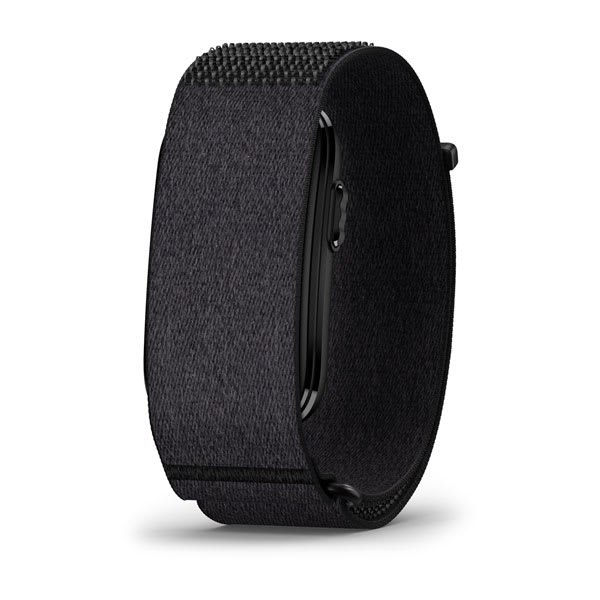
Garmin’s first screen-free band is interesting precisely because it does not pretend a screen is useless. The CIRQA Smart Band, announced July 21 and available now for $199.99 in the US, is built for the hours when a smartwatch is too much: sleep, recovery days, a low-distraction walk, or a run where you do not want pace numbers nagging from your wrist.
That makes it a better complement to a smartwatch than a clean replacement for one. Garmin says CIRQA delivers up to 10 days of battery life, 24/7 monitoring and no required subscription. Those are official claims, not GearPulse test results. Independent hands-on reporting supports the basic premise—good health tracking and a useful physical button—but also finds a bulkier, slower-drying fabric band than some buyers may expect. GearPulse has not worn CIRQA.
What the $199.99 gets you
Garmin’s launch material lists wrist heart rate, Body Battery, Pulse Ox, stress and skin temperature, with data reviewed in Garmin Connect. It also says the band can auto-detect activities and learn from corrections made in the app. A single button starts and stops a chosen favourite activity; LEDs and vibration supply feedback where a display normally would.
| Feature | What Garmin officially says | The important limitation |
|---|---|---|
| Battery | Up to 10 days | A claim, not a promise for every feature or user. |
| Health signals | Heart rate, Body Battery, Pulse Ox, stress, skin temperature and sleep-related data in Connect | These are wellness tools, not medical diagnosis. |
| Activity tracking | Manual start/stop plus editable auto-detection | Classification improves with corrections; it will not be perfect on day one. |
| GPS | Records outdoor location when connected to a phone’s GPS | No onboard GPS: bring the phone for a route/map. |
| Water | 5 ATM / 50m water rating, with swim tracking | Water rating is not permission for every water sport or depth. |
| Wearing options | Wrist band or upper-arm band | Fit, skin comfort and a dry band still matter. |
The connected-GPS point is the one to understand before buying. CIRQA can record a phone-assisted outdoor route, but it cannot replace a Forerunner, Fenix, Apple Watch or Pixel Watch for phone-free navigation, live pace on the wrist, or a map when you are halfway through an unfamiliar run. Its silence is the product feature and the product constraint.
No required subscription is true, but not the whole sentence
Garmin’s announcement is clear: CIRQA does not require a subscription for its core tracking and Garmin Connect data. That is a material contrast with Whoop and Oura’s subscription-heavy models, and with premium coaching layers attached to some alternatives.
The manual adds the necessary asterisk. Guided workouts in Garmin Connect require Garmin Connect+. The device itself is not a subscription trap; some optional service content is paid. That is a fairer distinction than either “everything is free forever” or “Garmin secretly made it a subscription band.”
Tom’s Guide reports that Fitbit Air’s Gemini-powered coach costs $9.99 monthly and Oura Ring 5’s app membership costs $5.99 monthly; prices and plans can change by region. CIRQA’s advantage is not that it offers every competing insight without a fee. It is that its core record of sleep, activity and recovery does not become inaccessible without one.
What independent hands-on work adds
TechRadar’s week-long review found the band generally accurate against an electrical heart-rate benchmark, although one workout was an outlier, and liked the certainty of the physical button. That is one reviewer’s test, not a clinical validation and not a promise of identical accuracy across skin, fit, activity type or firmware.
Tom’s Guide’s three-week experience puts the tradeoff in more personal terms: Garmin Connect is especially useful for someone already using Garmin devices, and the button is practical, but the fabric band felt bulky on petite wrists and stayed wet after water exposure. A separate 5,000-step comparison found CIRQA’s step count very close to a manual count and its climb figure close to the reference, while the same test had a session in which CIRQA recorded no heart-rate data. That mixture is exactly the right way to read early hands-on coverage: encouraging, but not a licence to stop checking data quality.
Garmin’s own manual is refreshingly specific about fit, too. It says to keep the band lightly snug, clean and dry, not to overtighten it, and to remove it if irritation occurs. A screenless tracker only succeeds if you can tolerate wearing it; comfort is not a cosmetic footnote.
CIRQA versus Whoop, Oura and Fitbit Air
| If you value… | CIRQA’s case | Better fit elsewhere |
|---|---|---|
| Garmin ecosystem continuity | Strong: Connect, Body Battery and multi-device use make it easy to wear CIRQA while a Garmin watch rests. | None of the rivals matches Garmin’s native device ecosystem. |
| No compulsory monthly fee | Strong for core tracking. | Whoop and Oura make more sense only if their coaching/app model is worth the recurring cost to you. |
| Disappearing on the body | Mixed: screenless, but several reviewers find it larger than Fitbit Air or an Oura ring. | Fitbit Air or Oura may be less obtrusive depending on wrist and ring tolerance. |
| Phone-free outdoor training | Weak: connected GPS only. | A smartwatch or GPS sports watch is the right tool. |
| A deliberate workout start | Better than many screenless devices because of the physical button. | Whoop/Oura/Fitbit Air lean more heavily on app or automatic detection. |
The most compelling CIRQA buyer is already in Garmin Connect and does not want to sleep in, shower with or wear to every desk meeting the same watch used for navigation and structured workouts. CIRQA can preserve the continuity of that person’s health record while reducing the sensation of being constantly on call.
The least compelling buyer is shopping for a single device to replace a smartwatch. You can make it work if your phone always comes along and you are happy reviewing results afterwards. But you will give up on-wrist pace, navigation, notifications, payment, music control and the small real-time decisions a display supports. That is not a flaw; it is the bargain CIRQA asks you to make.
Water and health caveats deserve plain language
Garmin rates CIRQA at 5 ATM/50m and includes swim tracking. That rating is about resistance under specified test conditions, not a blanket “waterproof forever” promise. Tom’s Guide’s water test also notes the familiar industry caveat: a 50m rating should not be read as approval for a 50m swim or every high-pressure water activity. Rinse, dry and follow Garmin’s care guidance—especially with a fabric band.
And no wearable turns readings into medical advice. Pulse Ox, skin temperature, stress and recovery estimates can be useful trends. They are not a diagnosis, and unexpected symptoms should go to a qualified clinician rather than an app dashboard.
Bottom line
CIRQA is Garmin making a thoughtful case for less interface, not less information. At $199.99, its best pitch is a subscription-free, screenless companion for people who already like Garmin’s data and want their wrist back at night or between training sessions.
Buy it as a smartwatch complement and the tradeoff makes sense. Buy it expecting GPS-watch independence and the phone-dependent GPS, app-first experience and deliberately absent display will feel like omissions rather than relief.