
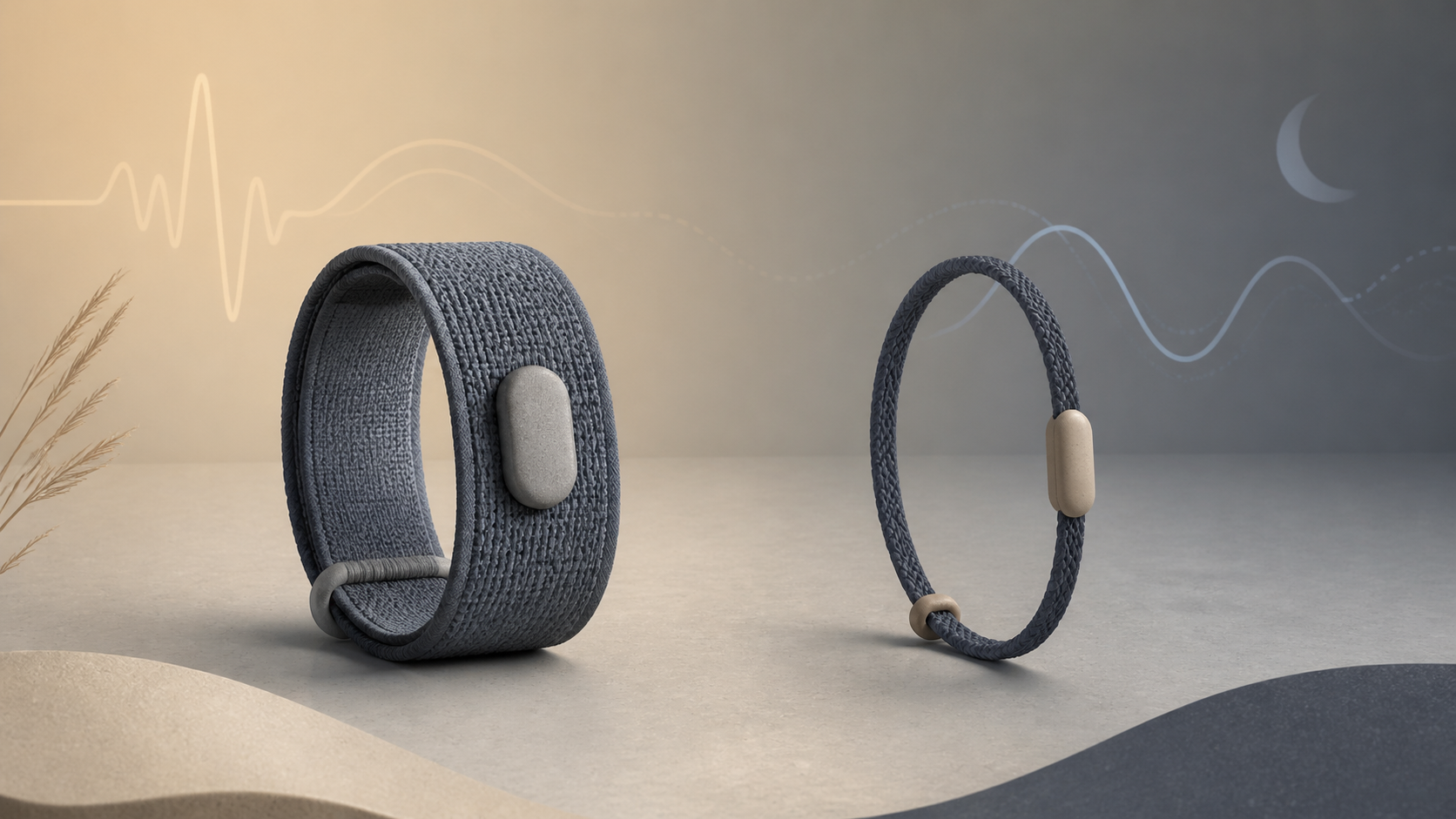
The interesting divide between the Garmin CIRQA and Google Fitbit Air is not a sensor arms race. Both are screenless bands meant to collect the day quietly. The divide is whether that quiet tracker should still give you a decisive way to say, this workout starts now.
CIRQA is the $199.99 answer: a broader band with a physical button, Garmin Connect and a serious set of training terms—training readiness, recovery time and VO2 max among them. Fitbit Air is the $99.99 answer: an exceptionally small 5.2g tracker module, a phone-first Google Health experience and a lighter touch on both wrist and wallet. Neither has onboard GPS or a display. GearPulse has not tested either; this comparison separates the manufacturers’ promises from the evidence in independent hands-on coverage.
The decision in one table
| Garmin CIRQA Smart Band | Google Fitbit Air | |
|---|---|---|
| Current US price and availability | $199.99; Garmin says available now | From $99.99 at Google Store; available to buy |
| Battery claim | Up to 10 days | Up to 7 days; Google also claims one day from a five-minute charge |
| Module weight | Garmin’s manual does not list module weight | 5.2g without band; 12g with band |
| Sensors / key metrics | Wrist heart rate, Pulse Ox, stress, skin temperature, Body Battery; sleep stages, score, HRV, respiration and naps | Optical heart rate, accelerometer/gyroscope, red/IR SpO2 sensors and temperature sensor; HR/HRV, SpO2, skin-temperature variation, sleep stages/score, cardio load and resilience |
| Workout control | One favourite activity can start/stop with the band button; 80+ activities in the app; auto-detection | Start a workout in the Google Health app or use auto-detection; no on-band button control described by Google |
| GPS / live information | Connected phone GPS; LEDs and vibration, no map or pace screen | Connected phone GPS; all viewing and workout interaction happens on the phone |
| Water rating | 5 ATM, equivalent test pressure to 50m | Water-resistant to 50m; IP68 rating at manufacture |
| Phone / ecosystem | Garmin Connect; compatible iPhone or Android phone for connected GPS | Google Health app and Google Account; Android 11+ or iOS 16.4+ |
| Subscription | No required subscription for core tracking; Connect+ is optional and guided workouts require it | No required subscription for core tracking; Google Health Premium unlocks Coach and premium features |
Those are maker-stated specifications and feature descriptions, not our lab results. They make the practical split unusually clear: CIRQA gives you more ways to classify and deliberately record training, while Air makes fewer demands on the wearer.
CIRQA is the better fit for people who train by intent
Garmin says the CIRQA button starts and stops one favourite activity, confirmed by LED and haptic feedback. That sounds modest until you compare it with reaching for a phone at the start and finish of every run, ride or gym session. In the manual, Garmin lists more than 80 activity types and says auto-detected activities can use motion, exertion, account history and, with consent, connected-phone location. It also warns that some activities and phone-guided workouts require Connect+.
That creates a more deliberate kind of screenless tracker. You can leave the visual coaching and live data behind, but still mark the boundary around a workout without unlocking a phone. Garmin’s wider training vocabulary—readiness, HRV status, VO2 max, training status, workout benefit and recovery time—will also land better for someone already fluent in Garmin Connect.
The companion case is covered in more depth in our earlier CIRQA review. The important comparison point here is narrower: CIRQA is not trying to be the least noticeable band. It is trying to make a mostly passive tracker feel less ambiguous when exercise is intentional.
Independent experience supports that distinction, with qualifications. Tom’s Guide found the button useful and called CIRQA bigger and heavier than Air, with a wider strap; it also noted that the fabric strap retained moisture. TechRadar praised the physical control in its review, but one reviewer or one firmware build is not proof that every fit will be equally comfortable or accurate. If you want a tracker you can confidently start at the wrist, CIRQA has the better interface. If you want to forget there is an interface, it does not.
Fitbit Air wins the sleep-and-low-friction brief
Google positions Air as its smallest tracker, and the specification sheet gives the reason its comfort pitch is credible: the module is 34.9mm by 17mm by 8.3mm and weighs 5.2g without its band. CIRQA’s exact weight is not published in the manual, so it would be false precision to invent a gram-for-gram comparison. The independent reviews are enough to establish the more useful truth: Air is the smaller-feeling option.
Android Central’s reviewer said Air’s thin woven Performance Loop was comfortable enough to forget and found it especially easy to sleep in. That is a reviewer observation, not a promise for every wrist or skin. Google itself advises removing and fully drying a sweaty or wet band before wearing it again, and notes that heart-rate accuracy varies with physiology, placement and movement. Comfort and clean skin are part of data quality, not an afterthought.
Air’s core health stack is not bare-bones. Google lists continuous heart rate, heart-rhythm monitoring with atrial-fibrillation alerts where available, SpO2, resting heart rate, HRV, sleep stages and duration. Its specifications add the optical heart-rate sensor, motion sensors, red/infrared oxygen sensors and temperature sensor. Google’s data documentation lists sleep score, cardio fitness/VO2 max, cardio load, target cardio load and resilience alongside those signals.
The limitation is interaction: a reviewer running a 5K with Air described starting it from the phone and missing a screen for wrist-glance pacing. That tester’s distance and heart-rate comparison with a Garmin was encouraging, but it was a single real-world run, not a validation study. Air can track a workout; it simply asks you to accept that the phone is the place to initiate, follow and inspect it.
Same GPS compromise, different consequence
Neither is the right standalone running watch. Garmin says CIRQA uses a compatible iPhone or Android phone’s GPS for outdoor walks, rides and runs. Google’s support table calls Air’s GPS type “phone (connected) GPS.” Bring the phone, grant the required location permissions and expect route, pace and distance to be phone-assisted; leave it behind and neither band supplies an onboard route track.
That shared limitation matters more than their seven- versus 10-day battery claims. Both can log a quiet lunch walk without becoming another notification screen. Neither can replace a sports watch for phone-free live pace, navigation or an on-wrist map. CIRQA’s button at least makes it less awkward to create a workout record; Air is more natural for people happy to review the day after it is over.
In Tom’s Guide’s two manually counted comparison walks, both bands came close on steps and distance, but the results changed with wrist placement. In the 5,000-step reversal test, CIRQA came closer on steps and climb while it recorded no heart-rate data; Air undercounted climb. That is useful caution, not a winner’s trophy. Treat any consumer wearable’s calorie, elevation, recovery and heart-rate trends as estimates sensitive to fit, movement and software—not medical evidence.
The subscription question: neither locks the basics, but the upgrade paths differ
Garmin explicitly says CIRQA needs no subscription for its core health and fitness tracking. Its manual says phone-guided workouts need Garmin Connect+, so “no required subscription” should not be stretched into “every service is free.” Current third-party pricing reported by Tom’s Guide is $6.99 monthly or $69.99 annually for Connect+; confirm the price in the app before subscribing.
Google includes a three-month Google Health Premium trial with the $99.99 Air. Google’s launch terms say it then renews at $9.99 per month unless cancelled; its help documentation says Premium adds Gemini-built Health Coach guidance, personalized plans, recommendations and workouts, with regional and eligibility limits. Core tracking does not require the plan. Google also says Google AI Pro and Ultra subscribers receive Health Premium at no additional charge, but that is only a saving if you already want—and pay for—those broader plans.
| First-year cost, before tax | What is verified | Practical reading |
|---|---|---|
| CIRQA without Connect+ | $199.99 hardware | The complete core-tracking cost, based on Garmin’s no-required-subscription position. |
| CIRQA with a year of Connect+ | $269.98 using the $69.99 annual price reported by Tom’s Guide | Optional coaching/workout layer; recheck checkout pricing. |
| Fitbit Air without Premium after the included trial | $99.99 hardware | Core tracking remains available without a paid plan. |
| Fitbit Air with Premium for nine paid months after its three-month trial | $189.90 at Google’s stated $9.99/month renewal | Assumes the buyer uses the whole included trial, then pays nine months; prices and eligibility can change. |
This is why Air is not merely the cheap pick. Even with nine paid Premium months, the stated first-year arithmetic remains below CIRQA hardware alone. Conversely, a Garmin user who does not need Connect+ gets a cleaner one-time-cost proposition, along with data that belongs in the Garmin environment they may already use.
Which screenless tracker deserves your wrist?
Choose Fitbit Air if sleep comfort, a smaller presence and a $99.99 entry price matter most. It is the stronger choice for someone who wants sleep, health and everyday movement collected with as little wrist presence as possible, is content to use the phone for workout control and lives happily in Google Health. Android and iPhone support make it broader than a Pixel-only accessory, though it still needs a Google Account and the Google Health app.
Choose Garmin CIRQA if you already use Garmin Connect, want richer training/recovery framing, or care about pressing a real control to begin a favourite workout. The extra $100 pays for more than battery headroom: it pays for a less phone-dependent start/stop ritual and better continuity with Garmin devices. It does not buy phone-free GPS, a screen or universal comfort; the broader, moisture-retaining fabric band is a meaningful drawback for some wrists.
There is no universal winner because these trackers are unusually honest about the same tradeoff. Air makes tracking nearly disappear. CIRQA makes a few training decisions feel deliberate without putting a tiny second phone on your arm. Pick the one whose absence you will actually keep wearing.