
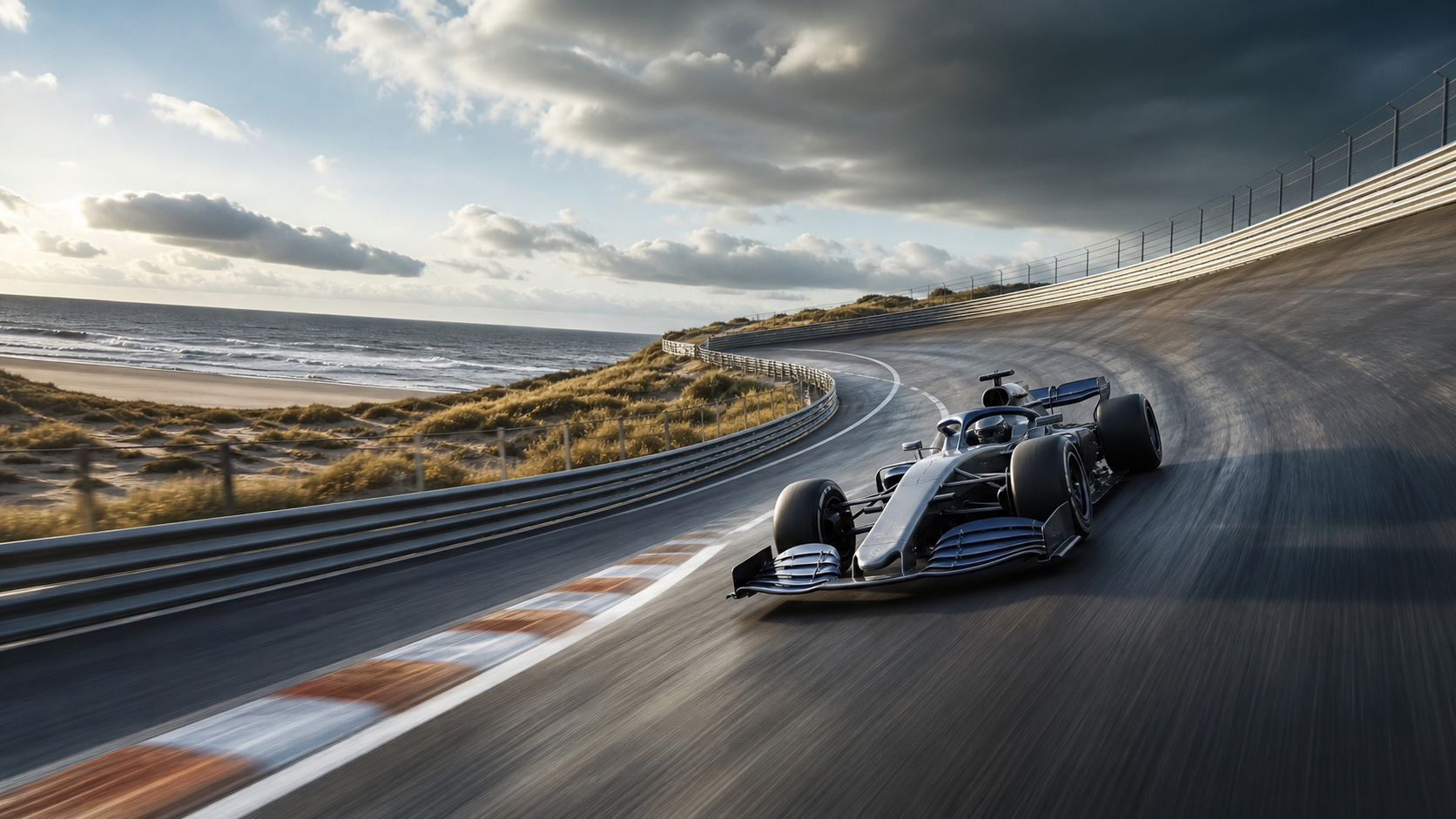
Zandvoort’s last scheduled Formula 1 weekend is not arriving gently. The Formula 1 Heineken Dutch Grand Prix, August 21-23, is also the circuit’s first Sprint event: one practice session, Friday Sprint Qualifying, a 24-lap Sprint on Saturday, Grand Prix qualifying later that day, then 72 laps on Sunday.
That is a lot of consequence for a 4.259km lap. It is also the right farewell shape for a circuit whose appeal has always been compression: banked corners, a narrow rhythm, dunes close to the asphalt and a crowd that makes every local detail feel larger. Formula 1 has confirmed that 2026 is Zandvoort’s final scheduled round, a context explored in our look at Verstappen’s Delft Blue home-race tribute. The weekend now has to do both jobs: produce a serious championship contest and say goodbye properly.
The essential timetable
All times are local (CEST, UTC+2) and remain subject to change, per Formula 1.
| Session | When | Why it matters |
|---|---|---|
| FP1 | Friday, Aug. 21, 12:30-13:30 | The only practice hour before Sprint Qualifying. |
| Sprint Qualifying | Friday, 16:30-17:14 | Sets the first points race and creates the initial parc-fermé compromise. |
| Sprint | Saturday, Aug. 22, 12:00, 24 laps | Eight points for the winner; tyre and traffic clues, not a Sunday rehearsal. |
| Grand Prix Qualifying | Saturday, 16:00-17:00 | The key session at a circuit where track position is precious. |
| Grand Prix | Sunday, Aug. 23, 15:00, 72 laps | 306.587km, or a two-hour limit, of small margins becoming big ones. |
Formula 1’s timetable supplies the 72-lap and 4.259km context. The Sprint calendar confirmation makes the larger point: Zandvoort is not merely the next race; it is a weekend where teams must settle their setup before they have seen much of the circuit in representative conditions.
Why this place rewards conviction
Zandvoort asks a car to be planted through long loaded corners and agile through sequences where a small slide costs the next corner too. The banking at Hugenholtz and Arie Luyendyk changes the line choices and vertical load; the short lap makes a tiny balance defect look dramatic on the timing screen. It also makes traffic awkward. A clean qualifying lap can be worth more than a theoretical race-pace advantage that cannot find a way past.
The strategy baseline is therefore simple, but not easy: protect track position, keep tyre temperatures in their narrow working window and leave enough flexibility for a Safety Car or changing coastal conditions. Wind and rain risk are not forecasts disguised as certainty here—late-August seaside weather can shift quickly, and the relevant call will be the official event forecast closer to each session. Teams that lock themselves into one tyre plan after FP1 may regret it.
There is a useful caveat for anyone treating the Sprint as a complete preview. The 24-lap race offers live information, but it occurs under different fuel, track-evolution and risk conditions from Sunday. It can validate a car’s traction or tyre-temperature behaviour; it cannot settle a 72-lap strategy by itself.
Who starts with the strongest hand?
Kimi Antonelli arrives leading the standings on 219 points, 50 ahead of Ferrari’s Lewis Hamilton and 59 clear of Mercedes team-mate George Russell. Mercedes has won eight of 11 Grands Prix, while Ferrari’s Hamilton and Leclerc have each won once and McLaren’s Lando Norris won the final race before the break in Hungary.
That gives the front of the grid three compelling comparisons:
| Comparison | GearPulse read | Editorial likelihood |
|---|---|---|
| Antonelli vs. Hamilton | Antonelli has the season-long cushion; Hamilton’s every-round points record makes him the pressure specialist. | Antonelli is the stronger all-weekend favourite, 35-45%; Hamilton a 18-25% win contender. |
| Mercedes vs. Ferrari | Mercedes’ two-car depth is the best protection against a volatile Sprint weekend; Ferrari has demonstrated genuine Sunday-winning pace. | Mercedes has a 50-60% chance to win, assuming normal reliability. |
| Norris/McLaren vs. the leaders | Hungary was the right kind of reminder: McLaren can still win, but needs to turn one strong weekend into a repeatable pattern. | Norris sits in the 8-14% win range. |
Those are transparent editorial assessments, not betting advice. They start with the standings and the 11 completed race results, then give Zandvoort extra weight for qualifying, short-run confidence and a Sprint’s limited preparation. They do not assume any unannounced upgrade, weather outcome or reliability failure.
Verstappen deserves a separate line, not a sentimental exemption. His home circuit knowledge and the final-Zandvoort atmosphere may elevate a strong Red Bull weekend, but the official standings place him sixth on 109 points. A podium would be a more grounded expectation than declaring a home win inevitable. That distinction matters more in a farewell year, not less.
Strategy notes worth keeping in mind
-
A front-row start has outsize value. The circuit’s flow and short lap punish time lost in traffic, while the banking can tempt drivers into ambitious but tyre-costly lines.
-
The undercut only works if the pit lane, warm-up and clear air cooperate. On a short lap, a small stop loss or traffic release can erase a paper advantage.
-
A Safety Car can change the tyre allocation and track-position calculation instantly. That is normal Zandvoort variance, not a prediction.
-
The Sprint gives teams an extra competitive session but not extra practice. The first setup decision has to be good enough to survive a weekend of changing grip.
Two proper farewell facts
Zandvoort returned to the F1 calendar in 2021 after a 35-year absence, and 2026 is its last contracted edition. Verstappen won the first three races after that return; Lando Norris won in 2024 and Oscar Piastri in 2025. The modern record is therefore already less one-note than the orange grandstands can make it appear.
The other good number is 72. Over 72 laps, the 4.259km circuit produces 306.587km of racing—enough distance for strategy to matter, but short enough that a few tenths in qualifying can shape the entire afternoon. Add Saturday’s 24-lap Sprint and the weekend asks cars to preserve more than 400km of competitive composure.
Bottom line
The Dutch Grand Prix is a wonderful test because it gives nobody much room to hide: not the car with a poor warm-up window, not the driver who misses a qualifying apex, and not the strategist who trusts Friday data too completely.
Mercedes and Antonelli arrive as the sensible reference, Ferrari and Hamilton as the sharpest counterargument, and McLaren as the team most capable of changing the conversation. Zandvoort’s final F1 weekend should be emotional. Its Sprint format ensures it will also be unforgiving.