
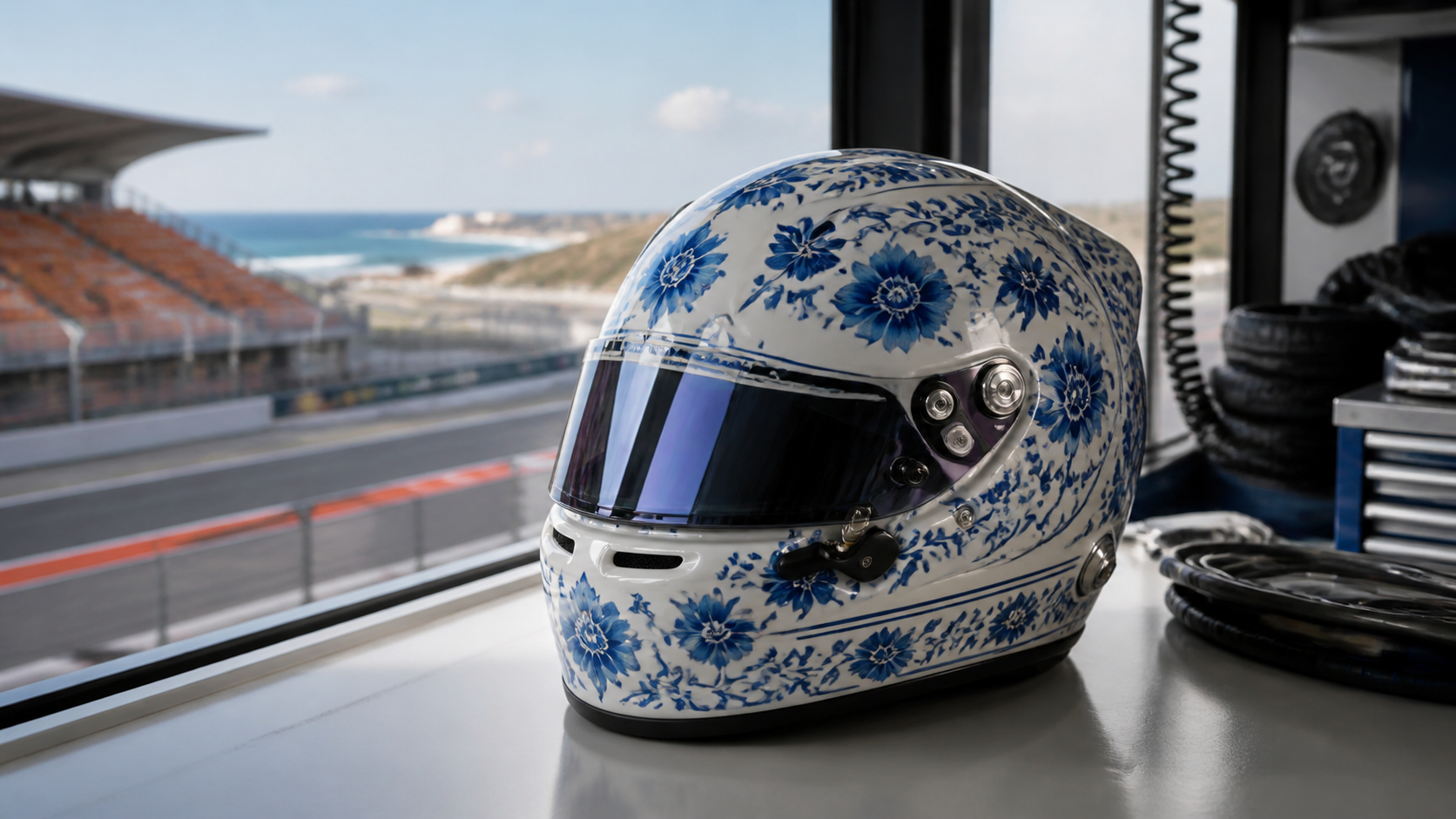
Max Verstappen’s latest Dutch Grand Prix helmet could easily be dismissed as a merchandise launch with a nice paint job. That would miss the point. The Delft Blue design lands one week before Formula 1 returns to Zandvoort for the last scheduled Dutch GP, and it neatly captures why this race is harder to replace than a date on a calendar.
The primary source is commercial, because the helmet was launched through Verstappen’s own store and collection page. But the news angle is wider than a half-scale model. Verstappen’s official copy frames it as a tribute to his final home race at Zandvoort, Motorsport.com reported same-day pickup and strong social traction around the reveal, and NL Times anchored the local context: the blue-and-white pattern draws on Delft Blue pottery, one of the Netherlands’ most recognizable craft traditions.
That makes this a rare summer-break F1 story with real texture. It is about a driver, a circuit, a national fanbase and a race that Formula 1 has chosen to let end while it keeps building a broader global calendar.
Why this helmet became the story
The design matters because it says the quiet part out loud. Zandvoort is not just another European round where a local hero happens to be popular. Since its modern F1 return in 2021, it has been built around Verstappen’s gravitational pull, the Orange Army and a seaside circuit that looks and sounds different from the sport’s more corporate venues.
Formula 1 confirmed in 2024 that the Dutch GP promoter had extended through 2026, but would not continue after that. The official Dutch GP site now sells the weekend as “The final lap,” with 21-23 August 2026 hosting the last edition and the venue’s first F1 Sprint on Dutch soil. So when Verstappen reveals a white-and-blue helmet for “my last home race,” it is not vague sentiment. It is a calendar marker.
There is also a useful sporting tension underneath the nostalgia. Verstappen is sixth in the drivers’ standings on 109 points, according to Formula 1’s current table. Red Bull is fourth in the constructors’ standings on 177 points, behind Mercedes, Ferrari and McLaren. That is not the context Zandvoort was used to during the early Verstappen boom, when the home weekend often felt like a Max-versus-the-world coronation.
This year, the farewell has a different edge. Verstappen can still make Zandvoort feel like the center of the F1 universe, but Red Bull does not currently look like the center of the title fight.
The calendar loss is bigger than one grandstand
GearPulse’s view: F1 should be careful about treating Zandvoort as a replaceable European slot. Not because every historic or atmospheric race has a permanent right to exist, but because the Dutch GP is one of the clearest examples of what F1 says it wants from modern events: a distinctive fan culture, visible identity, strong destination logic and a circuit with actual character.
The official F1 announcement praised Zandvoort’s fan experience, banked corners and sustainability work. The promoter’s own position was more practical: the event is privately run, and the decision to stop after 2026 balanced opportunity against risk and responsibility. That caveat matters. F1 cannot simply demand that every promoter keep absorbing costs because the television pictures look good.
Still, the loss is real. When Zandvoort drops away, F1 loses a race that tells a simple story before a lap is even completed. Orange grandstands, a local champion, a narrow old-school circuit and a crowd that behaves more like a national festival than a luxury hospitality product. Not every venue needs that exact formula. More venues need a formula at all.
The sporting stakes at Zandvoort
The Dutch GP race page lists a 4.259km circuit, 72 race laps and a 306.587km race distance. The 2026 weekend adds Sprint Qualifying on Friday and a Sprint on Saturday before Grand Prix qualifying. For Red Bull, that means more points on offer, but also less time to hide if the RB22 is still inconsistent over kerbs, wind changes or tyre temperature.
The likely competitive picture, as editorial analysis rather than betting advice:
| Question | GearPulse read |
|---|---|
| Is Verstappen the favourite? | Not on championship form alone. Mercedes and Ferrari have stronger 2026 momentum. |
| Can Red Bull win at Zandvoort? | Plausible if the car’s low-speed traction and tyre usage are tidy, but it needs a clean Sprint weekend. |
| What makes the weekend volatile? | Zandvoort’s short lap, traffic, coastal weather shifts and limited passing can magnify qualifying. |
| What would count as success? | A podium would be meaningful; a win would turn the farewell into one of the season’s signature moments. |
The fun stat is that Verstappen won the first three Dutch GPs after Zandvoort returned to the calendar. NL Times notes Lando Norris won in 2024 and Oscar Piastri in 2025, which means the modern Zandvoort story has already moved from Verstappen dominance to a broader competitive arc. That is exactly why the 2026 farewell is interesting: it is not a guaranteed homecoming parade.
The caveat: do not overread a helmet
A helmet reveal does not make Red Bull faster. It does not confirm Verstappen’s future, change the 2027 calendar or tell us what the RB22 will do over a Sprint distance. It is also tied to a product launch, which is why the commercial framing should be kept separate from the sporting argument.
But symbols matter in F1 because the sport runs on identity as much as lap time. Ferrari at Monza, McLaren in papaya at Silverstone, Mercedes under pressure at a German-speaking venue, Verstappen in orange at Zandvoort - these are not just color palettes. They are shortcuts for why people care.
The Delft Blue helmet works because it is more specific than another orange tribute. It connects Verstappen to Dutch craft history rather than just national branding, and it arrives as the race prepares to leave the calendar. That combination explains why the story cut through during the summer break, when many F1 headlines are either transfer speculation or mid-season grading exercises.
Bottom line
Verstappen’s Delft Blue helmet is a small object carrying a large message: Zandvoort’s final F1 weekend is not just the next race after the shutdown. It is the closing scene of the Verstappen-era Dutch GP as we know it.
If Red Bull is merely fourth-fastest, the weekend will still be emotional. If Verstappen can drag the car into the fight, it becomes something much rarer: a farewell with competitive bite. Either way, Formula 1 is about to be reminded that some calendar losses are measured in atmosphere, not only in hosting fees.