
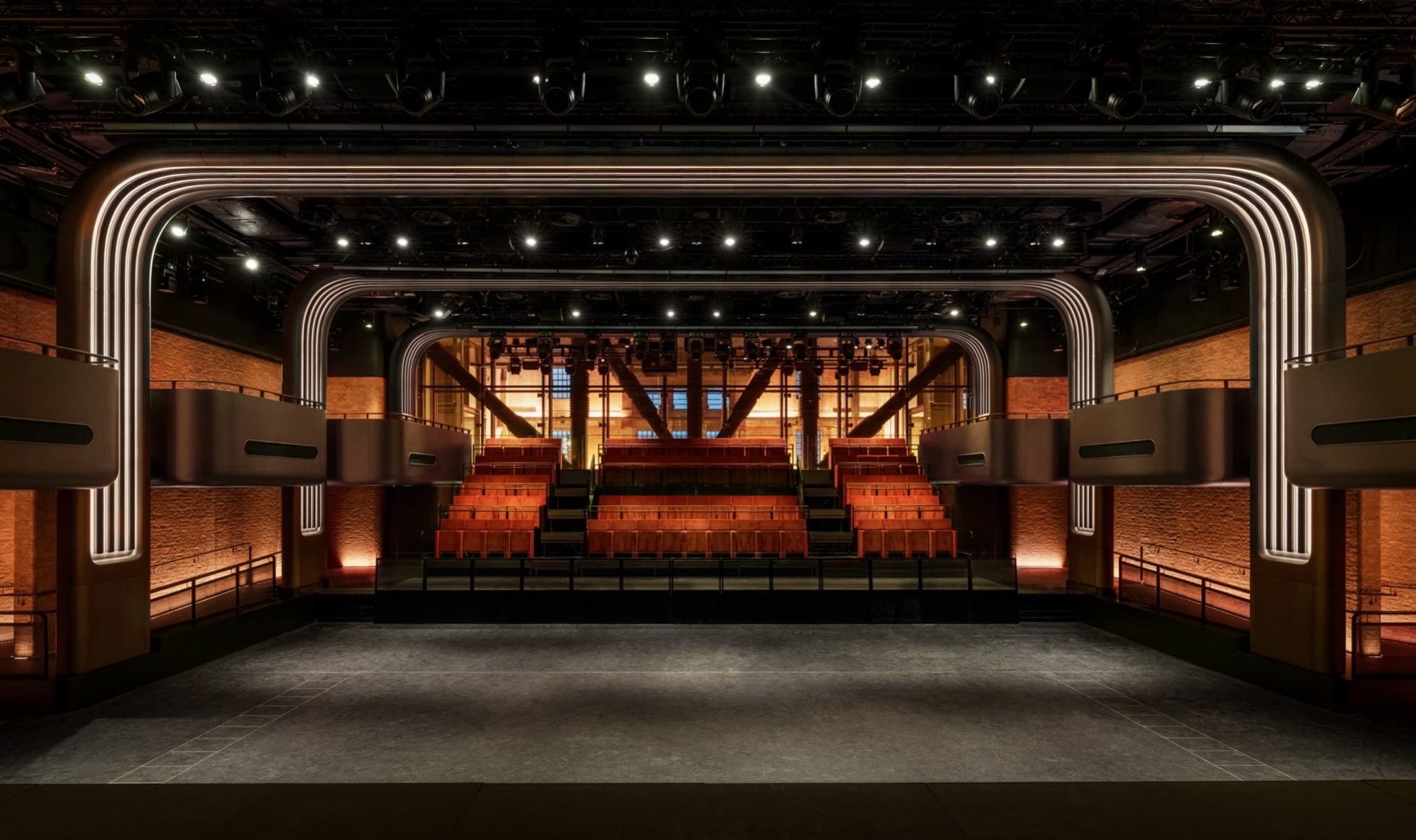
Apple has opened Apple Music Hall inside London’s Battersea Power Station. It holds 600 people, which is modest for a city accustomed to venue superlatives. But this room has been designed less as a place to merely host a show than as a place to finish one: capture the performance, mix it, package the picture and send it outward.
That distinction matters. Apple says the room combines a configurable 38-foot stage, a 48-speaker Spatial Audio system, two recording-and-mix studios and infrastructure for 16 or more cameras. Its stated goal is for a performer to leave a single event with a multitrack recording, a broadcast-ready mix and multicamera video. Apple’s announcement sets out those specifications; 9to5Mac’s launch coverage independently reports the September 28 opening date and says the first acts have not been announced.
For listeners, the audience in the room remains only part of the product. Apple says performances will be livestreamed globally, while the new London radio studios at Battersea will become the base for the company’s London-based Apple Music Radio output. The move makes the live room a bridge between Apple’s music subscription, radio shows, iPhone cameras and its Spatial Audio catalogue.
A venue designed around the edit suite
| Room element | What Apple says it enables | Why it changes the proposition |
|---|---|---|
| 600-capacity audience | An intentionally intimate live show | The room can feel like a special event rather than an arena rehearsal. |
| 38-foot reconfigurable stage | Conventional front-facing or in-the-round setups | Artists can change the visual language without rebuilding the venue. |
| 48-speaker spatial system | Immersive playback around the audience | Spatial Audio is part of the performance environment, not just a later release format. |
| Two recording and mix studios | Multitrack capture and Spatial Audio mixing | A performance can move toward a finished release without leaving the building. |
| 16-plus camera infrastructure | Broadcast cameras alongside iPhone capture | The visual deliverable is planned in the room, not improvised after the fact. |
The technical kit does not guarantee a great concert, a compelling livestream or a mix that translates beyond the venue. Spatial Audio in particular needs thoughtful production; more speakers are not a substitute for a good performance or a considered mix. But putting capture, postproduction and broadcast control together removes the usual handoff between a touring production, an outside studio and a video crew.
That is the genuinely interesting part of Apple Music Hall. The company is trying to make the 600-person show work at two scales at once: intimate enough to create scarcity in London, repeatable enough to reach everyone who was not there. Wallpaper*’s early look describes a project years in the making inside the restored power station, which helps explain why this is more substantial than a temporary branded stage.
The audience gets the benefit, but Apple owns the route
For artists, the attraction is practical. A single performance can potentially produce material for a live stream, an on-demand concert film, radio segments and an immersive release. That can be efficient, especially for an act that wants a polished moment without the expense and sprawl of an arena production.
For Apple, the same setup creates a controlled pipeline. The company can commission an event, record it in a format associated with its service, distribute it to subscribers and use the result to keep a fan inside Apple Music and Apple hardware. It is a familiar platform strategy, now expressed in a physical room.
That should make listeners ask ordinary but important questions as lineups arrive: Will the streams be available to every Apple Music subscriber? Will finished performances remain on demand? How are artists compensated for the subsequent uses? Apple has not published enough programming detail to answer those questions yet, so it would be premature to treat the Hall as an automatic win for artists or fans.
The tension resembles the one behind our look at Apple’s creator-suite push: Apple is good at turning a chain of tools into a smoother experience, but the value of that convenience depends on the terms and access around it.
Bottom line
Apple Music Hall is compelling because it treats a live show as raw material for several finished experiences without stripping away the reason people value a small room in the first place. The 600 seats create the occasion; the cameras, studios and speakers are how Apple intends to extend it.
The missing ingredient is programming. Until Apple reveals artists, ticket rules and the scope of its streams, this is impressive infrastructure rather than proof of a new live-music destination. Still, it is a smarter bet than a generic flagship venue: a purpose-built engine for turning one good night in Battersea into something much larger.