
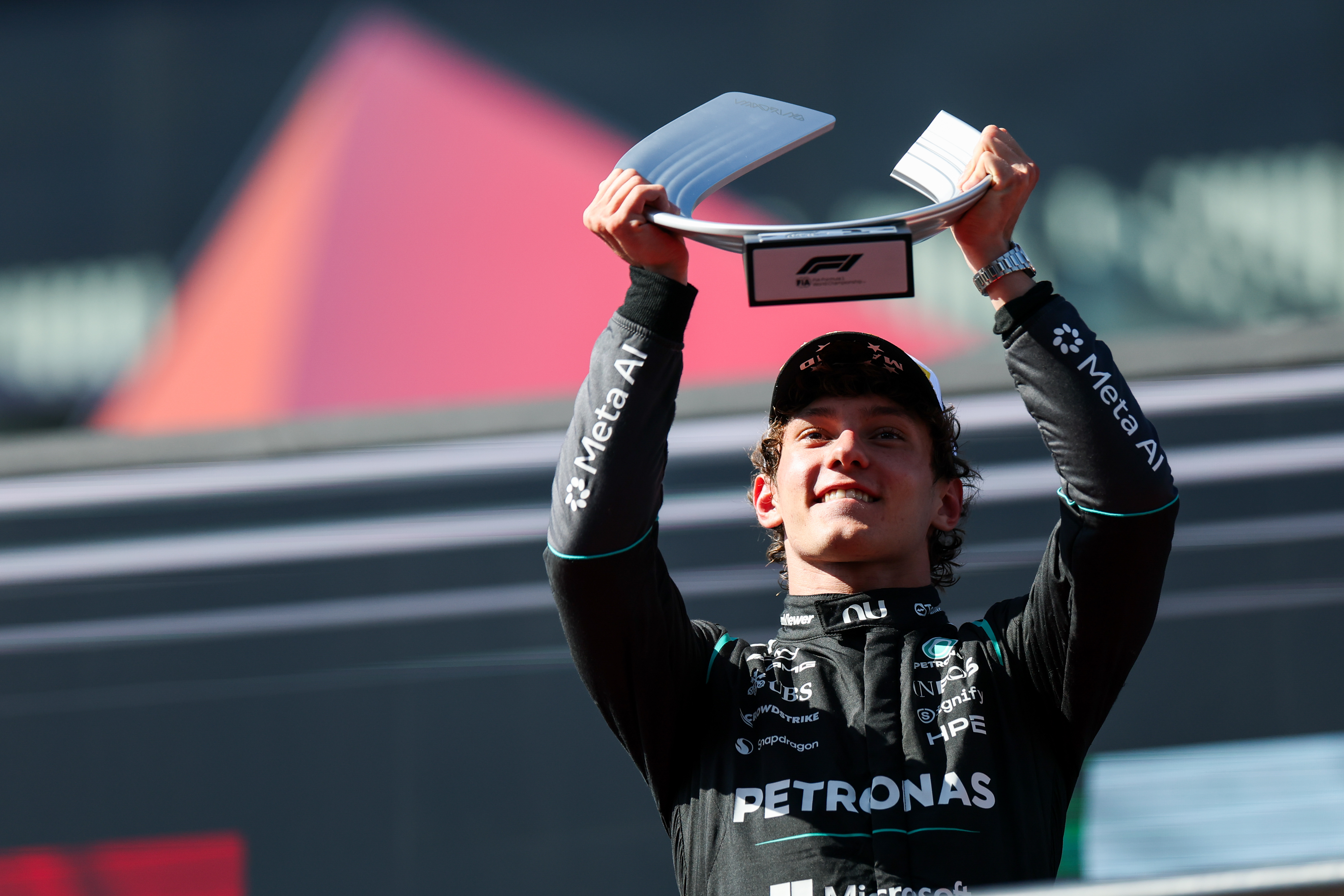
Kimi Antonelli won Madring’s first Formula 1 race, but the more revealing part of the Spanish Grand Prix was not a wheel-to-wheel coup. It was the moment a Virtual Safety Car arrived after Lando Norris had committed to the pit lane.
Norris had controlled the early race from pole. Antonelli eventually won for Mercedes, 4.351 seconds ahead of Max Verstappen, with Norris 0.738 seconds behind the Red Bull in third. The FIA’s final classification confirms the order; its race report identifies Lance Stroll’s Lap-13 stoppage as the trigger for the VSC that changed the stop sequence.
That is not an argument that Antonelli was somehow undeserving. It is a sharper lesson: on a difficult new circuit, a safety-car decision can turn position on the road, a 562-metre pit lane and a few seconds of timing into the decisive performance variable.
The result
| Position | Driver | Team | Gap |
|---|---|---|---|
| 1 | Kimi Antonelli | Mercedes | 1:34:23.754 |
| 2 | Max Verstappen | Red Bull | +4.351s |
| 3 | Lando Norris | McLaren | +5.089s |
| 4 | Charles Leclerc | Ferrari | +29.116s |
| 5 | George Russell | Mercedes | +29.829s |
Antonelli had to give up position after his opening-lap attack through the chicane, while Norris built an early lead of roughly 4.5 seconds. The FIA report says Stroll then stopped at Turn 20 with a suspected brake issue, bringing out the VSC on Lap 13. Drivers able to take service at reduced pace gained heavily; Norris had already passed the pit entry and could not exploit that window in the same way.
Autosport and Motorsport.com independently describe the same strategic reversal. Norris recovered to the podium but could not find a way past Verstappen in the closing laps. Antonelli, speaking after the race, made the point without much spin: he said Norris deserved the win, while also noting Mercedes had strong pace on the hard tyre.
Why the VSC mattered more than a conventional strategy split
A normal pit stop costs time because the car slows for entry, travels the pit lane and rejoins. Under a VSC, the field is constrained to a delta, which shrinks the relative loss for a car that happens to stop at the right moment. That is not a loophole; it is part of the sporting framework. But on a track where passing proved difficult, the effect can be brutal.
| Race ingredient | What changed at Madring |
|---|---|
| Norris’s early advantage | It was not large enough to protect him from an unfavourable VSC window. |
| Pit-lane timing | Being beyond the entry when the VSC appeared mattered as much as the stop itself. |
| Track position | Verstappen could defend second despite Norris’s recovery pace. |
| New-circuit uncertainty | Teams had less historical evidence for tyre life, traffic and stop timing. |
Our race-start preview framed Madring as a tyre-and-brake management problem over 57 laps. The race added another conclusion: the circuit’s narrow strategic margin makes operational readiness unusually visible. A team can execute a fast stop and still lose the important race because the event arrives one corner too late.
Madring’s first race did not make the track a solved quantity
The weekend’s first winner also became the first useful reference point—not a definitive verdict on the circuit. The FIA’s report records an early lead change, a VSC, tyre management, retirements and a late fight for the podium. Those ingredients made the race meaningful, but they also make it dangerous to declare that Madring will always reward one type of car or strategy.
There are specific caveats. Charles Leclerc stayed out hoping for a later interruption and eventually finished fourth after stopping. Hamilton, Stroll, Sergio Pérez and Carlos Sainz did not finish; Piastri recovered to eighth after early front-wing damage. One event with that many interruptions cannot give engineers a clean baseline for degradation or overtaking.
The audience relevance is more practical than the podium headline. F1’s 2026 active-aero era has made the sport increasingly legible as an operating system: deployment states, brake temperatures, energy management, pit windows and race-control decisions interact in public. Madring showed that the operation is not merely supporting the car—it is part of the car’s race pace.
Antonelli leaves Madrid with the right kind of momentum
Antonelli’s win was his eighth of the season and extended his championship lead to 81 points, according to the FIA. Mercedes will understandably take confidence from the result, including the hard-tyre pace Antonelli cited afterward. Still, the strongest interpretation is narrower than “Mercedes had the fastest car all afternoon.”
They were in position to benefit, avoided turning the early battle into damage and executed the race that came to them. Verstappen likewise converted a difficult afternoon into second; Norris drove well enough to make the missed opportunity obvious.
Bottom line
Madring’s first Grand Prix was not decided by a mysterious technical failure or a headline overtaking move. It was decided by the sort of timing decision that rewards a team already ready to act—and punishes one caught on the wrong side of pit entry.
Antonelli has the trophy, and Mercedes has a deserved result. But the enduring lesson from Madrid is for every contender: at a track where overtaking is scarce, the VSC is not background noise. It can be the race.