
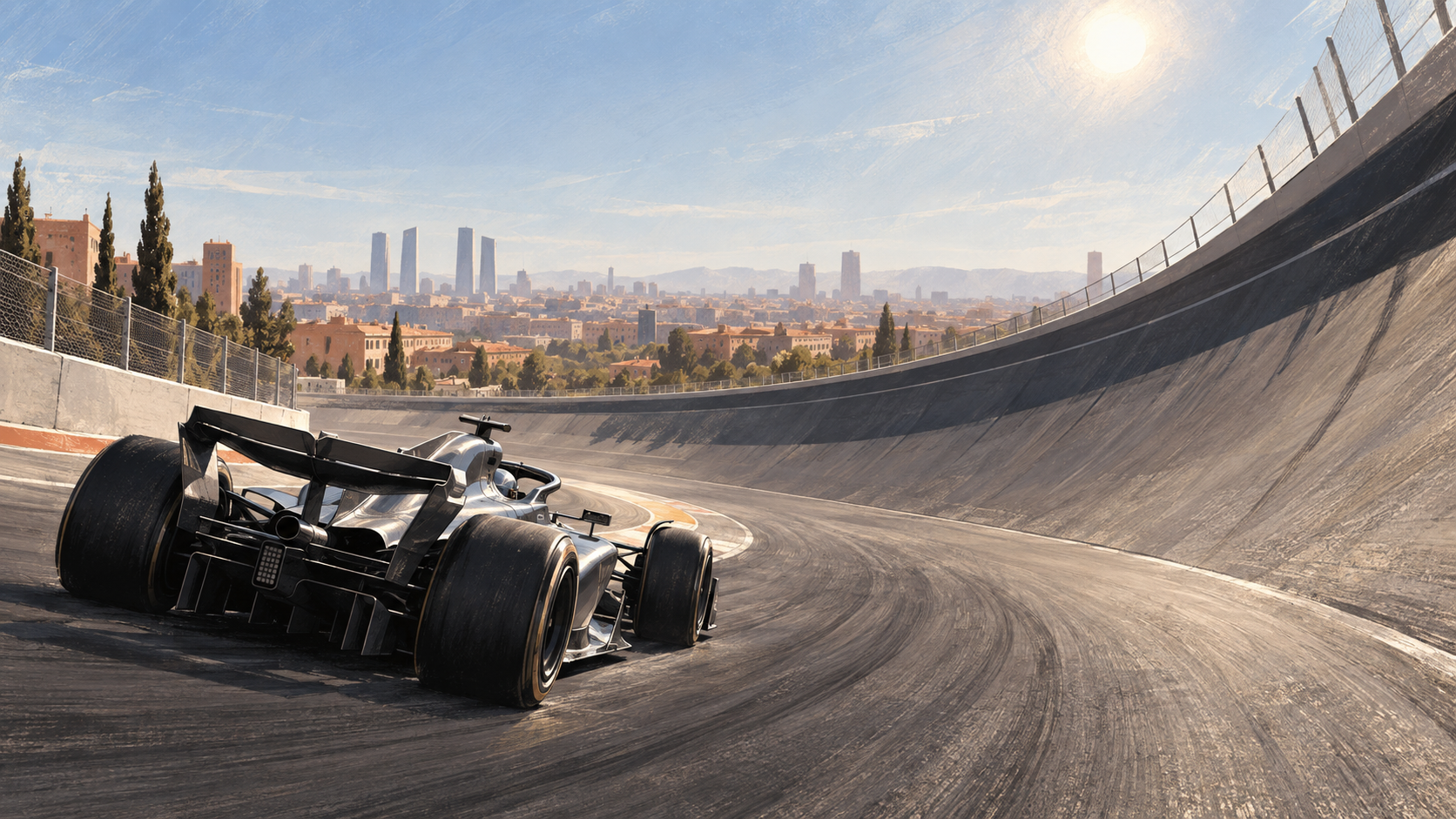
The 2026 Spanish Grand Prix is scheduled to start at 13:00 UTC on Sunday, September 13 — 15:00 CEST in Madrid. Formula 1’s official event page sets the first Grand Prix at the new Madring over 57 laps, for 308.399 km.
This is an event-start preview, not a live report. GearPulse is not trackside, has no live timing or telemetry access, and makes no claim about the race’s outcome. The important question at the start is more durable than a first-corner prediction: can a team preserve a working tyre-and-brake platform through a race distance at a circuit with almost no Formula 1 history?
A 57-lap problem, not a qualifying extension
Madring is 5.414 km long and has 22 corners. It combines permanent and public-road sections, but its defining piece is La Monumental, the long banked Turn 12. Formula 1’s circuit guide and Pirelli’s pre-event material point to unusually high vertical loading there; Motorsport.com’s independent pre-weekend reporting also identified low initial grip, track evolution and lateral load as the central tyre questions.
That changes the race engineering hierarchy. A setup that can produce one committed lap is only the opening requirement. Across 57 laps, it must also prevent the rear axle from overheating in traction phases, keep braking responses consistent after the two Straight Mode sections and leave the driver confidence to return to the banking without asking too much from the tyre surface.
| Verified Madring fact | Race consequence |
|---|---|
| 5.414 km, 22 corners | The platform must work in mixed-speed sequences rather than protect one ideal sector. |
| 57 laps, 308.399 km | Stint length, cooling and tyre life matter as much as initial pace. |
| Smooth new asphalt | Grip and tyre behaviour may evolve faster than at an established venue. |
| Long banked Turn 12 | A stable aerodynamic and mechanical platform helps protect the tyres at sustained load. |
For GearPulse readers, the useful comparison is between peak performance and usable performance. A car can look efficient when the drag is reduced, but it is only race-efficient if that choice does not create a braking or temperature penalty that repeats every lap. The new venue turns that compromise from a background calculation into the race’s main technical story.
Straight Mode is a stability test too
The 2026 rules replace old DRS shorthand with active-aero states. At Madring, Formula 1 identifies two designated Straight Mode zones: the start/finish straight and the section from Turn 3 to Turn 4. The car moves from a low-drag state back to a higher-downforce cornering state; it is not simply a question of who achieves the largest terminal-speed number.
That handoff matters most when the race has settled into tyre management. Less drag can improve the run along a straight, while a calmer return to the braking phase can reduce the small corrections that add heat to the front tyres or unsettle the rear. A team chasing the first benefit must still pay for the second one 57 times.
The strategic implication is deliberately conditional. The first Formula 1 race at this layout does not provide a historical baseline for declaring a one-stop or two-stop answer before the lights go out. A lower-degradation run could favour track position and a simpler race; higher thermal stress or a changeable surface could make fresher rubber more valuable. What teams will try to establish is the crossover point: when does staying out cost more than the time and position recovered by a stop?
Heat turns tyre management into an operating window
Pirelli’s nominated compounds are C2 hard, C3 medium and C4 soft. The official pre-race forecast calls for dry conditions in Madrid, with temperatures around the high twenties Celsius during the afternoon; it does not remove uncertainty, but it raises the importance of tyre preparation, brake cooling and energy use. Hot conditions can make an initially responsive car difficult to keep within its useful window over a long green-flag stint.
The new asphalt is equally important. On a circuit teams know well, historical runs help separate a tyre issue from a setup issue. Here, teams have less race-distance evidence and must treat the surface as an active variable. A car that can make the C3 or C4 work briefly but cannot retain balance once surface temperatures climb may force an earlier decision; a car that asks less of the tyre may have more flexibility if the race becomes a contest of stint length.
That is why the tyre choices cannot be read as a prediction. C2/C3/C4 is a sensible middle-range allocation, but Madring’s combination of heat, smooth surface and banking can push the race in different directions. The more credible preview is a checklist: watch for tyre-temperature language, brake management and whether drivers can follow another car without immediately compromising the next sequence.
Madrid’s first modern F1 race is a shared learning exercise
Formula 1 last held a World Championship race in Madrid at Jarama in 1981. The history is meaningful because it underscores the absence of a relevant modern setup archive: this is a new Formula 1 circuit, not a renamed version of an old weekend. El País’s pre-event reporting described La Monumental as almost 550 metres long with banking up to 24%, a characterful feature that makes the new track more than a generic city backdrop.
Carlos Sainz and Fernando Alonso carry the natural home-race attention, but their relevance here is technical as well as emotional. A driver who can articulate whether a limitation comes from the car’s entry stability, the tyre’s temperature or the changing grip gives engineers a faster route to a better race platform. That is a useful distinction on a first visit, where confidence can otherwise be mistaken for a permanent setup advantage.
The same logic applies to every team. McLaren, Mercedes, Ferrari, Red Bull and their rivals can arrive with simulator work and practice data, yet none has a previous F1 Spanish Grand Prix at Madring to use as a full-distance control sample. The strongest operation will be the one that makes a car predictable enough for its driver to place it accurately while retaining options when the tyres ask for restraint.
What to watch without a result lens
Three race details will explain more than a single headline number:
- The transition back from Straight Mode. Stability at the next braking phase reveals whether efficiency is helping the whole lap or merely its easiest section.
- The length of the useful tyre window. Listen for grip, surface temperature, graining and cooling rather than treating a compound name as a strategy verdict.
- Repeatability through the banking. La Monumental rewards a car that lets the driver commit without turning a high-load corner into a tyre-management debt for the next sector.
The fixed frame is clear: a 13:00 UTC start, 57 laps around a 5.414 km, 22-corner Madring, two Straight Mode zones, C2/C3/C4 tyres and a dry, warm forecast. Madrid’s new Grand Prix gives Formula 1 a circuit with its own visual identity, but its first race is likely to be decided by a more familiar engineering discipline: preserving enough control, temperature margin and strategic choice for the final part of a long afternoon.