
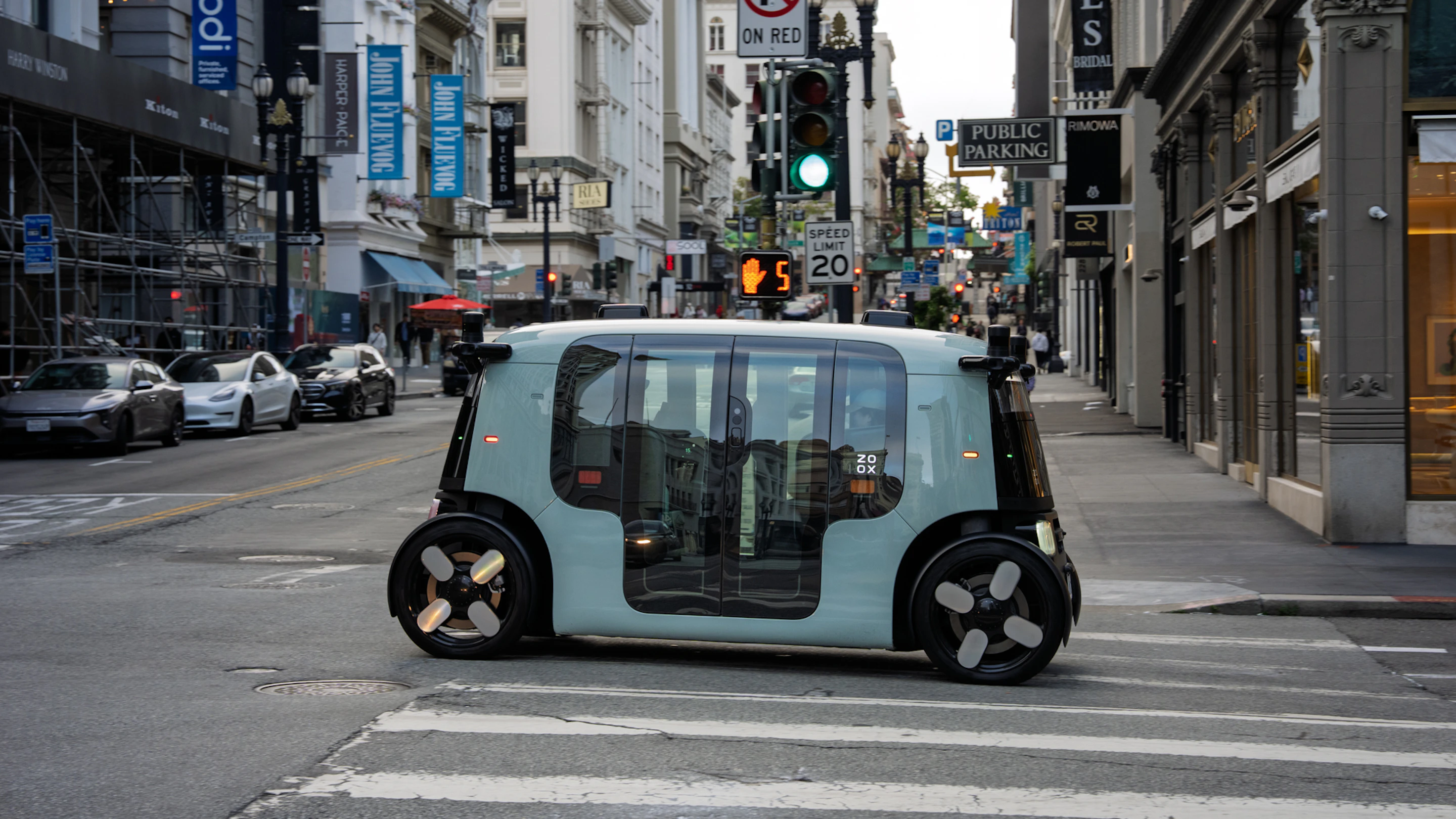
Zoox has spent years looking like the weirdest answer to the robotaxi question. On August 10, that answer becomes a paid service in Las Vegas.
The Amazon-owned company says it will begin charging for rides in its purpose-built robotaxi after the National Highway Traffic Safety Administration cleared a temporary commercial exemption. The important number is not just the fare. It is the exemption cap: NHTSA says Zoox can commercially deploy up to 2,500 vehicles annually for two years, under an oversight structure that can adapt as the technology changes.
That turns Zoox from a curiosity into a very public test of what riders actually want from autonomy.
Waymo made robotaxis feel familiar by putting sensors on recognizable vehicles. Tesla keeps promising a cheaper, more minimal robotaxi future. Zoox is taking the opposite emotional route: sit sideways, face other passengers, forget the steering wheel exists and let the vehicle behave like transportation machinery built for passengers from day one.
My read: this is the first Zoox moment that really matters to normal people. Free rides are marketing. Paid rides are product.
What changes on August 10
Zoox has already been visible in Las Vegas. The new step is commercial operation. TechCrunch reports that Zoox will start charging for rides in Las Vegas on August 10, with fares calculated from a base fare plus distance and time. The final price is shown before booking, and Zoox says it will not change if the robotaxi takes a different route.
NHTSA’s July 30 announcement is the regulatory backbone. The agency says the temporary exemption allows commercial deployment of up to 2,500 Zoox vehicles per year for two years. It also says the broader automated-vehicle push includes work on AV performance standards, safety guidance and updates to legacy vehicle rules that assume a human driver and conventional controls.
That is the tension in one paragraph. Zoox is not just launching a ride-hailing product. It is pushing a vehicle design that old safety standards were never written to describe cleanly.
| Detail | What is confirmed | Why it matters |
|---|---|---|
| Launch market | Las Vegas paid rides from August 10 | A tourist-heavy, dense service area is a practical robotaxi proving ground. |
| Vehicle type | Purpose-built autonomous EV with no steering wheel or pedals | Zoox is not retrofitting a normal car. The entire cabin bet is different. |
| Federal approval | Two-year NHTSA temporary exemption | Paid service depends on regulatory permission, not just software confidence. |
| Deployment cap | Up to 2,500 vehicles annually | The approval is meaningful, but it is not unlimited scale. |
| Fare model | Base fare plus time and distance, shown before booking | Riders will compare it directly with Uber, Lyft and taxis. |
Why this feels more interesting than another robotaxi launch
Robotaxis are easy to talk about in abstract terms: autonomy, sensors, cities, AI, scale. Zoox makes the conversation physical.
The vehicle looks like a small urban pod because that is what it is trying to be. No driver seat. No front-facing ritual. No polite fiction that a human could take over. The cabin says the quiet part out loud: if autonomy works, the car does not need to be arranged around a missing driver.
That makes Zoox more honest than many robotaxi demos, and also more exposed. A rider stepping into a Waymo still sees the ghost of a normal car. A rider stepping into Zoox is accepting the whole premise at once.
For GearPulse readers, that is the useful bit. We are not watching one more app add a city. We are watching the car itself become negotiable.
The caveat: paid does not mean proven at scale
There is a difference between regulatory permission, technical progress and durable business.
Zoox still has to prove wait times, routing, pickup behavior, cleaning, charging, fleet maintenance, incident handling, customer support and airport-style edge cases. It also has to do that while convincing riders that a vehicle with no manual controls is not just clever, but calm.
The NHTSA exemption is also bounded. Two years and a capped vehicle count give Zoox room to operate, but they do not answer the bigger question of whether purpose-built pods can spread city by city faster than competitors using more conventional platforms.
And then there is Waymo. Alphabet’s robotaxi unit already has a broader public footprint. Uber is rebuilding its autonomous strategy through partners. Tesla keeps pulling attention toward a cheaper future Cybercab. Zoox has Amazon behind it, but the market will not reward interesting hardware forever if the service feels limited or expensive.
What riders should watch first
The first public signal will not be a technical white paper. It will be rider behavior.
| Question | Good sign | Bad sign |
|---|---|---|
| Are pickups easy? | The car stops predictably and does not make riders hunt for it. | Confusing pickup points make the ride feel like work. |
| Are fares sensible? | Pricing sits near premium ride-hailing without surprise fees. | The novelty tax wears off after the first ride. |
| Does the cabin feel natural? | The face-to-face layout feels social and airport-shuttle simple. | Riders feel exposed, awkward or motion-sick. |
| Does routing feel confident? | The vehicle behaves boringly in traffic. | Hesitation becomes the personality of the service. |
| Does support feel reachable? | Problems are handled quickly in-app. | A driverless ride also feels ownerless. |
This is where Zoox has a real chance to be memorable. The pod does not need to feel like a sports sedan. It needs to feel like the cleanest airport shuttle you have ever taken, except it appears when summoned and nobody is sitting up front.
Bottom line
Zoox paid rides in Las Vegas matter because they turn a radical vehicle shape into a paid consumer promise.
The excitement is not that a robotaxi exists. We already know robotaxis exist. The excitement is that Zoox is asking people to pay for the full driverless idea: a vehicle designed around passengers, regulated through an exemption, priced against normal ride-hailing and tested in one of America’s strangest mobility laboratories.
If the service is boring in the best way, Zoox suddenly looks less like Amazon’s eccentric transport experiment and more like a serious answer to what urban cars become after the driver seat disappears.
Support independent source-backed coverage at buymeacoffee.com/gearpulse.site.