
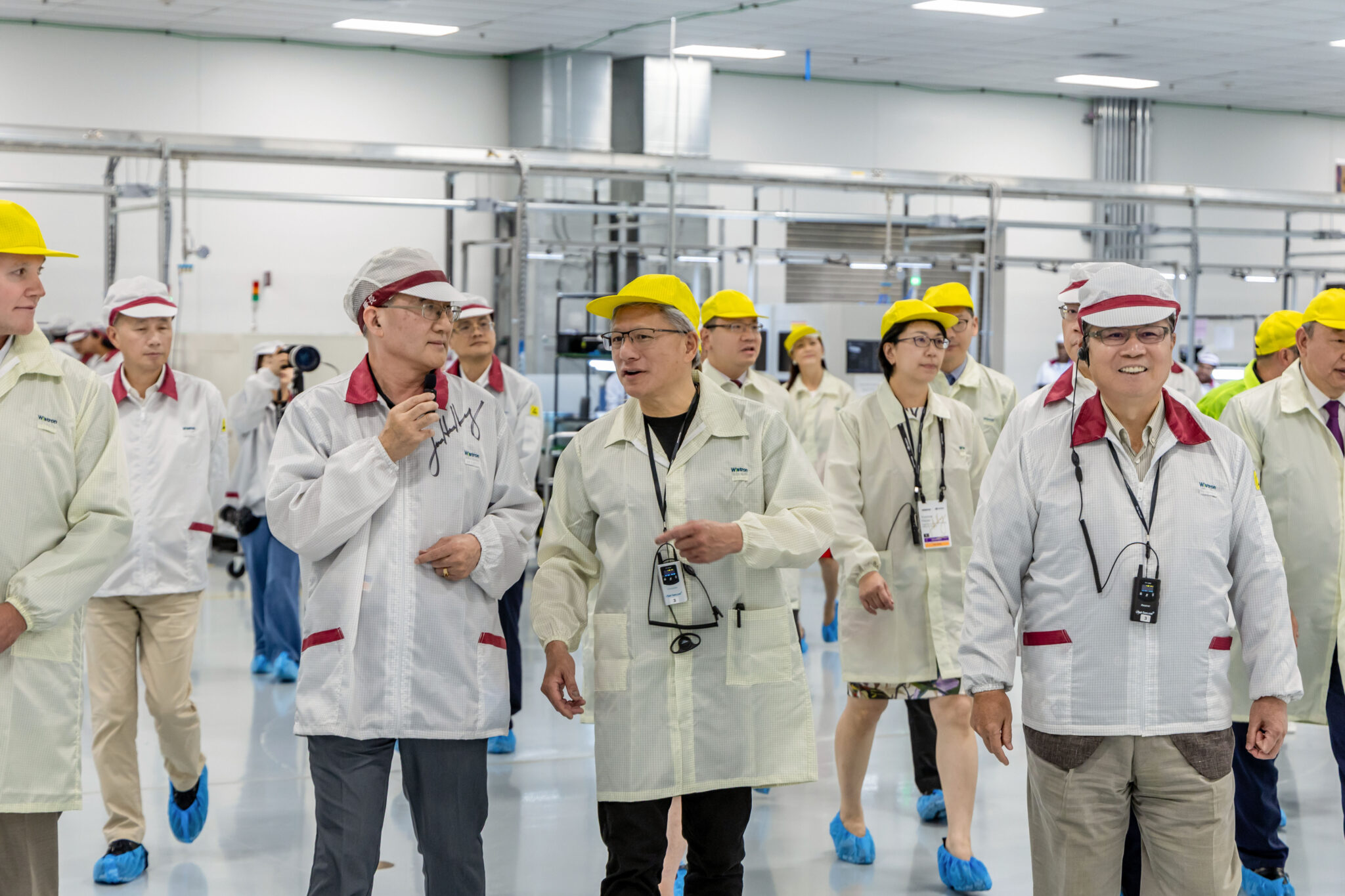
NVIDIA’s favorite phrase, “AI factory,” can sound like marketing until you see the literal factory.
Wistron has opened its first U.S. smart factory in Fort Worth, Texas, a 324,000-square-foot facility tied to a US$700 million commitment and built to produce NVIDIA AI systems. NVIDIA says the plant is already producing GB300 Grace Blackwell Ultra Superchips and will produce Vera Rubin Superchips. Wistron says the D1 facility is the site where the first NVIDIA GB300 Grace Blackwell Ultra Superchip was built and mass-produced in the United States.
GearPulse’s view: this matters because the AI boom is moving from cloud-demo language into physical geography. The next phase of AI will be shaped by factories, power contracts, cooling systems, logistics, skilled labor and political pressure as much as by model leaderboards. A chatbot may feel weightless on a laptop. The hardware behind it is anything but.
The useful facts
The Fort Worth opening gives NVIDIA a more tangible version of its U.S. manufacturing pitch. In April, NVIDIA said it planned to manufacture up to $500 billion of AI infrastructure in the United States over four years with partners. Wistron’s new facility is one of the first high-profile proof points.
The plant is not just a warehouse with a press-event ribbon. NVIDIA says Wistron designed and simulated the facility before construction using a digital twin built on NVIDIA’s own stack, including Omniverse, Metropolis, Cosmos, Nemotron and PhysicsNeMo. That is a very NVIDIA story: sell the chips, sell the software layer, then use both to help build the place that makes the chips useful.
| Detail | Confirmed by | Why it matters |
|---|---|---|
| Location | Fort Worth, Texas | Puts advanced AI system assembly inside the U.S. supply chain. |
| Facility size | NVIDIA and Wistron | 324,000 square feet is large enough to make the manufacturing claim concrete. |
| Investment | NVIDIA and Wistron | US$700 million frames this as a strategic plant, not a pilot. |
| Current product | NVIDIA GB300 Grace Blackwell Ultra | Connects the factory to current high-end AI reasoning infrastructure. |
| Future product | Vera Rubin Superchip | Gives the site a runway into NVIDIA’s next platform cycle. |
| Jobs | NVIDIA | More than 500 now, with plans to expand to 1,000 by year-end. |
The important caveat: nearly every performance number around these systems is a vendor benchmark or projection. NVIDIA’s GB300 page says the rack-scale NVL72 platform combines 72 Blackwell Ultra GPUs and 36 Grace CPUs, and claims large gains over Hopper-era systems for reasoning and AI factory output. That is useful context, but it is not independent testing.
AI supply chains are becoming visible
For most people, the AI supply chain has been abstract: a model name, a subscription tier, a server error when demand spikes. The Fort Worth plant makes the pipeline easier to picture.
Chips are designed, fabricated, packaged, assembled into systems, tested, installed into data centers and connected to networks and power. Every stage has bottlenecks. Every stage has geopolitical meaning. When companies say they are “scaling AI,” they are also saying they need enough boards, racks, cooling equipment, electricians, engineers and grid capacity to keep the whole machine moving.
That is why a manufacturing story belongs on a tech site. The future cost of AI assistants, coding agents, video models and enterprise search is tied to whether companies can build and operate the infrastructure cheaply enough. If AI stays expensive to serve, users get stricter rate limits, higher prices and more aggressive bundling. If the hardware pipeline improves, the software starts to feel less rationed.
The Fort Worth angle is bigger than reshoring
It would be easy to reduce this to a “made in America” headline. That is part of it, but the story is wider.
Taiwanese manufacturers such as Wistron have deep experience turning complex electronics into repeatable products at scale. NVIDIA has the chips and systems roadmap. U.S. cities want high-value manufacturing jobs and tax base. The federal political climate rewards domestic capacity. Data-center customers want shorter, more resilient supply chains.
Those incentives all point in the same direction, but they do not remove the hard parts.
| Promise | Friction |
|---|---|
| More local AI hardware capacity | Plants still depend on global components and upstream semiconductor supply. |
| Skilled manufacturing jobs | Hiring, training and retaining workers will decide whether output scales cleanly. |
| Faster delivery for U.S. AI customers | Data-center power, cooling and permitting can still slow deployment. |
| More resilient supply chain | Concentrating AI infrastructure in new regions creates new local dependencies. |
The power question deserves special attention. An AI factory that builds AI systems is only one part of the energy story. Those systems then move into data centers that consume serious electricity. The economic upside is real, but so is the infrastructure burden.
Why readers should care
The personal connection is price and availability. When AI tools feel expensive, slow or weirdly constrained, the answer is often hiding in infrastructure. Enough GPUs, enough racks, enough networking and enough power translate into better latency, lower marginal cost and fewer artificial limits.
This is also why the phrase “AI factory” has stuck. NVIDIA is trying to make tokens sound like an industrial output. The metaphor is useful as long as we remember what factories require: capital, labor, land, supply chains and accountability.
Fort Worth does not solve that alone. But it turns the AI buildout into something you can put on a map.
Bottom line
Wistron’s Fort Worth opening is one of the clearest signs that the AI race is no longer just about whose model demo looks smarter this week. It is about who can build the machines, ship them at volume and keep them powered.
My take: this is good news for AI availability, but it should make readers more demanding, not less. If companies want to sell AI as essential infrastructure, then jobs, energy use, supply-chain resilience and real-world costs belong in the conversation right next to model performance.