
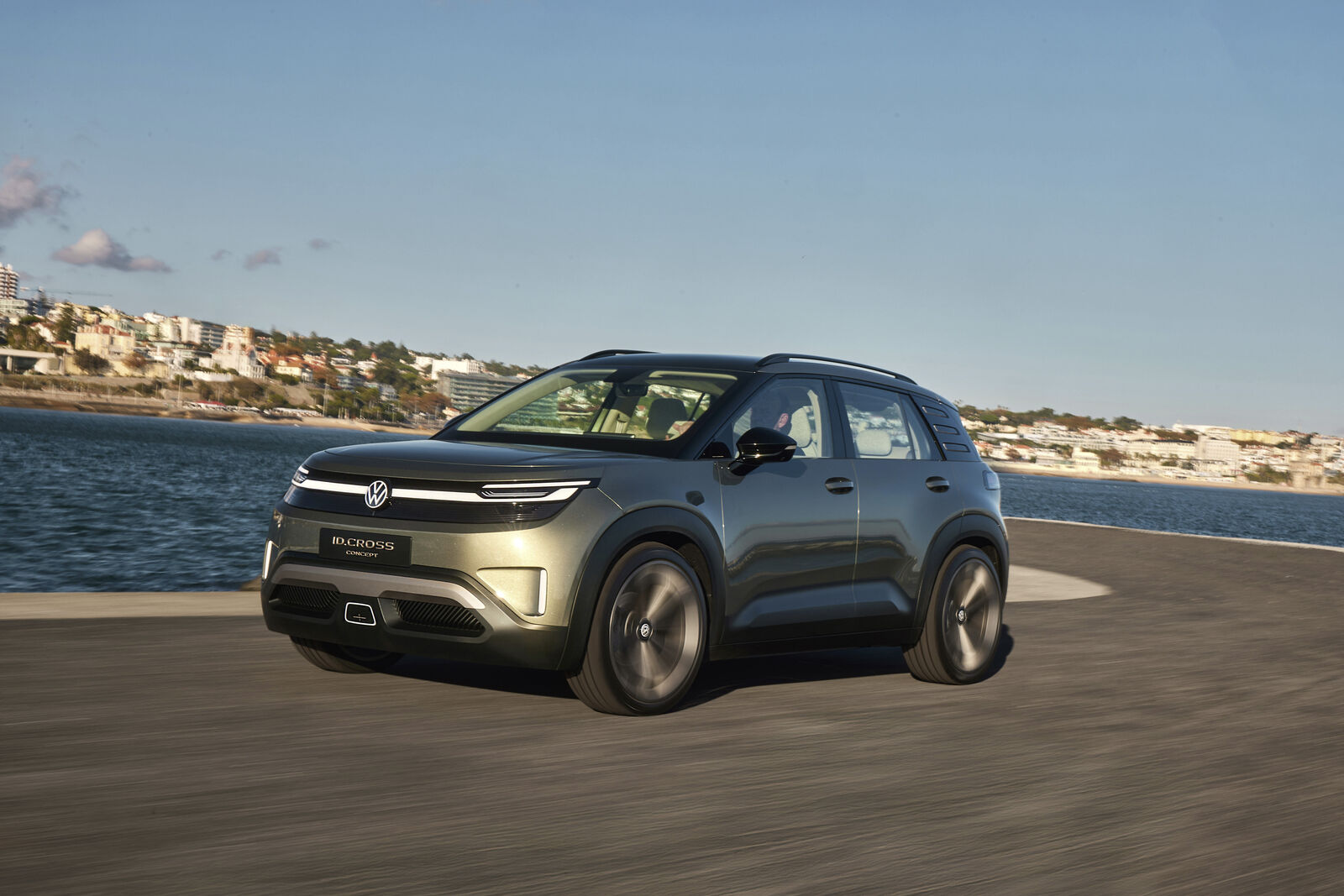
Volkswagen’s most interesting new EV may not be the fastest one.
The ID. Cross matters because it is trying to make the small electric SUV feel obvious. Volkswagen says the near-production compact SUV will launch in Europe from autumn 2026, with a starting price of around 28,000 euros. That puts it in a far more practical conversation than another six-figure performance EV: school runs, apartment parking, weekend trips, button placement, boot space and whether a buyer can understand the car in five minutes.
GearPulse’s view: this is relevant because VW seems to have listened to the part of the market that never wanted a spaceship cabin. Early ID cars pushed hard into touch controls and clean-screen minimalism. The ID. Cross appears to pull VW’s electric future back toward simple, familiar car logic. For a mainstream EV, that may be more important than another headline horsepower number.
What Volkswagen has confirmed
Volkswagen’s official model page describes the ID. Cross as a fully electric compact SUV for the European market, due from autumn 2026. It is a five-seater, aimed at everyday use, with a roughly 28,000 euro starting point.
The earlier official IAA concept release gives the technical baseline: the ID. CROSS Concept is based on MEB+ with front-wheel drive, a 155 kW motor, a WLTP range forecast of up to 420 km, a 175 km/h top speed, a 4,161 mm length and 450 liters of luggage space, plus a 25-liter front compartment.
| Detail | Official public figure | Why it matters |
|---|---|---|
| Launch timing | Europe from autumn 2026 | VW is talking about market arrival, not just a show car. |
| Price target | Around 28,000 euros | The car sits in the affordable-mainstream EV fight. |
| Layout | MEB+, front-wheel drive | Simpler packaging for a small family SUV. |
| Concept output | 155 kW / 211 PS | Enough for normal buyers without pretending to be a hot hatch. |
| Concept range | Up to 420 km WLTP | Competitive if real-world efficiency holds up. |
| Boot space | 450 liters plus 25-liter frunk | Space is the secret weapon in a small EV. |
There are caveats. Volkswagen has not published the final consumer configurator, final trim-by-trim battery list, exact charging curve or final equipment for every market. Motor1 and Electrifying have reported expected 37 kWh and 52 kWh battery options and multiple power outputs, but buyers should treat those as pre-launch details until VW locks the production brochure.
The buttons are not nostalgia
Autocar’s prototype review focuses on the part real owners will notice every day: Volkswagen has moved back toward physical controls. The steering wheel gets buttons instead of haptic pads. Climate controls get hard controls. Window switches are more conventional. Even the cabin references old Volkswagen clarity rather than trying to make every interaction feel new.
That sounds small until you remember how much frustration the early ID cabin generated. A cheap EV does not become desirable because the interface is clever. It becomes desirable because it is calm when you are late, cold, tired or carrying groceries.
This is where the ID. Cross feels personal. Plenty of buyers like EV smoothness, low running costs and quiet city driving. Far fewer want to relearn basic controls just to adjust the temperature. VW’s correction is not glamorous, but it is mature.
The small SUV shape is doing real work
Electrifying’s prototype coverage described the ID. Cross as compact yet practical, with a grown-up drive and meaningful load space. Autocar’s verdict also points in the same direction: this is not meant to be revolutionary; it is meant to be a sensible small SUV with a big boot and a clearer cabin.
That is exactly the brief VW needs. The affordable EV market in Europe is no longer empty. Renault, Citroen, Ford, Hyundai, Kia, BYD, MG, Skoda and Cupra all want the same buyer: someone ready for an EV, but not ready to pay premium-SUV money.
| Buyer question | ID. Cross answer so far | What still needs proof |
|---|---|---|
| Is it affordable? | Around 28,000 euros is the target. | Final market pricing and equipment levels. |
| Is it easy to use? | Physical controls and simpler interface are the headline. | Whether lower trims keep the good cabin decisions. |
| Is it practical? | 450-liter boot is strong for this footprint. | Rear-seat comfort and charging stops with a family load. |
| Is the range enough? | Up to 420 km WLTP on the concept. | Real motorway range and winter efficiency. |
| Is it exciting? | Probably not in the traditional sense. | That may be fine if the ownership experience is clean. |
The ID. Cross is not trying to win a poster-wall contest. It is trying to become the EV a normal buyer can point at and understand: this is the electric alternative to a small VW crossover.
Why the price target matters
The roughly 28,000 euro starting figure is not cheap in an absolute sense. It is still a lot of money. But in the EV market, it moves the conversation away from early-adopter luxury and toward replace-your-family-car math.
If VW can keep the entry version honest, the ID. Cross could be one of those vehicles that does more for EV adoption than a faster flagship. Mainstream buyers do not need another proof that electricity can be quick. They need good financing, reliable software, sane controls, enough range and a car that does not feel like a compromise every morning.
The danger is that VW loads the appealing features into expensive trims and leaves the base car feeling thin. The other danger is charging: if the lower battery version lands with modest DC speeds and real-world range falls short, the affordable price will carry asterisks. This is where the final spec sheet will matter.
Bottom line
The ID. Cross is intriguing because it looks like Volkswagen rediscovering the value of being understandable.
It has a compact SUV body, a practical cargo pitch, a real European launch window, a price target people can discuss without laughing, and a cabin philosophy that sounds less hostile to actual humans. That combination is not flashy, but it is exactly where the next wave of EV competition will be fought.
GearPulse’s read: if VW gets the final price, software and charging experience right, the ID. Cross could be one of the first small electric SUVs that feels less like an EV statement and more like the next obvious family car.